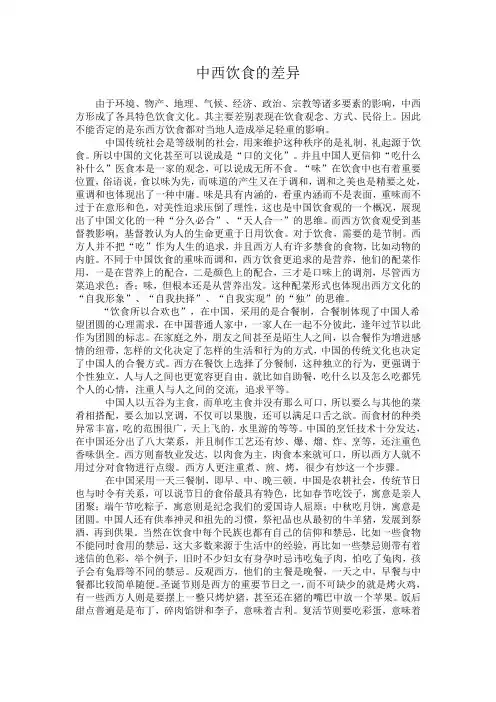
中西饮食差异英语作文
- 格式:docx
- 大小:37.59 KB
- 文档页数:4
中西饮食差异英语作文
Certainly! Here's an essay on the differences between Chinese
and Western diets:
Culinary Culture: A Comparative Study of Chinese and Western
Diets
The world is a diverse tapestry, and nowhere is this more
evident than in the culinary traditions of different cultures.
Among these, the Chinese and Western diets stand out as two
distinct entities, each with its own set of characteristics,
flavors, and dietary philosophies. This essay aims to explore
the key differences between these two culinary worlds.
1. Ingredients and Food Sources
Chinese cuisine is renowned for its use of a wide array of
ingredients, from various types of grains and vegetables to a
vast selection of meats and seafood. The Chinese diet often
includes a variety of spices and herbs that are used to
enhance flavor and, according to traditional Chinese medicine,
to balance the body's energy. In contrast, Western diets tend
to focus on a staple of bread, pasta, and potatoes,
complemented by meats such as beef, pork, and chicken. Dairy
products are also a significant component of Western diets.
2. Cooking Methods
The methods of preparation differ greatly between the two
cultures. Chinese cooking often involves stir-frying,
steaming, and deep-frying, which are techniques that preserve
the natural flavors and nutrients of the ingredients. There
is also a strong emphasis on the art of cooking, with dishes
often being visually appealing and carefully plated. Western
cooking, on the other hand, often involves baking, grilling,
and roasting, with an emphasis on simplicity and the hearty
nature of the dishes.
3. Meal Structure
A typical Chinese meal is structured around rice or noodles
as the staple, accompanied by multiple dishes that may
include meat, vegetables, and soup. This communal style of
eating encourages sharing and trying a variety of flavors in
one sitting. Western meals, in comparison, tend to have a
more linear structure, with each course being distinct and
separate, often starting with an appetizer, followed by a
main course, and ending with dessert.
4. Portion Sizes
Portion sizes are another area where significant differences
can be observed. Chinese meals are often served in smaller
portions, allowing for a broader range of tastes and textures
to be enjoyed throughout the meal. Western dining,
particularly in the United States, is known for its larger
portion sizes, which can sometimes lead to overeating.
5. Dietary Philosophy
The Chinese diet is deeply rooted in the principles of
balance and harmony, with an emphasis on the yin and yang of
food. This philosophy seeks to maintain a balance between
different types of food and their effects on the body.
Western diets, while increasingly focused on health and
nutrition, have historically been less concerned with such
philosophical underpinnings and more focused on taste and
convenience.
6. Influence of Tradition and Modernity
Chinese cuisine has a long history and is deeply influenced
by traditional practices and beliefs. Modern Chinese cooking
continues to respect these traditions while also
incorporating new techniques and global influences. Western
diets have also evolved over time, with a current trend
towards healthier options and a greater awareness of the
environmental impact of food production.
In conclusion, the differences between Chinese and Western
diets are as rich and varied as the cultures from which they
originate. Understanding these differences not only broadens
our culinary horizons but also deepens our appreciation for
the diversity of human culture and the importance of food in
shaping our lives.
This essay provides a concise overview of the culinary
differences between Chinese and Western diets, touching on
ingredients, cooking methods, meal structure, portion sizes,
dietary philosophy, and the influence of tradition and
modernity.