代词用法归纳
- 格式:docx
- 大小:39.76 KB
- 文档页数:13
代词用法归纳
代词用法总结
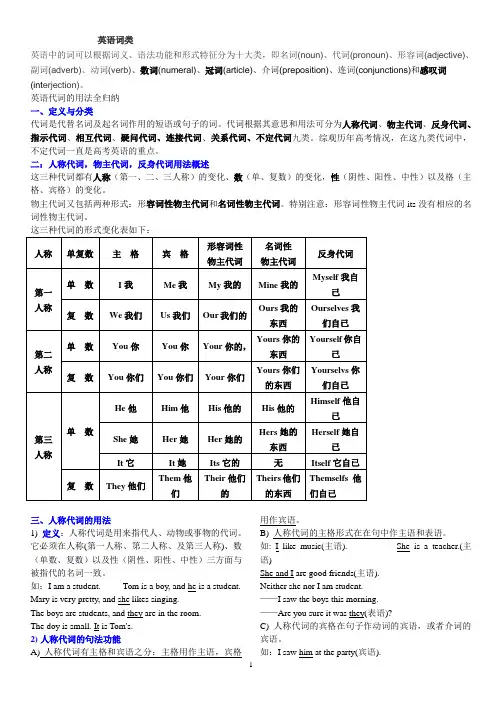
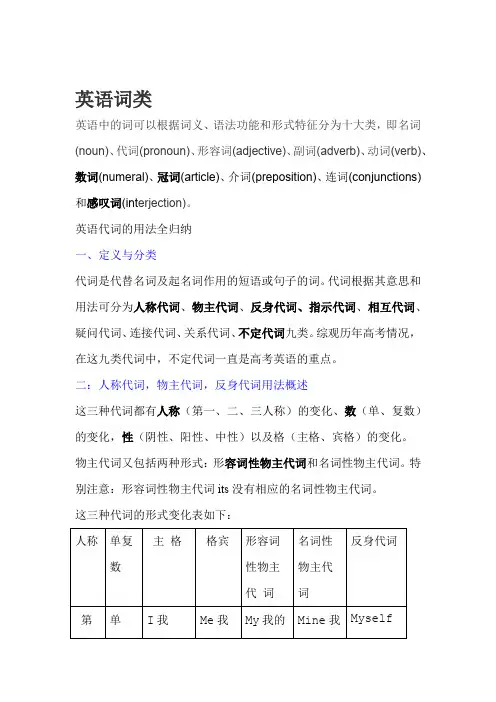
代词可以分为九类,包括人称代词、物主代词、反身代词、相互代词、指示代词、疑问代词、连接代词、不定代词和关系代词。大多数代词可以起到名词和形容词的作用。
1.人称代词
人称代词作主语时,应使用主格;作宾语或表语时,应使用宾格。但是需要注意以下四种情况:
① 当人称代词作为主语独立使用于没有谓语动词的句子中,或者与动词不定式连用时,常用宾格。
例如:
Does any of you know where Tom lives?
Me.
What。Me (to)play him at chess。No!
② 当代词作为宾语或宾语补足语时,应与所指代的名词在人称、数、格上保持一致。
例如:
XXX.(the thief是主格,故用he代替)
They took me to be her.(me是宾格,故用her替代)
③ 作为表语时,人称代词一般使用宾格。但在强调句型中,被强调的代词格不变。
例如:
I met her in the hospital。→ It was her who I met in the
hospital.
④ 在比较级的句子中,than、as后使用主格或宾格都可以。例如:He is taller than me (I)。但在以下句子中,需要注意区别:
I like Jack as much as her。= I like both Jack and her.
I like Jack as much as she。= I like Jack and she likes him。too.
2.人称代词的并列顺序原则
当两个或两个以上的人称代词并列时,排列顺序原则如下:
① 在并列主语中,“我”(I)通常放在最后,排列顺序为:二三一(人称)。XXX也一样。
例如:
You。she and I will be in charge of the case.
Mr。Zhang asked Li Hua and me to help him.
② 第三人称,男女并用时,男性代词先于女性代词。
例如:
He and she still don’t agree to the plan.
3.人称代词的特殊用法
① we / you(口语)通常用来泛指一般人。
② she可以代表国家、船只、大地、月亮等。
This is my desk and that is yours。The use of "this" refers to
the object that is being introduced。while "that" refers to
something that has already been XXX
In the past。attending school was not an n for many
individuals。
I want to inform you that the English party will be XXX。
He was XXX injuring his leg the us day。
When speaking on the phone。"this" is used for n。while
"that" is used for inquiries。Both words can also be used as
adverbs。with a similar meaning to "so"。
I am XXX to such a height。
The word "such" is used to XXX as "this kind of" or "that
kind of" and can n as a subject or an adjective。
For example: Such was the story。We have never seen such a
tall building。
The word "same" is used to describe something or someone as
"the same" and can n as a subject。predicate。object or adjective。It is preceded by the definite article "the"。
For example: The same can be said of the other article。It is
all the same to me whether he can do it or not。
The word "it" can refer to time or be used as a formal element
to XXX。
For example: If I can help it。it won't happen again。It was
evening when we arrived home。and it was already dark outside.
XXX.
When expecting a positive response。"some" can be used in
XXX.
XXX: Would you like some bananas。(n)
Mum。could you give me some money。(request)
In negative sentences。"some" can be used to partially negate.
XXX: I don't know some of the students。(object)
some" and "any" can also be used as adverbs in a sentence。"Some" means "about" while "any" indicates degree。meaning
"slightly" or "at all."
XXX: There are some 300 workers on strike. Do you XXX today?
One," "both," and "all"
One" can be used as an adjective。predicate。subject。or
object to refer to either a person or an object。meaning "one." The
plural form is "ones." When referring to a person。the possessive
form is "one's," and the XXX "oneself."
XXX: One should try one's best to serve the people。(subject/adjective)
This is not the one I want。(predicate)
One" and "ones" XXX。They can be modified by words such
as "this," "that," "these," "those," "the," or "which."
XXX: XXX.
Here are three pens。Which one is yours。this one or that
one or the one in the pencil-box?
Both" can be used as an adjective。object。subject。or
appositive to refer to either a person or an object。meaning "both."
It can be used in negative sentences as "not both" to partially
negate。while "neither" is used to XXX. XXX: This math problem can be worked out in both ways。(adjective)
Both of the boys are here。(subject)
We both are students。(appositive)
XXX: Both of us are not teachers。(partially negated)
Neither of us is a teacher。We are both not XXX.
When using "both"。it should be placed before "the"。"these"。"those"。"my"。etc。For example:
XXX.
XXX.
All" can be used as a subject。predicate。object。attributive。or appositive。meaning "all" or "whole"。It can be used with
countable or uncountable nouns。XXX plural nouns。it means
"all" or "whole"。XXX.
He gave me all the money.
All the XXX.
I told him all about it.
That's all for today.
They have all been to Xi'an.
All are here。(countable)