
修辞格及语言风格修辞
- 格式:ppt
- 大小:1.62 MB
- 文档页数:58


八种常见修辞格近年来的《考试说明》仍然规定常见修辞格为八种,即:比喻、比拟、借代、夸张、对偶、排比、设问、反问。
1.比喻(1)比喻的特点及作用比喻就是“打比方”。
即抓住两种不同性质的事物的相似点,用一事物来喻另一事物。
比喻的结构一般由本体(被比喻的事物)、喻体(作比方的事物)和比喻词(比喻关系的标志)构成。
构成比喻的关键:甲和乙必须是本质不同的事物,甲乙之间必须有相似点,否则比喻不能成立。
比喻的作用主要是:化平淡为生动;化深奥为浅显;化抽象为具体;化冗长为简洁。
(2)比喻的种类①明喻。
典型形式是:甲像乙。
本体喻体都出现,中间用比喻词“像、似、仿佛、犹如”等相联结。
例如:收获的庄稼堆成垛,像稳稳矗立的小山。
”②暗喻。
典型形式是:甲是乙。
本体喻体都出现,中间没有比喻词,常用“是”、“成了”、“变成” 等联结。
例如:马克思主义和中国革命的关系,就是箭和靶的关系。
③借喻。
典型形式是:甲代乙。
不出现本体,直接叙述喻体。
但它不同于借代。
借代取两事物相关点,借喻取两事物的相似点。
例如:放下包袱,开动机器。
④博喻。
连用几个比喻从不同角度,运用不同的相似点对同一本体进行比喻。
例如:层层的叶子中间,零星地点缀着些白花,有袅娜地开着的,有羞涩地打着朵儿的;正如一粒粒明珠,又如碧天里的星星,又如刚出浴的美人。
(“明珠”、“星星”“刚出浴的美人”分别从色彩、光华、感受等角度,抓住光亮、隐约闪烁、清新洁静等相似点来描绘出荷花的美。
)2.比拟(1)比拟的特点及作用把物当作人来写,或把人当作物来写,或把此物当作彼物来写,其形式特点是:事物“人化”,或人“物化”,或甲物“乙物化”。
其作用是使所写“人”或“物”色彩鲜明、描绘形象,表意丰富。
(2)比拟的种类①拟人。
例如:杜甫川唱来柳林铺笑,红旗飘飘把手招。
②拟物。
例如:咱们老实,才有恶霸,咱们敢动刀,恶霸就得夹着尾巴跑。
3.借代(1)借代的特点及其作用借代不直接说出所要表述的人或事物,而用与其相关的事物来代替。

英语修辞手法总结Figures of speech (修辞)are ways of making our language figurative. When we use words in other than their ordinary or literal sense to lend force to an idea, to heighten effect, orto create suggestive imagery, we are said to be speaking or writing figuratively. Now we are going to talk about some common forms of figures of speech.1) Simile:(明喻)It is a figure of speech which makes a comparison between two unlike elements having at least one quality or characteristic (特性)in common. To make the comparison, words like as, as...as, as if and like are used to transfer the quality we associate with one to the other. For example, As cold waters to a thirsty soul, so is good news from a far country.2) Metaphor:(暗喻)It is like a simile, also makes a comparison between two unlike elements, but unlike a simile, this comparison is implied rather than stated. For example, the worldis a stage.3) Analogy: (类比)It is also a form of comparison, but unlike simile or metaphor which usually uses comparison on one point of resemblance, analogy draws a parallel between two unlike things that have several common qualities or points of resemblance.4) Personification: (拟人)It gives human form of feelings to animals, or life and personal attributes(赋予) to inanimate(无生命的) objects, or to ideas and abstractions(抽象). For example, the wind whistled through the trees.5) Hyperbole: (夸张) It is the deliberate use of overstatement or exaggeration to achieve emphasis. For instance, he almost died laughing.6) Understatement: (含蓄陈述) It is the opposite of hyperbole, or overstatement. Itachieves its effect of emphasizing a fact by deliberately(故意地) understating it,impressing the listener or the reader more by what is merely implied or left unsaid than by bare statement. For instance, It is no laughing matter.7) Euphemism: (委婉) It is the substitution of an agreeable or inoffensive(无冒犯) expression for one that may offend or suggest something unpleasant. For instance, we refer to "die" as " pass away".8) Metonymy (转喻)It is a figure of speech that has to do with the substitution of the mane of one thing for that of another. For instance, the pen (words) is mightier than the sword (forces).9) Synecdoche (提喻) It is involves the substitution of the part for the whole, or thewhole for the part. For instance, they say there's bread and work for all. She was dressedin silks.10) Antonomasia (换喻)It has also to do with substitution. It is not often mentioned now, though it is still in frequent use. For example, Solomon for a wise man. Daniel for a wise and fair judge. Judas for a traitor.11) Pun: (双关语) It is a play on words, or rather a play on the form and meaning of words. For instance, a cannon-ball took off his legs, so he laid down his arms. (Here "arms" has two meanings: a person's body; weapons carried by a soldier.)12) Syllepsis: (一语双叙) It has two connotations.In the first case, it is a figure by which a word, or a particular form or inflection of a word, refers to two or more words in the same sentence, while properly applying to or agreeing with only on of them in grammar or syntax(句法). For example, He addressed you and me, and desired us to follow him. (Here us is used to refer to you and me.)In the second case, it a word may refer to two or more words in the same sentence. For example, while he was fighting , and losing limb and mind, and dying, others stayed behind to pursue education and career. (Here to losing one's limbs in literal; to lose one's mindis figurative, and means to go mad.)13) Zeugma: (轭式搭配) It is a single word which is made to modify or to govern two or more words in the same sentence, wither properly applying in sense to only one of them, orapplying to them in different senses. For example, The sun shall not burn you by day, nor the moon by night. (Here noon is not strong enough to burn)14) Irony: (反语) It is a figure of speech that achieves emphasis by saying the opposite of what is meant, the intended meaning of the words being the opposite of their usual sense. For instance, we are lucky, what you said makes me feel real good.15) Innuendo: (暗讽) It is a mild form of irony, hinting in a rather roundabout (曲折)way at something disparaging(不一致) or uncomplimentary(不赞美) to the person or subject mentioned. For example, the weatherman said it would be worm. He must take his readings in a bathroom.16) Sarcasm: (讽刺) It Sarcasm is a strong form of irony. It attacks in a taunting and bitter manner, and its aim is to disparage, ridicule and wound the feelings of the subject attacked. For example, laws are like cobwebs, which may catch small flies, but let wasps break through.17) Paradox: (似非而是的隽语) It is a figure of speech consisting of a statement or proposition which on the face of it seems self-contradictory, absurd or contrary to established fact or practice, but which on further thinking and study may prove to be true, well-founded, and even to contain a succinct point. For example more haste, less speed.18) Oxymoron: (矛盾修饰) It is a compressed paradox, formed by the conjoining(结合) of two contrasting, contradictory or incongruous(不协调) terms as in bitter-sweet memories, orderly chaos(混乱) and proud humility(侮辱).19) Antithesis: (对照) It is the deliberate arrangement of contrasting words or ideas in balanced structural forms to achieve emphasis. For example, speech is silver; silence is golden.20) Epigram: (警句) It states a simple truth pithily(有利地) and pungently(强烈地). It is usually terse and arouses interest and surprise by its deep insight into certain aspects of human behavior or feeling. For instance, Few, save the poor, feel for the poor.21) Climax: (渐进) It is derived from the Greek word for "ladder" and implies the progression of thought at a uniform or almost uniform rate of significance or intensity,like the steps of a ladder ascending evenly. For example, I came, I saw, I conquered.22) Anti-climax or bathos: (突降)It is the opposite of Climax. It involves stating one's thoughts in a descending order of significance or intensity, from strong to weak, from weighty to light or frivolous. For instance, But thousands die, without or this or that, die, and endow(赋予) a college, or a cat.23) Apostrophe: (顿呼) In this figure of speech, a thing, place, idea or person (dead or absent) is addressed as if present, listening and understanding what is being said. For instance, England! awake! awake! awake!24) Transferred Epithet: (转类形容词) It is a figure of speech where an epithet (anadjective or descriptive phrase) is transferred from the noun it should rightly modify(修饰) to another to which it does not really apply or belong. For instance, I spent sleeplessnights on my project.25) Alliteration: (头韵) It has to do with the sound rather than the sense of words for effect. It is a device that repeats the same sound at frequent intervals(间隔) and since the sound repeated is usually the initial consonant sound, it is also called "front rhyme". For instance, the fair breeze blew, the white foam flew, the furrow followed free.26) Onomatopoeia: (拟声) It is a device that uses words which imitate the sounds made by an object (animate or inanimate), or which are associated with or suggestive(提示的) of some action or movementExplanation version1一、什么是修辞格修辞格(figures of speech)是提高语言表达效果的语言艺术。
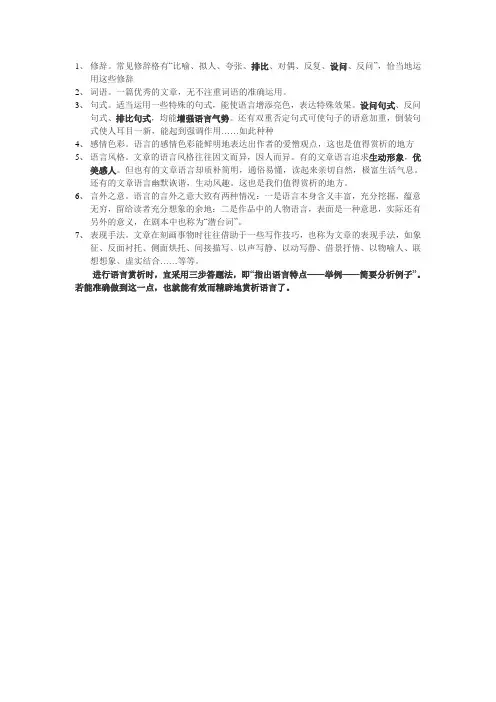
1、修辞。
常见修辞格有“比喻、拟人、夸张、排比、对偶、反复、设问、反问”,恰当地运
用这些修辞
2、词语。
一篇优秀的文章,无不注重词语的准确运用。
3、句式。
适当运用一些特殊的句式,能使语言增添亮色,表达特殊效果。
设问句式、反问
句式、排比句式,均能增强语言气势。
还有双重否定句式可使句子的语意加重,倒装句式使人耳目一新,能起到强调作用……如此种种
4、感情色彩。
语言的感情色彩能鲜明地表达出作者的爱憎观点,这也是值得赏析的地方
5、语言风格。
文章的语言风格往往因文而异,因人而异。
有的文章语言追求生动形象,优
美感人。
但也有的文章语言却质朴简明,通俗易懂,读起来亲切自然,极富生活气息。
还有的文章语言幽默诙谐,生动风趣。
这也是我们值得赏析的地方。
6、言外之意。
语言的言外之意大致有两种情况:一是语言本身含义丰富,充分挖掘,蕴意
无穷,留给读者充分想象的余地;二是作品中的人物语言,表面是一种意思,实际还有另外的意义,在剧本中也称为“潜台词”。
7、表现手法。
文章在刻画事物时往往借助于一些写作技巧,也称为文章的表现手法,如象
征、反面衬托、侧面烘托、间接描写、以声写静、以动写静、借景抒情、以物喻人、联想想象、虚实结合……等等。
进行语言赏析时,宜采用三步答题法,即“指出语言特点——举例——简要分析例子”。
若能准确做到这一点,也就能有效而精辟地赏析语言了。
