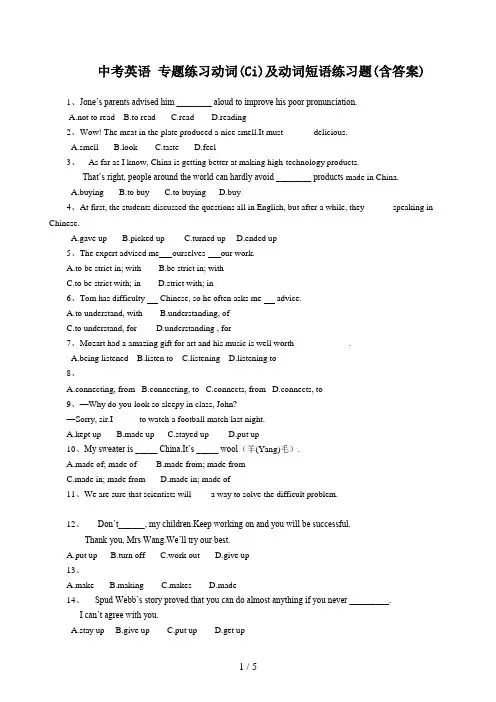
初三英语动词专题及专项练习(含答案)
- 格式:doc
- 大小:83.50 KB
- 文档页数:10
动词
动词的含义
动词是表示动作或状态的词,在句子中做谓语.动词的基本形式: 动词原形、 过去式、 现在分词和过去分词。
动词的种类:
类别 特点 举例
及物动词(vt) 跟宾语 I like music.
不及物动词(vi) 不跟宾语 It rained last night。
系动词 跟表语 I am a doctor. She is a nurse.
We are very happy。
助动词 跟动词原形或分词
I don't like playing basketball。
I have seen this movie before.
情态动词 跟动词原形 She can speak Japanese.
动词时态
一般现在时 (3种结构)
表示经常性、习惯性的动作;或普遍真理、客观事实;或某种状态。
“主·谓·(宾)"结构
Peter always spends too much time playing computer games。
Alice usually goes to school by bus in the morning.
I like listening to classical music.
“There· be”结构
There is a map on the wall.
There are some birds in the sky.
“主·系·表”结构
It’s very cold today.
The earth is bigger than the moon.
My father is a teacher.
动词第三人称单数
动词特征 构成 例词
一般过去时 (3种结构)
表示发生在过去的动作。在一般过去时的句子中, 动词必须用过去式.
动词过去式 及 过去分词的构成
规则变化
构成法 词例
(1) 一般情况下加 ed work -- worked —- worked
play —- played —- played
(2) 以 e 结尾的,加 d live —— lived -— lived
like —- liked -- liked
(3) 以“辅音字母 + y” 结尾的,改 y为i, 再加 ed. study -- studied -— studied
cry —— cried -— cried
(4) 以重读闭音节 或 r音节 结尾,且末尾只有一个辅音字母的词,要双写这个辅音字母,再加 ed。 stop —- stopped -- stopped
prefer -— preferred -- preferred
refer—referred-referred
occur—occurred—occurred
不规则变化 (参考课本)
一般过去时常见的提示: yesterday; the day before yesterday; last(week/ month/
year/Sunday —-)
this ——-;just now; ——— ago; after —-—; when --- 等等. 一般动词 词尾加s like—likes
以ch,sh,s,o,x结尾
记忆技巧:吃(ch)蛇(sh,s)后喝XO 词尾加es teach-teaches
do-does
go-goes
wash—washes
pass-passes
mix—mixes
fax—faxes(发送传真)
以y结尾 辅音字母+y,变y为i,再加es study-studies
carry-carries
try—tries
元音字母+y,直接加s play-plays
stay-stays
say-says
注:当谓语动词是行为动词时,肯定句用动词的过去式表达,构成疑问句或否定句时,需借助did或didn’t构成,谓语动词要还原成原形。例如:
I went to the zoo yesterday。
My mother didn’t go to the park last weekend.
Did Jim come to see you last night?
。
现在进行时
表示目前正在发生或进行的动作。 (只有延续性动词有进行时; 非延续性动词没有进行时 )
主语 + 系动词(am / is / are )+ 现在分词
现在分词的构成
构成法
词例
(1) 一般情况下加 ing. work —— working; learn —— learning
(2) 以 e 结尾的,去掉e,再加 ing. live -- living; take -- taking
(3) 以重读闭音节 或 r 音节 结尾,且末尾只有一个
辅音字母的词,要双写这个辅音字母,再加 ing。 sit -— sitting; stop -- stopping
chat -- chatting; refer -- referring
(4) 以 ie 结尾的,要改ie 为y,再加 ing。 tie -- tying; lie -- lying
现在进行时的标志:Look; Listen; now; at the moment / at present
Look。 Alice is reading a magazine over there.
Listen. Peter is singing a Chinese song.
Alice is talking to Peter now。
I’m learning Japanese at the moment.
特殊情况: 非延续性动词 没有进行时,它们的现在分词形式 表示 将来时。
主语 + ( am / is / are ) + 非延续性动词的现在分词:表示将来时。
I'm going to school now。
Mary is leaving for New York soon。
Spring Festival is coming。
I’m arriving in Beijing。
过去进行时
表示在过去的某时正在发生或进行的动作.
主语 + 系动词(was / were )+ 现在分词
David was doing his homework at 8 o'clock yesterday.
I was doing my homework at his time yesterday。
Tom was having breakfast when Mary called him。
一般将来时
表示将要发生的动作,或计划或打算作某事。
主语 + will + 动词原形
主语 + ( am / is / are ) + going to + 动词原形
主语 + ( am / is / are
) + 非延续性动词的 现在分词:
例如:
I will tell you the good news.
John is going to visit Hangzhou next week.
My father is coming to Qingdao tomorrow。
一般将来时常见的提示:
tomorrow; the day after tomorrow; next week; in the future; in three days;
this evening, soon, at the end of this term
一般将来时的用法
1. 表示将来的动作或状态。例如:
We will get to Shanghai tomorrow。
2. 在“祈使句+and/or+句子”这个结构中,“句子”用一般将来时.例如:
Get up early, and you will catch the early bus。