
新概念第一册第五课Lesson5
- 格式:ppt
- 大小:18.99 MB
- 文档页数:22


第1页 共5页 新概念英语第一册第5-6课:Nice to meet you
Lesson 5 Nice to meet you. 很开心见到你.
Listen to the tape then answer this question. Is Chang-woo
Chinese? 听录音,然后回答下列问题。 昌宇是中国人吗? MR.
BLAKE: Good morning. 布莱克先生:早上好。 STUDENTS: Good
morning, Mr. Blake. 学生:早上好,布莱克先生。 MR. BLAKE:
This is Miss Sophie Dupont. 布莱克先生:这位是索菲娅.杜邦小姐。 Sophie is a new student.She is French. 索菲娅是个新学生。她是法国人。 MR. BLAKE: Sophie, this is Hans.He
is German. 布莱克先生:索菲娅,这位是汉斯。他是德国人。
HANS: Nice to meet you. 汉斯:很开心见到你。 MR. BLAKE:
And this is Naoko.Shes Japanese. 布莱克先生:这位是直子。她是日本人。 NAOKO: Nice to meet you. 直子:很开心见到你。 MR. BLAKE: And this is Chang-woo.Hes Korean. 布莱克先生:这位是昌宇。他是韩国人。 CHANG-WOO: Nice to meet you.
昌宇:很开心见到你。 MR. BLAKE: And this is Luming.He is
Chinese. 布莱克先生:这位是鲁明。他是中国人。 LUMNG:
Nice to meet you. 鲁明:很开心见到你。 MR. BLAKE: And this

新概念第一册第五课课文
Lesson 5 Not for Jazz
Jazz is a symbol of American culture. The United States is the
birthplace of jazz. In fact, jazz was created by black musicians who
lived in the southern states of the United States. From the outset,
jazz was influenced by the music of these black musicians, but it
also incorporated many features of the music of white Americans.
In the early years of this century, jazz became popular in the
United States and Europe. Though many people loved jazz, there
were others who maintained that it was only a fad, like the hula
hoop which appeared in the 1950s. However, the fact that jazz has
become a fundamental part of the world of music is
incontrovertible.
At first, jazz was not taken very seriously. In those days,
people either loved it or they hated it. Few of them could

新概念第一册 5课笔记
1. Mr. 先生/老师 (用于男士的姓之前)
Mr. Yang 杨老师
Mr. Blake 布莱克先生
Miss 小姐 (对未婚女士或婚姻情况不明的女士的称呼)
Mrs. 夫人 (对已婚女士称呼)
2. Good morning. 早上好。
Good afternoon. 下午好。
Good evening. 晚上好。
Good night. 晚安
以上问候语,是相互问候的。当别人用这些问候语问候你时,我们用同样的回答问候对方。
A. Good morning.
B:Good morning.
3. Nice to meet you. 用于第一次见面时的用语。
回答:Nice to meet you, too.
正式场合,初次见面用How do you do? 回答也是How do you do?
4. too 也
用于句末,且要与前面句子用逗号隔开。
He is Chinese.
I am Chinese, too.
5. What make is it? 它是什么牌子的?
It is a Mercedes.
6. a/an 一个
a 放在辅音因素开始的单词前面 a book a desk
an 放在元音开头的单词前面 an egg an elephant
7. or 还是,或者
Is she a Swedish student or a French student?
8. 本课学生容易出错的地方
I am Chinese.
表示国人时,前面通常不加冠词a或者an
He is German. (正确)
He is a German. (错误,German前不能加a)
翻译成“某国的…”时,通常前面是要加a或an
It is an American car.
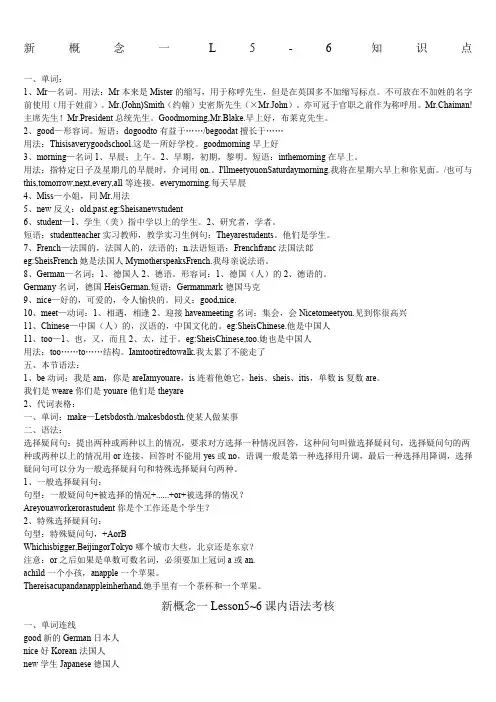
新概念一L5-6知识点
一、单词:
1、Mr—名词。用法:Mr本来是Mister的缩写,用于称呼先生,但是在英国多不加缩写标点。不可放在不加姓的名字前使用(用于姓前)。Mr.(John)Smith(约翰)史密斯先生(×Mr.John)。亦可冠于官职之前作为称呼用。Mr.Chaiman!主席先生!Mr.President总统先生。Goodmorning,Mr.Blake.早上好,布莱克先生。
2、good—形容词。短语:dogoodto有益于……/begoodat擅长于……
用法:Thisisaverygoodschool.这是一所好学校。goodmorning早上好
3、morning—名词1、早晨;上午。2、早期,初期,黎明。短语:inthemorning在早上。
用法:指特定日子及星期几的早晨时,介词用on.。I'llmeetyouonSaturdaymorning.我将在星期六早上和你见面。/也可与this,tomorrow,next,every,all等连接。everymorning.每天早晨
4、Miss—小姐,同Mr.用法
5、new反义:old,past.eg:Sheisanewstudent
6、student—1、学生(美)指中学以上的学生。2、研究者,学者。
短语:studentteacher实习教师,教学实习生例句:Theyarestudents。他们是学生。
7、French—法国的,法国人的,法语的;n.法语短语:Frenchfranc法国法郎
eg:SheisFrench她是法国人MymotherspeaksFrench.我母亲说法语。
8、German—名词:1、德国人2、德语。形容词:1、德国(人)的2、德语的。
Germany名词,德国HeisGerman.短语:Germanmark德国马克
9、nice—好的,可爱的,令人愉快的。同义:good,nice.
10、meet—动词:1、相遇,相逢2、迎接haveameeting名词:集会,会Nicetomeetyou.见到你很高兴