三维叠前深度偏移流程
- 格式:doc
- 大小:15.85 KB
- 文档页数:4
三维叠前深度偏移流程
### 3D Pre-Stack Depth Migration Workflow.
3D Pre-Stack Depth Migration Workflow.
Seismic imaging plays a crucial role in hydrocarbon
exploration and reservoir characterization. Conventional
seismic migration methods, such as Kirchhoff or beam
migration, assume a constant velocity model and ignore the
complex subsurface structures, which can lead to inaccurate
subsurface images. Pre-stack depth migration (PSDM) is an
advanced seismic imaging technique that addresses these
limitations by incorporating the velocity information and
accounting for the wave propagation in the subsurface. PSDM
produces higher-resolution and more accurate images of the
subsurface, which is essential for accurate interpretation
and decision-making in exploration and production.
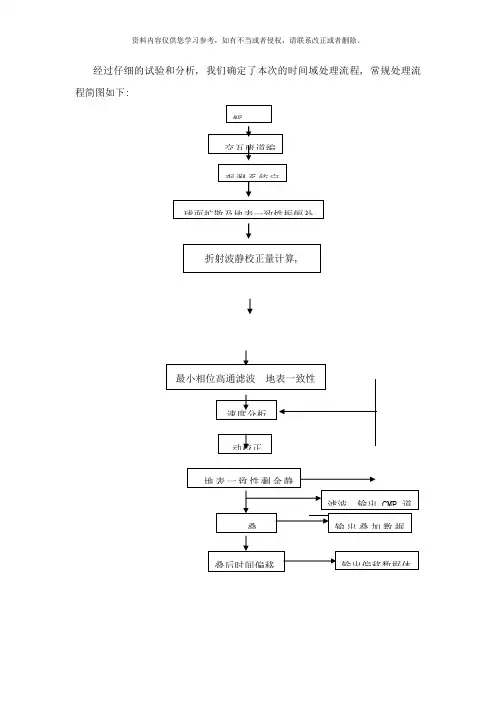
The 3D pre-stack depth migration workflow typically
involves the following steps:
1. Data preprocessing: This step involves preparing the
seismic data for migration by removing noise, correcting
for amplitude and phase distortions, and applying necessary
corrections for elevation and geometry.
2. Velocity model building: An accurate velocity model
is crucial for successful PSDM. Velocity models can be
derived from seismic data using techniques such as
tomography or full-waveform inversion.
3. Kirchhoff or beam migration: In this step, the
seismic data is migrated using the Kirchhoff or beam
migration algorithm, which accounts for the wave
propagation in the subsurface.
4. Post-migration processing: After migration, the
seismic image is processed to further enhance the image
quality and interpretability. This can include processes
such as noise suppression, dip filtering, and amplitude
balancing.
3D叠前深度偏移流程。
地震成像在油气勘探和储层表征中起着至关重要的作用。传统的震源域偏移方法,如Kirchhoff或波束偏移,假设一个恒定的速度模型并且忽略了复杂的地层结构,这可能导致不准确的地层图像。叠前深度偏移 (PSDM) 是一种先进的地震成像技术,通过纳入速度信息并考虑地下波传播来解决这些限制。PSDM 产生了更高分辨率、更准确的地层图像,这对于勘探和生产中的准确解释和决策至关重要。
3D叠前深度偏移工作流通常涉及以下步骤:
1. 数据预处理,此步骤涉及通过去除噪声、校正振幅和相位失真以及对高程和几何形状进行必要的校正来准备用于偏移的地震数据。
2. 速度模型构建,准确的速度模型对于成功的PSDM至关重要。速度模型可以使用层析成像或全波形反演等技术从地震数据中得出。
3. Kirchhoff或波束偏移,在此步骤中,地震数据使用Kirchhoff或波束偏移算法进行偏移,该算法考虑了地下波传播。
4. 偏移后期处理,偏移后,对地震图像进行处理以进一步增强图像质量和可解释性。这可以包括噪声抑制、倾角滤波和振幅平衡等过程。