
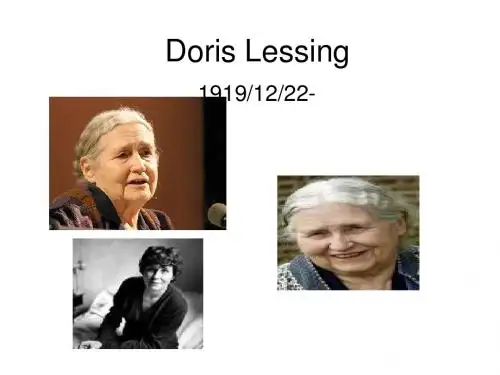
Doris Lessing
- 格式:ppt
- 大小:591.00 KB
- 文档页数:44


doris lessing flight短篇主题"Doris Lessing's 'Flight': A Reflection on the Theme of Freedom"Doris Lessing's short story "Flight" explores the theme of freedom through the lensof a coming-of-age narrative. The story follows the protagonist, a young girl named Alice, as she experiences a pivotal moment in her life. Through her journey, Lessing delves into the multifaceted nature of freedom and the inner conflicts that arise when one seeks independence.Set in the early 20th century, the story captures the oppressive patriarchal society that Alice lives in. Alice is portrayed as a dutiful daughter who takes care of her aging father and works tirelessly on the family farm. However, her desire for freedom is palpable. She yearns to break free from the confines of her domestic responsibilities and explore the world beyond.The motif of birds and flight serves as a powerful symbol throughout the story.Alice's fascination with the birds reflects her yearning for freedom and escape from her mundane existence. When Alice finally decides to leave her father and embarks on a symbolic flight, it represents her quest for independence. This flight not only symbolizes physical freedom but also the freedom to pursue her dreams and aspirations.However, the theme of freedom is complex in "Flight." Although Alice experiences moments of liberation, she also faces inner conflicts and doubts. The heavy weight of guilt and obligation towards her father momentarily hinders her journey towards freedom. This internal struggle highlights the paradoxical nature of freedom. It is not always easy to break free from societal expectations and familial responsibilities.Moreover, Lessing hints at the potential consequences of seeking freedom. Alice's naivety and lack of experience in the outside world leave her vulnerable and exposed. This dichotomy of freedom and vulnerability highlights the trade-offs that come with pursuing independence. It challenges the romanticized notion of absolute freedom and encourages readers to contemplate the sacrifices that accompany it.In conclusion, Doris Lessing's "Flight" intricately explores the theme of freedom through the character of Alice. It illustrates the desire for independence, the internal conflicts faced, and the potential consequences of seeking freedom. Through her poignant storytelling, Lessing invites readers to ponder upon the complexities and nuances of freedom in one's personal journey towards self-discovery and autonomy.。
Biography"Doris Lessing is the kind of writer who has followers, not just readers," Lesley Hazleton once observed. But Lessing, whose novel The Golden Notebook was embraced as a feminist icon, has seldom told her followers exactly what they wanted to hear. For much of her career, she has frustrated readers' expectations and thwarted would-be experts on her work, penning everything from traditional narratives to postmodern novels to mystic fables.Lessing was born in Persia (now Iran) and grew up in Southern Rhodesia (now Zimbabwe), where her father made an unsuccessf ul attempt to farm maize. Though she loved living on the f arm, her f amily life was of ten tense and unhappy. Lessing married at the age of 20, but three years later, feeling stif led by colonial lif e and increasingly distressed by the racism of her society, she joined the Communist Party, "because they were the only people I had ever met who f ought the color bar in their lives."Soon af ter that, she lef t her husband and f irst two children to marry f ellow Communist Gottf ried Lessing, with whom she had a son. They divorced, and she took her son with her to England, where she published her f irst novel, The Grass Is Singing, to high acclaim. Af ter several more novels, including the semi-autobiographical series Children of Violence, Lessing wrote The Golden Notebook, a postmodern, f ragmentary narrative about a writer's search f or identity. The Golden Notebook gained a passionate f ollowing in the f eminist movement and "lef t its mark upon the ideas and f eelings of a whole generation of women," as Elizabeth Hardwick wrote.To Lessing's dismay, she was f requently cited as a "feminist writer" af ter that. Yet as Diane Johnson pointed out in a 1978 review of Stories, Lessing "also understands men, politics, social class, striving, religion, loneliness and lust." Johnson added: "Mrs. Lessing is the great realist writer of our time, in the tradition of the major Continental novelists of the 19th century, particularly Stendhal and Balzac, but also Turgenev and Chekhov -- a masculine tradition with which she shares large moral concerns, an earnest and aff i rmative view of human nature, and a dead-eye f or social types."But Lessing, who once called realist f iction "the highest f orm of prose writing," soon launched into a science-f i ction series, Canopus in Argos: Archives, which baff led many of her fans. Lessing used the term "space f iction" f or the series, which recounts human history f rom the points of view of various extraterrestrial beings. Though Lessing gained some new readers with her Canopus series, her early admirers were relieved when she came back to Earth in The Fifth Child, the story of a monstrous child born to ordinary suburban parents, which Carolyn Kizer deemed "a minor classic." Later novels like Mara and Dann included elements of f ant asy and science f i ction, but recently, with the publication of The Sweetest Dream, Lessing has returned to domestic f iction in the realist mode, which many critics still see as her best f orm.Throughout her lif e, Lessing has been drawn to systems f or improving human experience -- f irst Marxism, then the psychiatry of R. D. Laing, then Suf i mysticism. But her yearning f or a single, transcendent truth coexists with a sharp awareness of the contradictory m ix of vanities, passions, and aggressions that make up most human lives. As Margaret Drabble noted, Lessing is "one of the very f ew novelists who haveref used to believe that the world is too complicated to understand."DORIS LESSINGBac k | Genr es | Bibliography | Prizes and awar ds | Critic al per spectiveAuthor statement | Further reading on this site | Contact details | Printer-friendly versionBIOGRAPH YDoris Lessing was bor n in Per sia (pr esent-day Ir an) to British par ents in 1919. Herfamily moved to Souther n Afric a where she spent her childhood on her father's far min what was then Souther n Rhodesia (now Zimbabwe). When her sec ond marriageended in 1949, she moved to London, where her first novel, The Grass is Singing ,was published in 1950. The book explores the c omplac ency and sha llowness ofwhite c olonial society in Souther n Afric a and established Lessing as a talentedyoung novelist.She is now widely r egarded as one of the most important post-war writers inEnglish. Her novels, short stories and essays have focused on a wide r a nge of twentieth-c entury issues and c oncer ns, fr om the politic s of r ace that she c onfr ontedin her early novels set in Afric a, to the politic s of gender which lead to her adoption by the feminist movement, to the role of the family and the individual in so ciety, explor ed in her spac e fiction of the late 1970s and early 1980s.The books in the 'Childr en of Violenc e' series (1952-69) ar e str ongly influenc ed by Lessing's r ejection of a domestic family role and her involvement with communism. The novels ar e au tobiogr aphical in many r espects, telling the story of Martha Quest, a girl growing up in Afric a who marries young despite her desper ate desir e to avoid the life her mother has led. The sec ond book in the series, A Proper Marriage (1954), describes the unhappiness of the marriage and Martha's eventual r ejection of it. The sequel, A Ripple from the Storm (1958), is very much a novel of ideas, exploring Marxism and Martha's increasing political awar eness. By the time that this book was written, however, Lessing had bec ome disillusioned with c ommunism and had left the party.With the publication of her next novel, The Golden Notebook (1962), Lessing bec ame fir mly identified with thefem inist movement. The novel conc erns Anna Wulf, a writer c aught in a personal and artistic crisis, who sees her life compartmentalised into various r oles - woman, lover , writer, politic al activist. Her diaries, written in differentcoloured notebooks, eac h c orr espond to a different part of her self. Anna eventually suffer s a mental br eakdown and it is only through this disintegr ation that she is able to disc over a new 'wholeness' which she writes about in the final notebook.The pr essur es of social c onfor mity on the individual and mental breakdown under this pr essur e was something that Lessing r eturned to in her next two novels, Briefing for a Descent into Hell (1971) and The Summer Before the Dark (1973). Briefing for a Descent into Hell is about a man who is found wandering the str eets of London with no memory of a 'nor mal' life, while Kate, the centr al c haracter of The Summer Before the Dark , achieves a kind of enlightenment through what doctor s would describe as a breakdown.In the late 1970s and early 1980s Doris Lessing tur ned almost exclusively to writing fantasy and science fiction in the 'Canopus in Ar gos' series, developing ideas which she had touc hed on towar ds the end of 'Childr en of Violenc e' and in Briefing for a Descent into Hell . The fir st book in the series, Re: Colonised Planet 5, Shikasta , was published in 1979. The fourth, The Making of the Representative for Planet 8, was adapted by Philip Glass as an oper a, with a libr etto by the author.She made a r eturn to realist fiction with Diary of a Good Neighbour (1983) and If the Old Could ... (1984), sent to her publisher under the pseudonym Jane Somer s. They wer e turned down for public ation several times and when published had only small print runs and few reviews. When the truth was uncovered, the books wer e, of course, reprinted to much greater acclaim.Lessing's mor e r ecent novels have c ontinued to c onfront taboos and c hallenge pr ec onc eptions, gener ating many differ ent and c onflicting critic al opinions. In The Good Terrorist (1985), Lessing r eturned to the politic al ar ena,through the story of a group of political activists who set up a squat in London. The book was awar ded the WH Sm ith Liter ary Award. The Fifth Child (1988) is also conc erned with alienation and the dangers inherent in a closed socialoto: © Ingrid van Krusegroup. Harriet and David r eact to the hedonism and exc esses of the 1960s by setting themselves up in a lar ge house and embar king on an enthusiastic pr ogramme of c hildbearing and domestic bliss. Their fifth child, however, emer ges as a malevolent, tr oll-like and angry figur e who quickly disrupts the f amily idyll.The acclaimed first volume of her autobiography, Under My Sk in (1994), won the James Tait Black Memorial Prize (f or biography), and was f ollow ed by a second volume, Wa lking in the S hade: Volume II o f My A uto bio graphy 1949-1962 (1997).Doris Lessing's recent fiction includes Be n, in the World(2000), a sequel to the The Fifth Child, and, The Sweete st Dream(2001), which follow s the f ortunes of a f amily through the tw entieth century, set in London during the 1960s and contemporary A frica. She was made a Companion of Honour by the British Government in 1999,and is President of Booktrust, the educational charity that promotes books and reading. In 2001 she received the David Cohen British Literature Prize.Doris Lessing lives in London. Her recent books include: the grandmo thers (2003), a collection of f our short novels centred on an unconventional extended f amily; and Time Bite s (2004), a selection of essays based on her lif e experiences. Her latest book is Alfred and Emily (2008), which explores the lives of both her parents.In 2007, Doris Lessing w as aw arded the Nobel Prize for Literature.On Not Winning the No bel Prize (2008) is the full text of the lecture she gave to the Sw edish Academy w hen accepting the prize.。