
高职国际英语Book1-Unit1
- 格式:ppt
- 大小:12.87 MB
- 文档页数:102

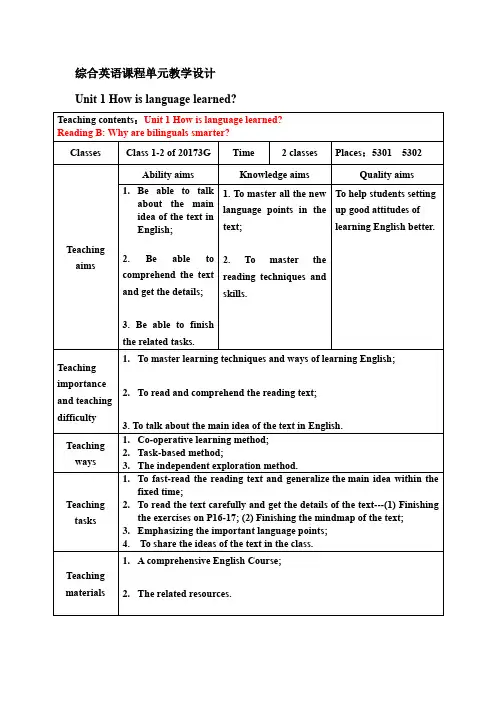
综合英语课程单元教学设计
Unit 1 How is language learned?
Teaching contents:Unit 1 How is language learned?
Reading B: Why are bilinguals smarter?
Classes Class 1-2 of 20173G Time 2 classes Places:5301 5302
Teaching
aims Ability aims Knowledge aims Quality aims
1. Be able to talk
about the main
idea of the text in
English;
2. Be able to
comprehend the text
and get the details;
3. Be able to finish
the related tasks. 1. To master all the new
language points in the
text;
2. To master the
reading techniques and
skills. To help students setting
up good attitudes of
learning English better.
Teaching
importance
and teaching
difficulty 1. To master learning techniques and ways of learning English;
2. To read and comprehend the reading text;
3. To talk about the main idea of the text in English.
Teaching
ways 1. Co-operative learning method;

WORD资料可编辑
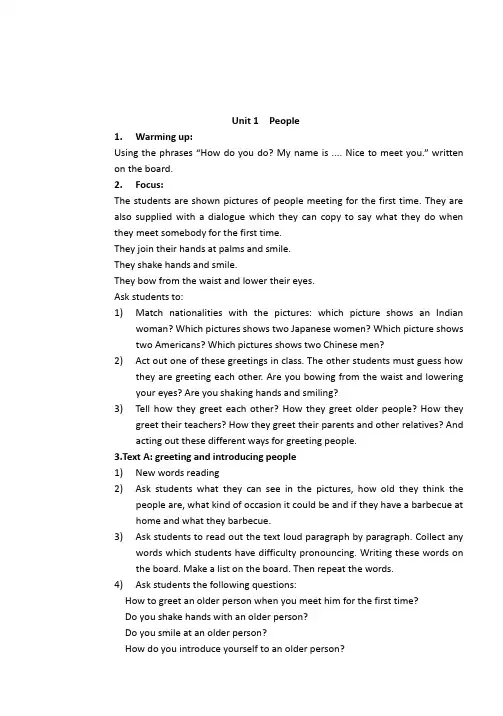
专业整理分享 Unit 1 People
1. Warming up:
Using the phrases “How do you do? My name is .... Nice to meet you.”
written on the board.
2. Focus:
The students are shown pictures of people meeting for the first time.
They are also supplied with a dialogue which they can copy to say what
they do when they meet somebody for the first time.
They join their hands at palms and smile.
They shake hands and smile.
They bow from the waist and lower their eyes.
Ask students to:
1) Match nationalities with the pictures: which picture shows an
Indian woman? Which pictures shows two Japanese women? Which
picture shows two Americans? Which pictures shows two Chinese men?
2) Act out one of these greetings in class. The other students must
Unit 1 People
1. Warming up:
Using the phrases “How do you do? My name is .... Nice to meet you.” written
on the board.
2. Focus:
The students are shown pictures of people meeting for the first time. They are
also supplied with a dialogue which they can copy to say what they do when
they meet somebody for the first time.
They join their hands at palms and smile.
They shake hands and smile.
They bow from the waist and lower their eyes.
Ask students to:
1) Match nationalities with the pictures: which picture shows an Indian
woman? Which pictures shows two Japanese women? Which picture shows
two Americans? Which pictures shows two Chinese men?
2) Act out one of these greetings in class. The other students must guess how
they are greeting each other. Are you bowing from the waist and lowering
your eyes? Are you shaking hands and smiling?
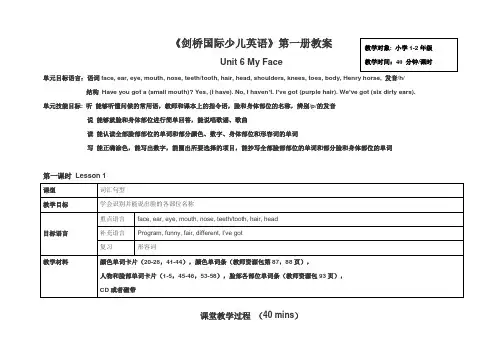
《剑桥国际少儿英语》第一册教案
Unit 6 My Face
单元目标语言:语词face, ear, eye, mouth, nose, teeth/tooth, hair, head, shoulders, knees, toes, body, Henry horse, 发音/h/
结构 Have you got a (small mouth)? Yes, (I have). No, I haven’t. I’ve got (purple hair). We’ve got (six dirty ears).
单元技能目标: 听 能够听懂问候的常用语,教师和课本上的指令语,脸和身体部位的名称,辨别/p/的发音
说 能够就脸和身体部位进行简单回答,能说唱歌谣、歌曲
读 能认读全部脸部部位的单词和部分颜色、数字、身体部位和形容词的单词
写 能正确涂色,能写出数字,能圈出所要选择的项目,能抄写全部脸部部位的单词和部分脸和身体部位的单词
第一课时 Lesson 1
课型 词汇句型
教学目标 学会识别并能说出脸的各部位名称
目标语言 重点语言 face, ear, eye, mouth, nose, teeth/tooth, hair, head
补充语言 Program, funny, fair, different, I’ve got
复习 形容词
教学材料 颜色单词卡片(20-26,41-44),颜色单词条(教师资源包第87,88页),
人物和脸部单词卡片(1-5,45-46,53-58),脸部各部位单词条(教师资源包93页),
CD或者磁带
课堂教学过程 (40 mins) 教学对象: 小学1-2年级
教学时间:40 分钟/课时 建议时间
教学步骤 教师活动 学生活动 活动设计意图
Warm up / Lead in