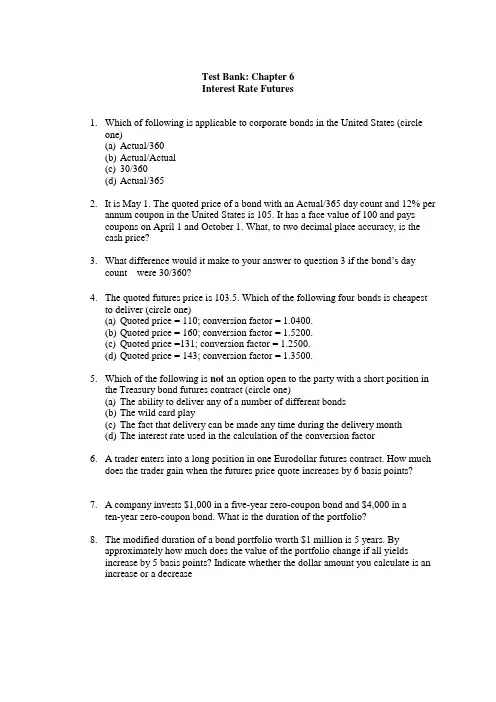
米什金货币金融学英文版习题答案chapter6英文习题Economics of Money, Banking, and Financial Markets, 11e, Global Edition (Mishkin) Chapter 6 The Risk and Term Structure of Interest Rates6.1 Risk Structure of Interest Rates1) The risk structure of interest rates isA) the structure of how interest rates move over time.B) the relationship among interest rates of different bonds with the same maturity.C) the relationship among the term to maturity of different bonds.D) the relationship among interest rates on bonds with different maturities.Answer: BAACSB: Reflective Thinking2) The risk that interest payments will not be made, or that the face value of a bond is not repaid when a bond matures isA) interest rate risk.B) inflation risk.C) liquidity risk.D) default risk.Answer: DAACSB: Application of Knowledge3) Bonds with no default risk are calledA) flower bonds.B) no-risk bonds.C) default-free bonds.D) zero-risk bonds.Answer: CAACSB: Application of Knowledge4) Which of the following bonds are considered to be default-risk free?A) municipal bondsB) investment-grade bondsC) U.S. Treasury bondsD) junk bondsAnswer: CAACSB: Analytical Thinking5) U.S. government bonds have no default risk becauseA) they are issued in strictly limited quantities.B) the federal government can increase taxes or print money to pay its obligations.C) they are backed with gold reserves.D) they can be exchanged for silver at any time.Answer: BAACSB: Reflective Thinking6) The spread between the interest rates on bonds with default risk and default-free bonds is called theA) risk premium.B) junk margin.C) bond margin.D) default premium.Answer: AAACSB: Application of Knowledge7) If the probability of a bond default increases because corporations begin to suffer large losses, then the default risk on corporate bonds will ________ and the expected return on these bonds will ________, everything else held constant.A) decrease; increaseB) decrease; decreaseC) increase; increaseD) increase; decreaseAnswer: DAACSB: Reflective Thinking8) A bond with default risk will always have a ________ risk premium and an increase in its default risk will ________ the risk premium.A) positive; raiseB) positive; lowerC) negative; raiseD) negative; lowerAnswer: AAACSB: Reflective Thinking9) If a corporation begins to suffer large losses, then the default risk on the corporate bond willA) increase and the bond's return will become more uncertain, meaning the expected return on the corporate bond will fall.B) increase and the bond's return will become less uncertain, meaning the expected return on the corporate bond will fall.C) decrease and the bond's return will become less uncertain, meaning the expected return on the corporate bond will fall.D) decrease and the bond's return will become less uncertain, meaning the expected return on the corporate bond will rise.Answer: AAACSB: Reflective Thinking10) If the possibility of a default increases because corporations begin to suffer losses, then the default risk on corporate bonds will ________, and the bonds' returns will become________ uncertain, meaning that the expected return on these bonds will decrease, everything else held constant.A) increase; lessB) increase; moreC) decrease; lessD) decrease; moreAnswer: BAACSB: Reflective Thinking11) Other things being equal, an increase in the default risk of corporate bonds shifts the demand curve for corporate bonds to the ________ and the demand curve for Treasury bonds to the ________.A) right; rightB) right; leftC) left; rightD) left; leftAnswer: CAACSB: Reflective Thinking12) Other things being equal, a decrease in the default risk of corporate bonds shifts the demand curve for corporate bonds to the ________ and the demand curve for Treasury bonds to the ________.A) right; rightB) right; leftC) left; rightD) left; leftAnswer: BAACSB: Reflective Thinking13) A(n) ________ in the riskiness of corporate bonds will ________ the price of corporate bonds and ________ the yield oncorporate bonds, all else equal.A) increase; increase; increaseB) increase; decrease; increaseC) decrease; increase; increaseD) decrease; decrease;decreaseAnswer: BAACSB: Reflective Thinking14) An increase in the riskiness of corporate bonds will ________ the price of corporate bonds and ________ the price of Treasury bonds, everything else held constant.A) increase; increaseB) reduce; reduceC) reduce; increaseD) increase; reduceAnswer: CAACSB: Reflective Thinking15) A decrease in the riskiness of corporate bonds will ________ the price of corporate bonds and ________ the price of Treasury bonds, everything else held constant.A) increase; increaseB) reduce; reduceC) reduce; increaseD) increase; reduceAnswer: DAACSB: Reflective Thinking16) An increase in the riskiness of corporate bonds will ________ the yield on corporate bonds and ________ the yield on Treasury securities, everything else held constant.A) increase; increaseB) reduce; reduceC) increase; reduceD) reduce; increaseAnswer: CAACSB: Reflective Thinking17) A decrease in the riskiness of corporate bonds will ________ the yield on corporate bonds and ________ the yield on Treasury securities, everything else held constant.A) increase; increaseB) decrease; decreaseC) increase; decreaseD) decrease; increaseAnswer: DAACSB: Reflective Thinking18) An increase in default risk on corporate bonds ________ the demand for these bonds, but ________ the demand for default-free bonds, everything else held constant.A) increases; lowersB) lowers; increasesC) does not change; greatly increasesD) moderately lowers; does not changeAnswer: BAACSB: Reflective Thinking19) A decrease in default risk on corporate bonds ________ the demand for these bonds, and________ the demand for default-free bonds, everything else held constant.A) increases; lowersB) lowers; increasesC) does not change; greatly increasesD) moderately lowers; does not changeAnswer: AAACSB: Reflective Thinking20) As default risk increases, the expected return on corporate bonds ________, and the return becomes ________ uncertain, everything else held constant.A) increases; lessB) increases; moreC) decreases; lessD) decreases; moreAnswer: DAACSB: Reflective Thinking21) As default risk decreases, the expected return on corporate bonds ________, and the return becomes ________ uncertain, everything else held constant.A) increases; lessB) increases; moreC) decreases; lessD) decreases; moreAnswer: AAACSB: Reflective Thinking22) As their relative riskiness ________, the expected return on corporate bonds ________ relative to the expected return on default-free bonds, everything else held constant.A) increases; increasesB) increases; decreasesC) decreases; decreasesD) decreases; does not changeAnswer: BAACSB: Reflective Thinking23) Which of the following statements are TRUE?A) A decrease in default risk on corporate bonds lowers the demand for these bonds, but increases the demand for default-free bonds.B) The expected return on corporate bonds decreases as default risk increases.C) A corporate bond's return becomes less uncertain as default risk increases.D) As their relative riskiness increases, the expected return on corporate bonds increases relative to the expected return on default-free bonds.Answer: BAACSB: Reflective Thinking24) Everything else held constant, if the federal government were to guarantee today that it will pay creditors if a corporation goes bankrupt in the future, the interest rate on corporate bonds will ________ and the interest rate on Treasury securities will ________.A) increase; increaseB) increase; decreaseC) decrease; increaseD) decrease; decreaseAnswer: CAACSB: Reflective Thinking25) Bonds with relatively high risk of default are calledA) Brady bonds.B) junk bonds.C) zero coupon bonds.D) investment grade bonds.Answer: BAACSB: Analytical Thinking26) Junk bonds, bonds with a low bond rating, are also known asA) high-yield bonds.B) investment grade bonds.C) high quality bonds.D) zero-coupon bonds.Answer: AAACSB: Application of Knowledge27) Bonds with relatively low risk of default are called ________ securities and have a rating of Baa (or BBB) and above; bonds with ratings below Baa (or BBB) have a higher default risk and are called ________.A) investment grade; lower gradeB) investment grade; junk bondsC) high quality; lower gradeD) high quality; junk bondsAnswer: BAACSB: Analytical Thinking28) Which of the following bonds would have the highest default risk?A) municipal bondsB) investment-grade bondsC) U.S. Treasury bondsD) junk bondsAnswer: DAACSB: Reflective Thinking29) Which of the following long-term bonds has the highest interest rate?A) corporate Baa bondsB) U.S. Treasury bondsC) corporate Aaa bondsD) municipal bondsAnswer: AAACSB: Reflective Thinking30) Which of the following securities has the lowest interest rate?A) junk bondsB) U.S. Treasury bondsC) investment-grade bondsD) corporate Baa bondsAnswer: BAACSB: Reflective Thinking31) The spread between interest rates on low quality corporate bonds and U.S. government bondsA) widened significantly during the Great Depression.B) narrowed significantly during the Great Depression.C) narrowed moderately during the Great Depression.D) did not change during the Great Depression.Answer: AAACSB: Reflective Thinking32) During the Great Depression years 1930-1933 there wasa very high rate of business failures and defaults, we would expect the risk premium for ________ bonds to be very high.A) U.S. TreasuryB) corporate AaaC) municipalD) corporate BaaAnswer: DAACSB: Reflective Thinking33) Risk premiums on corporate bonds tend to ________during business cycle expansions and ________ during recessions, everything else held constant.A) increase; increaseB) increase; decreaseC) decrease; increaseD) decrease; decreaseAnswer: CAACSB: Reflective Thinking34) The collapse of the subprime mortgage marketA) did not affect the corporate bond market.B) increased the perceived riskiness of Treasury securities.C) reduced the Baa-Aaa spread.D) increased the Baa-Aaa spread.Answer: DAACSB: Reflective Thinking35) The collapse of the subprime mortgage market increased the spread between Baa and default-free U.S. Treasury bonds. This is due toA) a reduction in risk.B) a reduction in maturity.C) a flight to quality.D) a flight to liquidity.Answer: CAACSB: Analytical Thinking36) During a "flight to quality"A) the spread between Treasury bonds and Baa bonds increases.B) the spread between Treasury bonds and Baa bonds decreases.C) the spread between Treasury bonds and Baa bonds is notaffected.D) the change in the spread between Treasury bonds and Baa bonds cannot be predicted. Answer: AAACSB: Reflective Thinking37) If you have a very low tolerance for risk, which of the following bonds would you be least likely to hold in your portfolio?A) a U.S. Treasury bondB) a municipal bondC) a corporate bond with a rating of AaaD) a corporate bond with a rating of BaaAnswer: DAACSB: Reflective Thinking38) Which of the following statements is TRUE?A) A liquid asset is one that can be quickly and cheaply converted into cash.B) The demand for a bond declines when it becomes less liquid, decreasing the interest rate spread between it and relatively more liquid bonds.C) The differences in bond interest rates reflect differences in default risk only.D) The corporate bond market is the most liquid bond market.Answer: AAACSB: Reflective Thinking39) Corporate bonds are not as liquid as government bonds becauseA) fewer corporate bonds for any one corporation are traded, making them more costly to sell.B) the corporate bond rating must be calculated each timethey are traded.C) corporate bonds are not callable.D) corporate bonds cannot be resold.Answer: AAACSB: Reflective Thinking40) When the Treasury bond market becomes more liquid, other things equal, the demand curve for corporate bonds shifts to the ________ and the demand curve for Treasury bonds shifts to the ________.A) right; rightB) right; leftC) left; rightD) left; leftAnswer: CAACSB: Reflective Thinking41) When the Treasury bond market becomes less liquid, other things equal, the demand curve for corporate bonds shifts to the ________ and the demand curve for Treasury bonds shifts to the ________.A) right; rightB) right; leftC) left; rightD) left; leftAnswer: BAACSB: Reflective Thinking42) A decrease in the liquidity of corporate bonds, other things being equal, shifts the demand curve for corporate bonds to the ________ and the demand curve for Treasury bonds shifts to the ________.A) right; rightB) right; leftC) left; leftD) left; rightAnswer: DAACSB: Reflective Thinking43) An increase in the liquidity of corporate bonds, other things being equal, shifts the demand curve for corporate bonds to the ________ and the demand curve for Treasury bonds shifts to the ________.A) right; rightB) right; leftC) left; leftD) left; rightAnswer: BAACSB: Reflective Thinking44) A(n) ________ in the liquidity of corporate bonds will ________ the price of corporatebonds and ________ the yield on corporate bonds, all else equal.A) increase; increase; decreaseB) increase; decrease; decreaseC) decrease; increase; increaseD) decrease; decrease; decreaseAnswer: AAACSB: Reflective Thinking45) An increase in the liquidity of corporate bonds will ________ the price of corporate bonds and ________ the yield of Treasury bonds, everything else held constant.A) increase; increaseB) reduce; reduceC) increase; reduceD) reduce; increaseAnswer: AAACSB: Reflective Thinking46) A decrease in the liquidity of corporate bonds will ________ the yield of corporate bonds and ________ the yield of Treasury bonds, everything else held constant.A) increase; increaseB) decrease; decreaseC) increase; decreaseD) decrease; increaseAnswer: CAACSB: Reflective Thinking47) The risk premium on corporate bonds reflects the fact that corporate bonds have a higher default risk and are ________ U.S. Treasury bonds.A) less liquid thanB) less speculative thanC) tax-exempt unlikeD) lower-yielding thanAnswer: AAACSB: Analytical Thinking48) Which of the following statements is TRUE?A) State and local governments cannot default on their bonds.B) Bonds issued by state and local governments are called municipal bonds.C) All government issued bonds—local, state, and federal—are federal income tax exempt.D) The coupon payment on municipal bonds is usually higherthan the coupon payment on Treasury bonds.Answer: BAACSB: Reflective Thinking49) Everything else held constant, if the tax-exempt status of municipal bonds were eliminated, thenA) the interest rates on municipal bonds would still be less than the interest rate on Treasury bonds.B) the interest rate on municipal bonds would equal the rate on Treasury bonds.C) the interest rate on municipal bonds would exceed the rate on Treasury bonds.D) the interest rates on municipal, Treasury, and corporate bonds would all increase. Answer: CAACSB: Reflective Thinking50) Municipal bonds have default risk, yet their interest rates are lower than the rates ondefault-free Treasury bonds. This suggests thatA) the benefit from the tax-exempt status of municipal bonds is less than their default risk.B) the benefit from the tax-exempt status of municipal bonds equals their default risk.C) the benefit from the tax-exempt status of municipal bonds exceeds their default risk.D) Treasury bonds are not default-free.Answer: CAACSB: Reflective Thinking51) Everything else held constant, an increase in marginal tax rates would likely have the effect of ________ the demand for municipal bonds, and ________ the demand for U.S. government bonds.A) increasing; increasingB) increasing; decreasingC) decreasing; increasingD) decreasing; decreasingAnswer: BAACSB: Reflective Thinking52) Everything else held constant, a decrease in marginal tax rates would likely have the effect of ________ the demand for municipal bonds, and ________ the demand for U.S. government bonds.A) increasing; increasingB) increasing; decreasingC) decreasing; increasingD) decreasing; decreasingAnswer: CAACSB: Reflective Thinking53) Everything else held constant, the interest rate on municipal bonds rises relative to the interest rate on Treasury securities whenA) income tax rates are lowered.B) income tax rates are raised.C) municipal bonds become more widely traded.D) corporate bonds become riskier.Answer: AAACSB: Reflective Thinking54) Everything else held constant, if income tax rates were lowered, thenA) the interest rate on municipal bonds would fall.B) the interest rate on Treasury bonds would rise.C) the interest rate on municipal bonds would rise.D) the price of Treasury bonds would fall.Answer: CAACSB: Reflective Thinking55) Everything else held constant, abolishing the individual income tax willA) increase the interest rate on corporate bonds.B) reduce the interest rate on municipal bonds.C) increase the interest rate on municipal bonds.D) increase the interest rate on Treasury bonds.Answer: CAACSB: Reflective Thinking56) Which of the following statements are TRUE?A) An increase in tax rates will increase the demand for Treasury bonds, lowering their interest rates.B) Because the tax-exempt status of municipal bonds was of little benefit to bond holders when tax rates were low, they had higher interest rates than U.S. government bonds before World War II.C) Interest rates on municipal bonds will be higher than comparable bonds without the tax exemption.D) Because coupon payments on municipal bonds are exempt from federal income tax, the expected after-tax return on them will be higher for individuals in lower income tax brackets. Answer: BAACSB: Reflective Thinking57) The Obama administration increased the tax on the top income tax bracket from 35% to 39%. Supply and demand analysis predicts the impact of this change was a ________ interest rate on municipal bonds and a ________ interest rate on Treasury bonds, all else the same.A) higher; lowerB) lower; lowerC) higher; higherD) lower; higherAnswer: DAACSB: Reflective Thinking58) Three factors explain the risk structure of interest ratesA) liquidity, default risk, and the income tax treatment of a security.B) maturity, default risk, and the income tax treatment of a security.C) maturity, liquidity, and the income tax treatment of a security.D) maturity, default risk, and the liquidity of a security.Answer: AAACSB: Application of Knowledge59) The spread between the interest rates on Baa corporate bonds and U.S. government bonds is very large during the Great Depression years 1930-1933. Explain this difference using the bond supply and demand analysis.Answer: During the Great Depression many businesses failed. The default risk for the corporate bond increased compared to the default-free Treasury bond. The demand for corporate bonds decreased while the demand for Treasury bonds increased resulting in a larger risk premium.AACSB: Reflective Thinking60) If the federal government where to raise the income tax rates, would this have any impact ona state's cost of borrowing funds? Explain.Answer: Yes, if the federal government raises income taxrates, demand for municipal bonds which are federal income tax exempt would increase. This would lower the interest rate on the municipal bonds thus lowering the cost to the state of borrowing funds.AACSB: Reflective Thinking6.2 Term Structure of Interest Rates1) The term structure of interest rates isA) the relationship among interest rates of different bonds with the same maturity.B) the structure of how interest rates move over time.C) the relationship among the term to maturity of different bonds.D) the relationship among interest rates on bonds with different maturities.Answer: DAACSB: Reflective Thinking2) A plot of the interest rates on default-free government bonds with different terms to maturity is calledA) a risk-structure curve.B) a default-free curve.C) a yield curve.D) an interest-rate curve.Answer: CAACSB: Application of Knowledge3) Differences in ________ explain why interest rates on Treasury securities are not all the same.A) riskB) liquidityC) time to maturityD) tax characteristicsAnswer: CAACSB: Analytical Thinking4) The typical shape for a yield curve isA) gently upward sloping.B) mound shaped.C) flat.D) bowl shaped.Answer: AAACSB: Analytical Thinking5) When yield curves are steeply upward slopingA) long-term interest rates are above short-term interest rates.B) short-term interest rates are above long-term interest rates.C) short-term interest rates are about the same as long-term interest rates.D) medium-term interest rates are above both short-term and long-term interest rates. Answer: AAACSB: Reflective Thinking6) When yield curves are flatA) long-term interest rates are above short-term interest rates.B) short-term interest rates are above long-term interest rates.C) short-term interest rates are about the same as long-term interest rates.D) medium-term interest rates are above both short-term and long-term interest rates. Answer: CAACSB: Reflective Thinking7) When yield curves are downward slopingA) long-term interest rates are above short-term interest rates.B) short-term interest rates are above long-term interest rates.C) short-term interest rates are about the same as long-term interest rates.D) medium-term interest rates are above both short-term and long-term interest rates. Answer: BAACSB: Reflective Thinking8) An inverted yield curveA) slopes up.B) is flat.C) slopes down.D) has a U shape.Answer: CAACSB: Application of Knowledge9) Economists' attempts to explain the term structure of interest ratesA) illustrate how economists modify theories to improve them when they are inconsistent with the empirical evidence.B) illustrate how economists continue to accept theories that fail to explain observed behavior of interest rate movements.C) prove that the real world is a special case that tends to get short shrift in theoretical models.D) have proved entirely unsatisfactory to date.Answer: AAACSB: Reflective Thinking10) According to the expectations theory of the term structure, the interest rate on a long-term bond will equal the ________ of the short-term interest rates that people expect tooccur over the life of the long-term bond.A) averageB) sumC) differenceD) multipleAnswer: AAACSB: Analytical Thinking11) If bonds with different maturities are perfect substitutes, then the ________ on these bonds must be equal.A) expected returnB) surprise returnC) surplus returnD) excess returnAnswer: AAACSB: Analytical Thinking12) If the expected path of one-year interest rates over the next five years is 4 percent, 5 percent, 7 percent, 8 percent, and 6 percent, then the expectations theory predicts that today's interest rate on the five-year bond isA) 4 percent.B) 5 percent.C) 6 percent.D) 7 percent.Answer: CAACSB: Analytical Thinking13) If the expected path of 1-year interest rates over the next four years is 5 percent, 4 percent, 2 percent, and 1 percent, then the expectations theory predicts that today's interest rate on the four-year bond isA) 1 percent.C) 3 percent.D) 4 percent.Answer: CAACSB: Analytical Thinking14) If the expected path of 1-year interest rates over the next five years is 1 percent, 2 percent, 3 percent, 4 percent, and 5 percent, the expectations theory predicts that the bond with the highest interest rate today is the one with a maturity ofA) two years.B) three years.C) four years.D) five years.Answer: DAACSB: Analytical Thinking15) If the expected path of 1-year interest rates over the next five years is 2 percent, 4 percent, 1 percent, 4 percent, and 3 percent, the expectations theory predicts that the bond with the lowest interest rate today is the one with a maturity ofA) one year.B) two years.C) three years.D) four years.Answer: AAACSB: Analytical Thinking16) Over the next three years, the expected path of 1-year interest rates is 4, 1, and 1 percent. The expectations theory of the term structure predicts that the current interest rate on 3-year bond isA) 1 percent.C) 3 percent.D) 4 percent.Answer: BAACSB: Analytical Thinking17) According to the expectations theory of the term structureA) the interest rate on long-term bonds will exceed the average of short-term interest rates that people expect to occur over the life of the long-term bonds, because of their preference for short-term securities.B) interest rates on bonds of different maturities move together over time.C) buyers of bonds prefer short-term to long-term bonds.D) buyers require an additional incentive to hold long-term bonds.Answer: BAACSB: Reflective Thinking18) According to the expectations theory of the term structureA) when the yield curve is steeply upward sloping, short-term interest rates are expected to remain relatively stable in the future.B) when the yield curve is downward sloping, short-term interest rates are expected to remain relatively stable in the future.C) investors have strong preferences for short-term relative to long-term bonds, explaining why yield curves typically slope upward.D) yield curves should be equally likely to slope downward as slope upward.Answer: DAACSB: Reflective Thinking19) According to the segmented markets theory of the term structureA) bonds of one maturity are close substitutes for bonds of other maturities, therefore, interest rates on bonds of different maturities move together over time.B) the interest rate for each maturity bond is determined by supply and demand for that maturity bond.C) investors' strong preferences for short-term relative to long-term bonds explains why yield curves typically slope downward.D) because of the positive term premium, the yield curve will not be observed to be downward-sloping.Answer: BAACSB: Reflective Thinking20) According to the segmented markets theory of the term structureA) the interest rate on long-term bonds will equal an average of short-term interest rates that people expect to occur over the life of the long-term bonds.B) buyers of bonds do not prefer bonds of one maturity over another.C) interest rates on bonds of different maturities do not move together over time.D) buyers require an additional incentive to hold long-term bonds.Answer: CAACSB: Reflective Thinking21) A key assumption in the segmented markets theory is that bonds of different maturities。