
国际市场营销-3
- 格式:ppt
- 大小:5.56 MB
- 文档页数:41
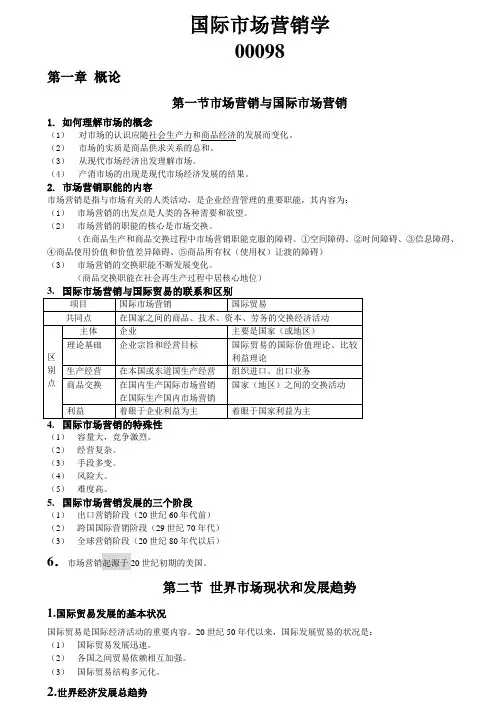
国际市场营销学00098第一章概论第一节市场营销与国际市场营销1.如何理解市场的概念(1)对市场的认识应随社会生产力和商品经济的发展而变化。
(2)市场的实质是商品供求关系的总和。
(3)从现代市场经济出发理解市场。
(4)产消市场的出现是现代市场经济发展的结果。
2.市场营销职能的内容市场营销是指与市场有关的人类活动,是企业经营管理的重要职能,其内容为:(1)市场营销的出发点是人类的各种需要和欲望。
(2)市场营销的职能的核心是市场交换。
(在商品生产和商品交换过程中市场营销职能克服的障碍。
①空间障碍、②时间障碍、③信息障碍、④商品使用价值和价值差异障碍、⑤商品所有权(使用权)让渡的障碍)(3)市场营销的交换职能不断发展变化。
(商品交换职能在社会再生产过程中居核心地位)(1)容量大,竞争激烈。
(2)经营复杂。
(3)手段多变。
(4)风险大。
(5)难度高。
5.国际市场营销发展的三个阶段(1)出口营销阶段(20世纪60年代前)(2)跨国国际营销阶段(29世纪70年代)(3)全球营销阶段(20世纪80年代以后)6.市场营销起源于20世纪初期的美国。
第二节世界市场现状和发展趋势1.国际贸易发展的基本状况国际贸易是国际经济活动的重要内容。
20世纪50年代以来,国际发展贸易的状况是:(1)国际贸易发展迅速。
(2)各国之间贸易依赖相互加强。
(3)国际贸易结构多元化。
2.世界经济发展总趋势科技进步和国家分工发展,使世界经济联系日益密切,出现了全球经济一体化趋势。
具体表现在:(1)生产国际化。
(2)国际贸易重要性全面增长。
(3)生活与消费方式趋同化。
(4)世界无形商品贸易越显重要。
(5)生产经营跨国公司化。
(6)世界经济区域集团化。
(7)世界各国经济差距扩大。
(8)贸易保护主义加强。
3.世界无形商品贸易项目,一般包括海外投资收入、运输与保险、国际旅游、私人无偿转让、专利和许可贸易。
4.按国际经济联盟分类,把国际市场分为欧洲共同体、独联体、东盟自由贸易区、南美洲共同市场等。

常见国际市场营销策划方案范文5篇(实用)常见国际市场营销策划方案篇1天猫就像是一个大的集市,但作为电子商务的领军平台,在这种大型的网络营销活动当中可以尝试着做得更开放。
这次双十二活动有一些比较有趣的特点,比如无底限折扣,突出活动的社交属性,这些特点使得本次的活动与以往的活动有很大的不同,但这些特点如果结合起来是否会更好呢事实上,是可以结合起来的,就说上文说的无底限折扣和社交属性就能结合起来。
好东西人们愿意分享,好且便宜的东西人们当然更愿意分享。
但怎样的分享形式才能让吸引更多的人呢当然做法有很多,但无外乎借助自身的平台增加人们的分享和借助一些社交平台增加分享两种途径。
下面是我们小组对于这两种途径增加分享的想法。
(一)借助知名社交平台借助知名社交平台进行分享是目前提高知名度和分享率的一般做法,此次活动中也可以使用,以价格便宜为引子,借助豆瓣、人人、微博等社交平台扩大知名度。
当用户拍下宝贝,付完账后,系统自动提醒用户要不要晒单,如果用户同意,淘宝系统会自动生成订单状况(缩略图、折扣情况等),然后发布到用户的那些平台上。
(二)站内信息更新平台当然,除了利用知名社交网站的社交平台之外,还可以利用淘宝自身的名气,建立自己的信息更新平台,当然可以是只针对此次活动的,也可以作为常用的信息更新平台。
针对此次淘宝活动中可以加入专门制作一个及时更新的网页,把消费者跟商家砍价的信息发布到这一网页上,当然,这个网页以分类标签的形式显示。
打一个比方吧,就是说:买家B跟商家A就某一双靴子进行砍价,最后他以很低的折扣给了我,当订单生成的时候,系统自动提醒——您要不要将您和商家砍价的情况发布到信息更新平台上,这样的话,很可能有更多的人也能像您那样低价购入该商品了。
如果买家同意了,然后系统自动将物品的缩略图以及基本信息乃至具体的折扣发至信息更新平台。
信息更新平台是对所有的淘宝用户公开,因此每一个淘宝用户均可以看到新更新的内容,不过需要在分类方面下工夫,因为有如果信息量太大会增加人们的信息搜寻难度,导致淘宝用户流失。

Chapter 3Cultural Influences on International Marketing1. Please Give the overview of Chapter 32. Please describe Hofstede Dimensions:3. What are the Elements of Culture4. Please mention Low-context versus High-context:5. Please complete the following terms:a. Norms:b. Oculesics:c. Olfactions:d. Orientations:e. Paralinguistics:Hofstede Dimensions:1.Power distance: The manner in which interpersonal relationships are formed whendifferences in power are perceived. The relationship can either be formal,subordinate, or, alternatively, based on equality and informality.2.Uncertainty avoidance: The extent to which individuals feel threatened byuncertainty, risk, and ambiguous situations. In countries where uncertaintyavoidance is high, consumers are resistant to change and focused on risk avoidanceand reduction. In cultures low in uncertainty avoidance, products that are new anddifferent are perceived as interesting and worth exploring.3.Masculinity: The degree to which a national culture is characterized byassertiveness, rather than nurturing. Masculine societies emphasize values such aswealth, ambition and achievement, while feminine societies prioritize nurturing,cooperation, and good will.4.Individualism versus collectivism: Individualism refers to the degree to which peoplein a country prefer to act as individuals, in their self-interest, rather than in theinterest of the group (which is characteristic of collectivist societies).Elements of Culture: Elements of culture include language (spoken/written, nonverbal communication), religion, cultural values (enduring beliefs about a specific mode of conduct), cultural norms (rules that dictate what is right or wrong, such as imperatives, exclusives, and adiaphoras), and national and regional character (distinct set of behavior characteristics, such as time orientation, socializing, gender roles, etc.).Low-context versus High-context: High-low-context continuum defines the extent to which a spoken statement conveys a full message. In low-context cultures, what is said is exactly what is meant, while, in high-context cultures, nonverbal communication is just as meaningful as the verbal message.Norms: Rules that dictate what is right or wrong, acceptable or unacceptable in a society.Oculesics: The use or avoidance of eye contact during communication.Olfactions: The use of odors to convey messages.Orientations: Individuals’ positioning relative to their counterparts during conversation. Paralinguistics: The nonverbal aspects of speech that include intonation, accents, and the quality of voice.REVIEW QUESTIONSTrue/False1.True2.False3.False4.False5.False6.TrueMultiple Choice1. C2. B3. C。