语言学题目
- 格式:doc
- 大小:41.00 KB
- 文档页数:4
填空题
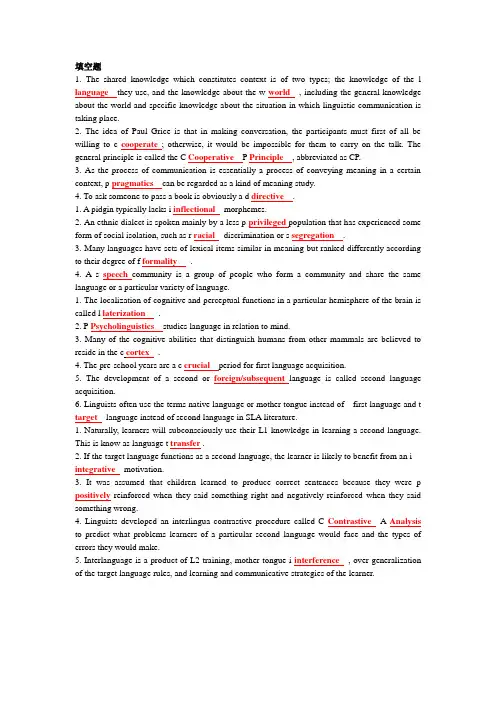
1. The shared knowledge which constitutes context is of two types; the knowledge of the l
language they use, and the knowledge about the w world , including the general knowledge
about the world and specific knowledge about the situation in which linguistic communication is
taking place.
2. The idea of Paul Grice is that in making conversation, the participants must first of all be
willing to c cooperate ; otherwise, it would be impossible for them to carry on the talk. The
general principle is called the C Cooperative P Principle , abbreviated as CP.
3. As the process of communication is essentially a process of conveying meaning in a certain
context, p pragmatics can be regarded as a kind of meaning study.
4. To ask someone to pass a book is obviously a d directive .
1. A pidgin typically lacks i inflectional morphemes.
2. An ethnic dialect is spoken mainly by a less p privileged population that has experienced some
form of social isolation, such as r racial discrimination or s segregation .
3. Many languages have sets of lexical items similar in meaning but ranked differently according
to their degree of f formality .
4. A s speech community is a group of people who form a community and share the same
language or a particular variety of language.
1. The localization of cognitive and perceptual functions in a particular hemisphere of the brain is
called l laterization .
2. P Psycholinguistics studies language in relation to mind.
3. Many of the cognitive abilities that distinguish humans from other mammals are believed to
reside in the c cortex .
4. The pre-school years are a c crucial period for first language acquisition.
5. The development of a second or foreign/subsequent language is called second language
acquisition.
6. Linguists often use the terms native language or mother tongue instead of first language and t
target language instead of second language in SLA literature.
1. Naturally, learners will subconsciously use their L1 knowledge in learning a second language.
This is know as language t transfer .
2. If the target language functions as a second language, the learner is likely to benefit from an i__
integrative motivation.
3. It was assumed that children learned to produce correct sentences because they were p
positively reinforced when they said something right and negatively reinforced when they said
something wrong.
4. Linguists developed an interlingua contrastive procedure called C Contrastive A Analysis
to predict what problems learners of a particular second language would face and the types of
errors they would make.
5. Interlanguage is a product of L2 training, mother tongue i interference , over generalization
of the target language rules, and learning and communicative strategies of the learner.
选择题
1. __C __ resulted mainly from the expansion of the study of linguistics, especially that of
semantics.
A. Pragmatism B. Phonology
C. Pragmatics D. Practicalism
2. __C __ act is the act performed by or resulting from saying something.
A. A locutionary B. An illocutionary
C. perlocutionary D. A speech
3. One of the contributions Searle has made is his classification of _B ___ acts.
A. locutionary B. illocutionary
C. perlocutionary D. speech
4. The maxim of quantity requires : _D___ .
A. make your contribution as informative as required
B. do not make contribution more informative than is required
C. do not say that for which you lack adequate evidence
D. Both A and B
5. The significance of Grice’s CP lies in that it explains how it is possible for the speaker to
convey _A__ is literally said.
A. more than B. less than
C. the same as D. none of the above
1. At the age of four, children __A __ .
A. can master the essentials of their mother tongue
B. can only babble several sounds
C. can name the things around them only
D. can write out all the grammatical rules of their mother tongue
2. Which stage does the child belong to according to the development of the grammatical system
when we heard his saying like “No heavy”, “No eat”, “He no bite you”, etc.? B
A. The development of phonology
B. The development of syntax
C. The development of morphology
D. The development of vocabulary and semantics
3. Children’s language begins to reflect the distinction between sentence-type at _ C__ stage.
A. the prelinguistic stage
B. the one-word stage
C. the two-word stage
D. the multiword stage
4. _ C__ has been found to occur usually in children’s pronunciation or reporting of the
truthfulness of utterances, rather than in the grammaticality of sentences.