
化纤工艺流程图
- 格式:doc
- 大小:9.50 KB
- 文档页数:1

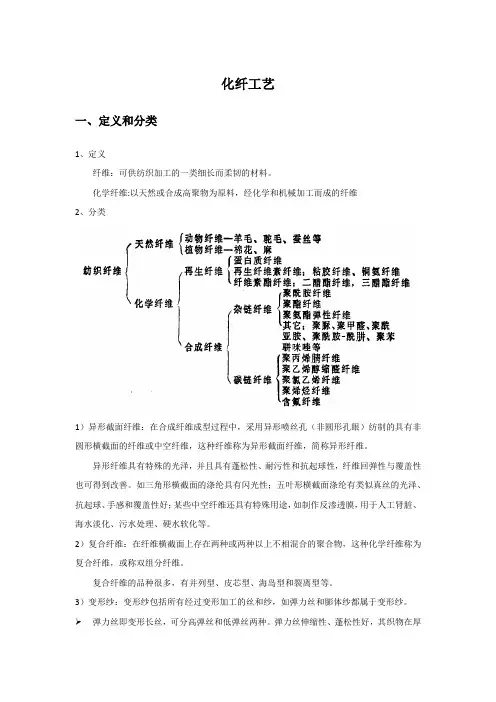
化纤工艺一、定义和分类1、定义纤维:可供纺织加工的一类细长而柔韧的材料。
化学纤维:以天然或合成高聚物为原料,经化学和机械加工而成的纤维2、分类1)异形截面纤维:在合成纤维成型过程中,采用异形喷丝孔(非圆形孔眼)纺制的具有非圆形横截面的纤维或中空纤维,这种纤维称为异形截面纤维,简称异形纤维。
异形纤维具有特殊的光泽,并且具有蓬松性、耐污性和抗起球性,纤维回弹性与覆盖性也可得到改善。
如三角形横截面的涤纶具有闪光性;五叶形横截面涤纶有类似真丝的光泽、抗起球、手感和覆盖性好;某些中空纤维还具有特殊用途,如制作反渗透膜,用于人工肾脏、海水淡化、污水处理、硬水软化等。
2)复合纤维:在纤维横截面上存在两种或两种以上不相混合的聚合物,这种化学纤维称为复合纤维,或称双组分纤维。
复合纤维的品种很多,有并列型、皮芯型、海岛型和裂离型等。
3)变形纱:变形纱包括所有经过变形加工的丝和纱,如弹力丝和膨体纱都属于变形纱。
➢弹力丝即变形长丝,可分高弹丝和低弹丝两种。
弹力丝伸缩性、蓬松性好,其织物在厚度、重量、不透明性、覆盖性和外观特征等方面接近毛织品、丝织品或棉织品。
涤纶弹力丝多数用于衣着,锦纶弹力丝宜于制造袜子,丙纶弹力丝则多数用于家用织物及地毯。
其变形方法主要有假捻法、空气喷射法、热气流喷射法、填塞箱法和赋型法等。
➢膨体纱是利用高聚物的热可塑性,将两种收缩性能不同的合成纤维毛条按比例混合,经热处理后,高收缩性的毛条迫使低收缩性的毛条卷曲,从而使其具有伸缩性和蓬松性、类似毛线的变形纱。
以腈纶膨体纱产量为最大,用于制作针织外衣、内衣、毛线、毛毯等。
二、化纤生产过程高聚物的提纯和聚合化学纤维是由高聚物制造而成的。
此高聚物可直接取自自然界,也可由低分子物经人工合成而得。
再生纤维是以天然高聚物为原料,经化学方法而制成。
它与原高聚物在化学构成上基本相同。
对于天然高聚物来说,这需要提纯以去除杂质。
如制造粘胶纤维的高聚物是纤维素,它是从绵绒、木材、芦苇、甘蔗渣等纤维素原料中将纤维素提纯出来,制成浆粕,然后再用浆粕制造纤维。

化纤面料工艺流程下载温馨提示:该文档是我店铺精心编制而成,希望大家下载以后,能够帮助大家解决实际的问题。
文档下载后可定制随意修改,请根据实际需要进行相应的调整和使用,谢谢!并且,本店铺为大家提供各种各样类型的实用资料,如教育随笔、日记赏析、句子摘抄、古诗大全、经典美文、话题作文、工作总结、词语解析、文案摘录、其他资料等等,如想了解不同资料格式和写法,敬请关注!Download tips: This document is carefully compiled by the editor. I hope that after you download them, they can help yousolve practical problems. The document can be customized and modified after downloading, please adjust and use it according to actual needs, thank you!In addition, our shop provides you with various types of practical materials, such as educational essays, diary appreciation, sentence excerpts, ancient poems, classic articles, topic composition, work summary, word parsing, copy excerpts,other materials and so on, want to know different data formats and writing methods, please pay attention!化纤面料工艺流程是纺织行业中至关重要的一环,它关乎着整个面料的质量和性能。
化纤的生产工艺化纤生产工艺是指将化纤原料经过一系列的化学和物理处理过程,最终转化为纤维的过程。
下面是一般的化纤生产工艺流程,总共700字:首先,化纤生产工艺的首要步骤是原料的准备。
化纤所使用的原料包括石油、煤炭、天然气等化石燃料。
这些原料通过炼化工艺获得化学品,然后再通过特殊的处理得到纤维原料,如聚酯原料、尼龙原料等。
第二步是聚合反应。
聚合反应是将纤维原料转化为可纺丝的高分子化合物的过程。
这一步通常在高温高压下进行,通过加入催化剂和活性剂来促进分子间的反应,使分子链逐渐增长,形成长链高聚物。
第三步是纺丝。
纺丝是将高分子化合物转化为纤维的过程。
一般有湿法纺丝和干法纺丝两种方法。
湿法纺丝是将聚合物溶解在特定的溶剂中,形成高粘度液体,然后通过纺丝机将液体挤出,使其形成纤维。
干法纺丝则是将高分子化合物熔融,然后通过喷丝孔挤出成纤维。
第四步是拉伸。
拉伸是使纤维变得更细、更强、更具有弹性和柔韧性的过程。
这一步通常是将纤维通过一对逐渐缩小的辊子或者喷射气流进行牵伸,使纤维具有更好的物理性能。
第五步是加工和处理。
将纺好的纤维进行切割、拼接、印染等加工步骤,使纤维达到所需的形态和功能。
这一步还包括对纤维进行染色、漂白、防缩等处理,以满足市场需求。
最后,还需要进行纺纱和织造等后续步骤,将纤维制成各种不同的纺织品,如服装、家纺等。
以上是一般化纤生产工艺的基本流程,不同种类的化纤生产工艺可能会有所差异。
化纤生产工艺的关键在于控制温度、压力、抽真空等条件,以及选择合适的催化剂和活性剂等。
同时,为了减少对环境的污染和资源的消耗,也需要进行废水处理、废气处理和能源回收等步骤。

化学纤维生产工艺流程英文回答:Chemical fiber production involves several steps in order to transform raw materials into fibers that can be used in various industries. The process typically includes the following stages: polymerization, spinning, drawing, and finishing.The first step in chemical fiber production is polymerization. This is where the raw materials, such as petrochemicals or natural polymers, are chemically processed to form long chains of polymer molecules. This can be done through different methods, such as melt polymerization or solution polymerization. Once the polymer is formed, it is then cooled and solidified into a resin.The next step is spinning, where the polymer resin is melted and extruded through spinnerets. Spinnerets are small holes that have a specific shape and size, whichdetermines the shape and size of the resulting fibers. As the molten polymer is forced through the spinnerets, it solidifies into continuous filaments. These filaments are then cooled and collected on a spinning wheel or drum.After spinning, the fibers go through the drawing process. Drawing involves stretching the filaments to align the polymer chains and increase the strength and uniformity of the fibers. This is typically done through a series of heated rollers or jets of air. The drawn fibers are then wound onto bobbins or spools.The final step in chemical fiber production is finishing. This includes various treatments to improve the properties of the fibers, such as dyeing, coating, or adding flame retardants. Finishing can also involve additional processes, such as texturing or crimping, to give the fibers specific characteristics, such as increased bulk or softness.Overall, chemical fiber production is a complex process that requires careful control of parameters such astemperature, pressure, and polymer composition. It involves a combination of chemical reactions, mechanical processes, and treatments to transform raw materials into fibers that meet specific requirements for various applications.中文回答:化学纤维的生产涉及多个步骤,以将原材料转化为可用于各个行业的纤维。