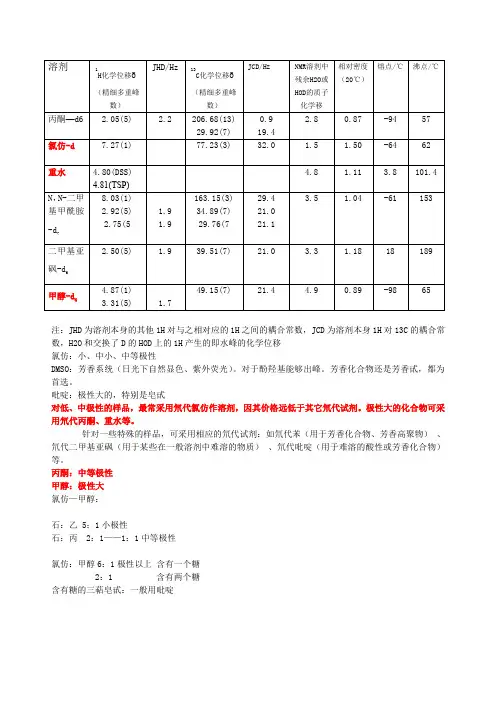
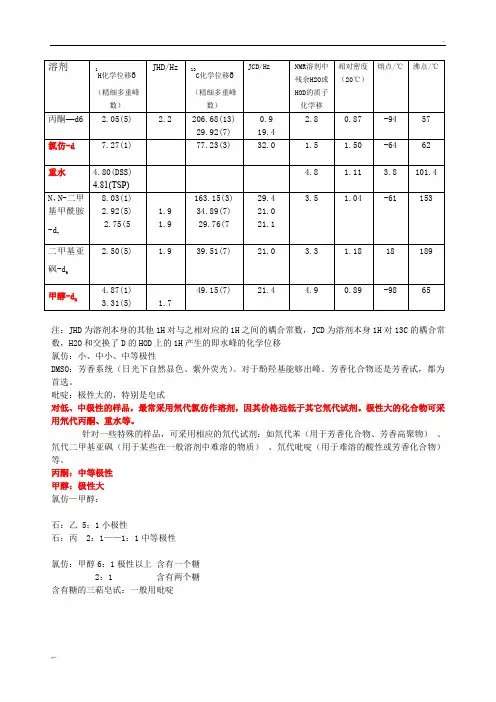
核磁常见溶剂峰
- 格式:pdf
- 大小:69.37 KB
- 文档页数:4
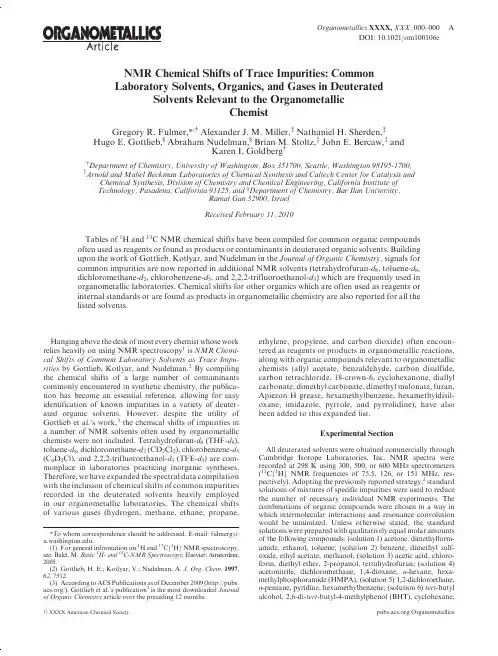
NMRChemicalShiftsofCommon
LaboratorySolventsasTraceImpurities
HugoE.Gottlieb,*VadimKotlyar,and
AbrahamNudelman*
DepartmentofChemistry,Bar-IlanUniversity,Ramat-Gan52900,Israel
ReceivedJune27,1997
InthecourseoftheroutineuseofNMRasanaidfor
organicchemistry,aday-to-dayproblemistheidentifica-
tionofsignalsderivingfromcommoncontaminants
(water,solvents,stabilizers,oils)inless-than-analyti-
cally-puresamples.Thisdatamaybeavailableinthe
literature,butthetimeinvolvedinsearchingforitmay
beconsiderable.Anotherissueistheconcentration
dependenceofchemicalshifts(especially1H);results
obtainedtwoorthreedecadesagousuallyrefertomuch
moreconcentratedsamples,andrunatlowermagnetic
fields,thantoday’spractice.
Wethereforedecidedtocollect1Hand13Cchemical
shiftsofwhatare,inourexperience,themostpopular
“extrapeaks”inavarietyofcommonlyusedNMR
solvents,inthehopethatthiswillbeofassistanceto
thepracticingchemist.
ExperimentalSection
NMRspectraweretakeninaBrukerDPX-300instrument
(300.1and75.5MHzfor1Hand13C,respectively).Unless
otherwiseindicated,allwererunatroomtemperature(24(1
°C).Fortheexperimentsinthelastsectionofthispaper,probe
temperaturesweremeasuredwithacalibratedEurotherm840/T
digitalthermometer,connectedtoathermocouplewhichwas
introducedintoanNMRtubefilledwithmineraloiltoap-
proximatelythesamelevelasatypicalsample.Ateach
temperature,theD2Osampleswerelefttoequilibrateforatleast
10minbeforethedatawerecollected.
Inordertoavoidhavingtoobtainhundredsofspectra,we
preparedsevenstocksolutionscontainingapproximatelyequal
amountsofseveralofourentries,choseninsuchawayasto
preventintermolecularinteractionsandpossibleambiguitiesin
assignment.Solution1:acetone,tert-butylmethylether,di-
methylformamide,ethanol,toluene.Solution2:benzene,di-
methylsulfoxide,ethylacetate,methanol.Solution3:acetic
acid,chloroform,diethylether,2-propanol,tetrahydrofuran.
Solution4:acetonitrile,dichloromethane,dioxane,n-hexane,
HMPA.Solution5:1,2-dichloroethane,ethylmethylketone,
n-pentane,pyridine.Solution6:tert-butylalcohol,BHT,cyclo-
hexane,1,2-dimethoxyethane,nitromethane,siliconegrease,
triethylamine.Solution7:diglyme,dimethylacetamide,ethyl-
eneglycol,“grease”(engineoil).ForD2O.Solution1:acetone,
tert-butylmethylether,dimethylformamide,ethanol,2-propanol.
Solution2:dimethylsulfoxide,ethylacetate,ethyleneglycol,
methanol.Solution3:acetonitrile,diglyme,dioxane,HMPA,
pyridine.Solution4:1,2-dimethoxyethane,dimethylacetamide,
ethylmethylketone,triethylamine.Solution5:aceticacid,tert-
butylalcohol,diethylether,tetrahydrofuran.InD2Oand
CD3ODnitromethanewasrunseparately,astheprotons
exchangedwithdeuteriuminpresenceoftriethylamine.
Results
ProtonSpectra(Table1).Asampleof0.6mLofthe
solvent,containing1µLofTMS,1wasfirstrunonits
own.Fromthisspectrumwedeterminedthechemical
shiftsofthesolventresidualpeak2andthewaterpeak.
Itshouldbenotedthatthelatterisquitetemperature-dependent(videinfra).Also,anypotentialhydrogen-
bondacceptorwilltendtoshiftthewatersignaldown-
field;thisisparticularlytruefornonpolarsolvents.In
contrast,ine.g.DMSOthewaterisalreadystrongly
hydrogen-bondedtothesolvent,andsoluteshaveonlya
negligibleeffectonitschemicalshift.Thisisalsotrue
forD2O;thechemicalshiftoftheresidualHDOisvery
temperature-dependent(videinfra)but,maybecounter-
intuitively,remarkablysolute(andpH)independent.
Wethenadded3µLofoneofourstocksolutionsto
theNMRtube.Thechemicalshiftswerereadandare
presentedinTable1.Exceptwhereindicated,the
couplingconstants,andthereforethepeakshapes,are
essentiallysolvent-independentandarepresentedonly
once.
ForD2Oasasolvent,theacceptedreferencepeak(δ
)0)isthemethylsignalofthesodiumsaltof3-(trimeth-
ylsilyl)propanesulfonicacid;onecrystalofthiswasadded
toeachNMRtube.Thismaterialhasseveraldisadvan-
tages,however:itisnotvolatile,soitcannotbereadily
eliminatedifthesamplehastoberecovered.Inaddition,
unlessonepurchasesitintherelativelyexpensive
deuteratedform,itaddsthreemoresignalstothe
spectrum(methylenes1,2,and3appearat2.91,1.76,
and0.63ppm,respectively).Wesuggestthatthere-
sidualHDOpeakbeusedasasecondaryreference;we
findthatiftheeffectsoftemperaturearetakeninto
account(videinfra),thisisveryreproducible.ForD2O,
weusedadifferentsetofstocksolutions,sincemanyof
thelesspolarsubstratesarenotsignificantlywater-
soluble(seeTable1).Wealsoransodiumacetateand
sodiumformate(chemicalshifts:1.90and8.44ppm,
respectively).
CarbonSpectra(Table2).Toeachtube,50µLof
thestocksolutionand3µLofTMS1wereadded.The
solventchemicalshifts3wereobtainedfromthespectra
containingthesolutes,andtherangesofchemicalshifts
(1)ForrecommendationsonthepublicationofNMRdata,see:IUPACCommissiononMolecularStructureandSpectroscopy.PureAppl.Chem.1972,29,627;1976,45,
217.(2)I.e.,thesignaloftheprotonfortheisotopomerwithonelessdeuteriumthantheperdeuteratedmaterial,e.g.,CHCl3inCDCl3orC6D5HinC6D6.ExceptforCHCl3,thesplittingduetoJHDistypicallyobserved(toagoodapproximation,itis1/6.5ofthevalueofthecorrespondingJHH).ForCHD2groups(deuteratedacetone,DMSO,acetonitrile),thissignalisa1:2:3:2:1quintetwithasplittingofca.2Hz.(3)Incontrasttowhatwassaidinnote2,inthe13Cspectrathesolventsignalisduetotheperdeuteratedisotopomer,andtheone-bondcouplingstodeuteriumarealwaysobservable(ca.20-30