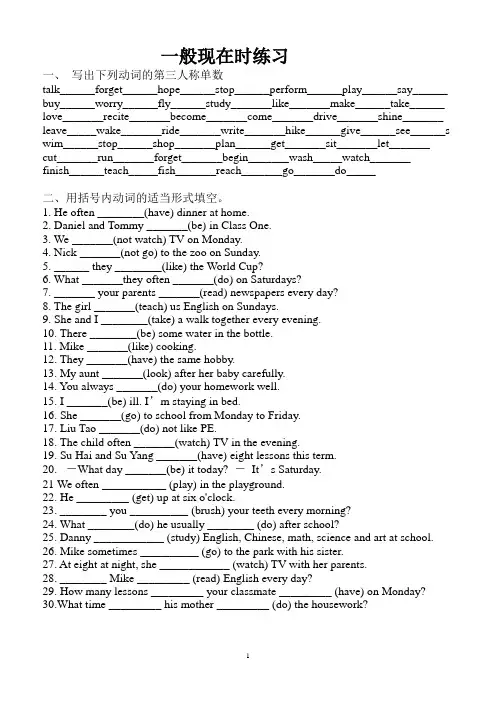
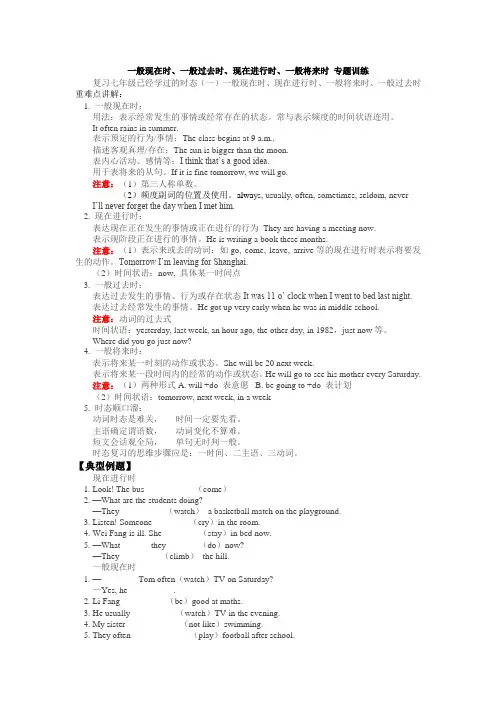
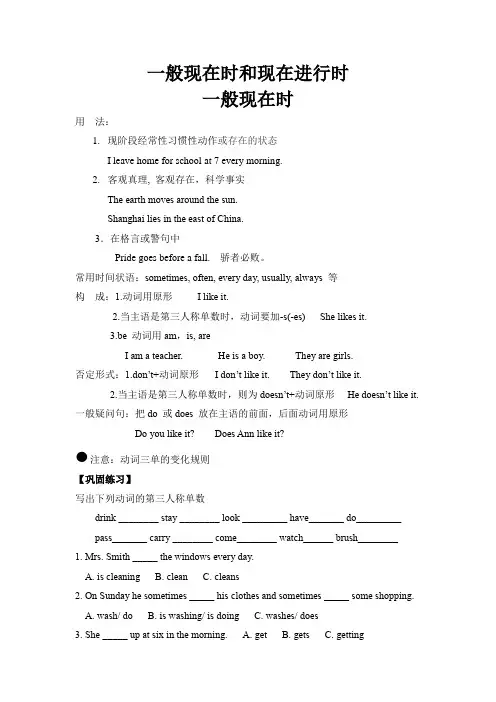
初中一般现在时和现在进行时讲解及练习题
- 格式:pdf
- 大小:26.88 KB
- 文档页数:6
1 / 6 现在进行时(一)现在进行时的构成肯定句:主语+be(am ,is, are)+Ving(现在分词)+其他成分主语be Ving(现在分词)第一人称单数I 复数We 第二人称单数You 复数You
第三人称单数He She It 其他单数Sam 复数they 注:现在分词的构成变化方法动词原形Ving(现在分词) 直接加ingplay 以不发音的字母e结尾的单词,去掉字母e,再加ing take 结尾呈现“辅,元,辅”结构的动词,先双写末尾的辅音字母,再加ing stop 以ie结尾的动词,把ie改为y ,再加ing lie 否定句: + + + + I ________ __________ a student.(我不是学生。一般疑问句:+ + + ?_________ _________ a student? 肯定回答:Yes, 主语+ be(am ,is, are)否定回答:No,主语+ be(am ,is, are)+not. 特殊疑问句:特殊疑问词+ be(am ,is, are)+主语+Ving(现在分词)+其他成分?2 / 6 (二)不用于现在进行时的动词:1)表示事实状态的动词,如have, belong, possess, cost, owe, exist, include, contain, matter, weigh, measure, continue等。I have two brothers. 我有两兄弟。This house belongs to my sister. 这房子是我姐的。2)表示心理状态的动词,如know, realize, think see, believe, suppose, imagine, agree, recognize, remember, want, need, forget, prefer, mean, understand, love, hate等。I need your help. 我需要你的帮助。He loves her very much. 他爱她很深。3)瞬间动词,如accept, receive, complete, finish, give, allow, decide, refuse等。I accept your advice. 我接受你的劝告。4)系动词,如seem, remain, lie, see, hear, smell, feel, taste, get, become, turn等。例如:You seem a little tired. 你看上去有点累。(三)现在进行时的用法1,表示说话时正在进行或发生的动作。Please don't make so much noise. I'm writing a composition. 不要吵闹。我正在写作文。Let's set off. It isn’t raining now. 咱们出发吧。现在不下雨了。这类情况常与now现在,at present现在,at the moment现在,today今天,this week这个星期,this year今年等时间状语连用。2,表示现阶段正在进行而说话时不一定在进行的动作。We are working in a factory these days. 这几天我们在一家工厂工作。They are compiling a dictionary. 他们在编一本词典。We are making model planes these days.这些天我们在做飞机模型。这类情况常与today今天,this week这个星期,this evening今天晚上,these days现在、目前等时间状语连用。1.有时通过上下文可以判断出应采用何种时态,如以look, listen开头的句子,提示我们动作正进行,这时要用现在进行时。It's four o'clock in the afternoon. The children are playing football on the sports ground. 现在是下午四点。孩子们在操场上踢足球。Hurry up! We are all waiting for you. 快点!我们大家都等着你。Look! They are reading over there under the tree. 看!他们在那边的树底下看书。Listen! She is singing in the room. 听!她在房间里唱歌。Where is Kate? She is reading in the room. 凯特在哪里?她在房间里看书。Why are you crying? Is something wrong? 为什么哭呢?有什么不对?Listen!She is singing an English song.听,她正在唱英语歌。3,在口语中表示主语计划将要作的动作。They are leaving for New York tomorrow. 明天他们将要动身前往纽约。Is your brother departing soon? 你的兄弟很快就要启程吗?这类情况常与come来,go去,leave离开,depart离开,arrive到达,stay逗留,start开始等动词连用。所用的动词必须是动作而不是状态,主语必须是人。4,现在进行时与always等副词连用时带有感情色彩。He's always quarrelling with others. 他老喜欢跟别人吵架。She is constantly worrying about her son's health. 她不停地为她儿子的健康担心着。The boy is forever asking questions. 那个男孩老是问问题。这类情况常与always总是,usually通常,continually不断的,constantly经常的,forever永远、老是等副3 / 6 词连用。5,有的现在进行时句子和一般现在时同义。用现在进行时表示问者的关切心情。How are you feeling today? (How do you feel today?)你今天感觉如何?I am looking (look)forward to your next visit. 我盼望你下次再来。Why are you looking(do you look)so sad? 为什么你看起来这么愁眉苦脸的样子呢?6,有的动词用于现在进行时表示“逐渐”的含义。此种用法除了偶尔和now连用外,一般不和其他时间副词连用的。Our study is becoming more interesting. 我们的学习变得越来越有趣了。The leaves are turning red. 树叶渐渐地变红了。The war is ending. 战争接近尾声了。Wait a moment; I am finishing my supper. 等一会儿,我的晚饭就要吃完了。适合于此种用法的动词有:bet/grow/become/turn/run/go变成,begin开始,forget忘记,remember记得,die死,finish完成,find发现,rise增强等. 7,“be”动词的现在进行时。“be”动词用于现在进行时表示说话者认为是短暂的、和平常不一样的、甚至是伪装的。He is being foolish. 他在装傻。He is being honest. 他表现得特别老实。She is being rude. 她故意表现粗鲁。I can't understand why he is being so selfish.我不明白此时他为何如此自私。适合于此种用法的有:foolish愚蠢的,nice好的,kind好心的,careful细心的,patient耐心的,lazy懒惰的,silly傻的,rude粗鲁的,polite礼貌的,impolite无礼的等表示人的特性、性格的形容词。(“be”动词用于现在进行时表示人的行为,纯粹表示心理或生理的状态而不带有行动时或主语不是人时,“be”动词不能用于现在进行时)如:I am happy.(表语是纯粹的心理状态,不可用am being)我很快乐。He's tired.(表语是纯粹的生理状态,不可用is being)他很疲倦。It's hot today.(主语不是人,不可用is being)今天很热。常和现在进行时连用的时间状语一般现在时和现在进行时练习题一、基础练习(一)写出下列动词的现在分词形式1. work___________ sing__________ play__________ study__________ 2. dance__________ come__________ write__________ take__________ 3. run__________ sit__________ shop__________ swim__________ 4. lie__________ die___________ (二)写出下列动词的第三人称单数形式1. work__________ read__________ clean__________ write__________ 2. teach__________ wash__________ guess__________ watch__________ 3. go__________ do___________ photo__________ 5. have__________ (三)填入be动词的适当形式4 / 6 1. He ________ drinking water. 2. The birds _________ flying in the sky. 3. Children __________ playing in the playground. 4. They _________ working now. 5. I _________ going to the supermarket. 6. I __________ coming. 二、填空:1. She is _______________ (walk) now. 2. Mother is _________________ (feed) birds. 3. They are ________________ (sit) on the chair. 4. Cindy is ____________ (watch,) TV. 5. Joe is __________ (jog) in the garden. 6. Look, Nick is ___________ (come). 7. The cat is ______________ (lie) on the rug. 8. Listen, she is _______________ (sing). 9. Look, the girl is _______________ (run). 10. The cat is ______________ (eat) now. 11. Look, the baby is _______________ (smile). 12. My mother and my father are _________________ (dance). 13. Uncle Jerry is ______________ (drive). 14. The fish is _____________ (swim) in the river. 15. She is _____________ (shop). 16. My father always __________(come) back from work very late. 17. The teacher is busy. He __________ (sleep) six hours a day. 18. Listen! Joan __________(sing) in the classroom. She often __________ (sing) there. 19. __________ your brother __________(know) Japanese? 20. Where __________ you __________ (have) lunch every day? 21. The girl __________(like) wearing a skirt. Look! She __________(wear) a red skirt today.三、单项选择1. Who _____ over there now? A. singing B. are sing C. is singing D. sing 2. It’s eight o’clock. The students _____ an English class. A. have B. having C. is having D. are having 3. Listen! The baby _____ in the next room. A. crying B. cried C. is crying D. cries 4. Look! The twins _____ new sweaters. A. are wearing B. wearing C. are wear D. is wearing 5. Don’t talk here. Grandparents _____. A. is sleepingB. are sleeping C. sleeping D. sleep 6. Tom is a worker. He _____ in a factory. His sisters _____ in a hospital. A. work/ work B. works/ work C. work/ works 7. Who _____ English best in your class? A. speak B. speaks C. speaking 8. Mrs Read _____ the windows every day. A. is cleaning B. clean C. cleans 9. We _____ music and often _____ to music. A. like/ listen B. likes/ listens C. like/ are listening 10. She _____ up at six in the morning. A. get B. gets C. getting 11. On Sunday he sometimes _____ his clothes and sometimes _____ some shopping. A. wash/ do B. is washing/ is doing C. washes/ does 12. The twins usually _____ milk and bread for breakfast, but Jim _____ some coffee for it.