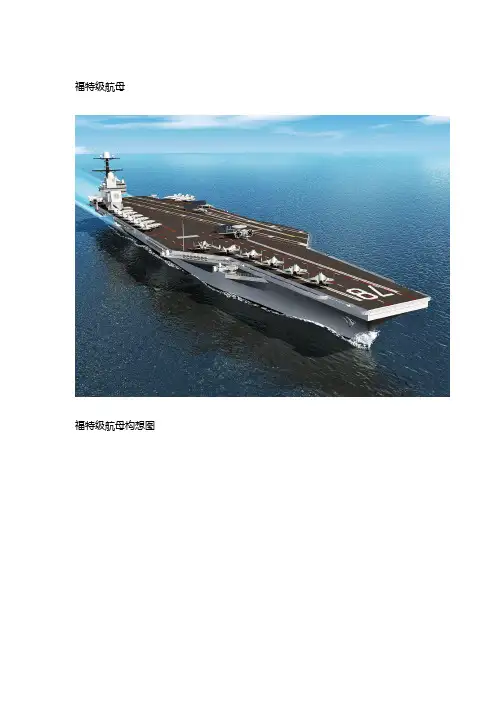
海军福特级航母计划:背景和争议
- 格式:pdf
- 大小:248.78 KB
- 文档页数:24
Navy Ford (CVN-78) Class Aircraft Carrier Program: Background and Issues for Congress Ronald O'RourkeSpecialist in Naval AffairsApril 13, 2010Congressional Research Service7-5700RS20643 CRS Report for CongressSummaryCVN-78, CVN-79, and CVN-80 are the first three ships in the Navy’s new Gerald R. Ford (CVN-78) class of nuclear-powered aircraft carriers (CVNs).CVN-78 was procured in FY2008 and is being funded with congressionally authorized four-year incremental funding in FY2008-FY2011. The Navy’s proposed FY2011 budget estimates the ship’s procurement cost at $11,531.0 million (i.e., about $11.5 billion) in then-year dollars, and requests $1,731.3 million in procurement funding as the final increment to complete this estimated procurement cost.CVN-79 is scheduled for procurement in FY2013, and has received advance procurement funding since FY2007. The Navy’s proposed FY2011 budget estimates the ship’s procurement cost at $10,413.1 million (i.e., about $10.4 billion) in then-year dollars and requests $908.3 million in advance procurement funding for the ship.CVN-80 is scheduled for procurement in FY2018, with advance procurement funding scheduled to begin in FY2014. The Navy’s proposed FY2011 budget estimates the ship’s procurement cost at $13,577.0 million (i.e., about $13.6 billion) in then-year dollars.On April 6, 2009, Secretary of Defense Robert Gates announced a number of recommendations he was making for the FY2010 defense budget. One of these was to shift procurement of carriers to five-year intervals. This recommendation effectively deferred the scheduled procurement of CVN-79 from FY2012 to FY2013, and the scheduled procurement of CVN-80 from FY2016 to FY2018. Secretary of Defense Robert Gates stated on April 6, 2009, that shifting carrier procurement to five-year intervals would put carrier procurement on “a more fiscally sustainable path.”Potential oversight issues for Congress for FY2011 for the CVN-78 program include the following:•Did shifting carrier procurement to five-year intervals put carrier procurement ona more fiscally sustainable path?•Where do the estimated procurement costs of CVNs 78, 79, and 80 stand in relation to the unit procurement cost caps for the CVN-78 program that wereestablished by Section 122 of the FY2007 defense authorization act (H.R.5122/P.L. 109-364 of October 17, 2006)?•What is the likelihood that the estimated procurement costs of CVNs 78, 79, and80 will increase from the estimates shown in the FY2011 budget?ContentsIntroduction (1)Background (2)The Navy’s Aircraft Carrier Force (2)Aircraft Carrier Construction Industrial Base (2)Gerald R. Ford (CVN-78) Class Program (2)CVN-78 (2)CVN-79 (3)CVN-80 (3)Procurement Funding (4)Increase in Estimated Unit Procurement Costs (4)Procurement Cost Cap (6)Issues for Congress (6)Shift to Five-Year Intervals: A More Fiscally Sustainable Path? (6)Estimated Procurement Costs in Relation to Procurement Cost Cap (9)Potential for Additional Growth in Estimated Procurement Costs (9)Legislative Activity for FY2011 (11)TablesTable 1. Procurement Funding for CVNs 78, 79, and 80 (4)Table 2. Estimated Procurement Costs of CVNs 78, 79, and 80 (5)AppendixesAppendix A. Text of Navy Report on Effects of Shifting to Five-Year Intervals (12)Appendix B. July 16, 2009, Hearing on EMALS (16)ContactsAuthor Contact Information (21)IntroductionCVN-78, CVN-79, and CVN-80 are the first three ships in the Navy’s new Gerald R. Ford (CVN-78) class of nuclear-powered aircraft carriers (CVNs).CVN-78 was procured in FY2008 and is being funded with congressionally authorized four-year incremental funding in FY2008-FY2011. The Navy’s proposed FY2011 budget estimates the ship’s procurement cost at $11,531.0 million (i.e., about $11.5 billion) in then-year dollars, and requests $1,731.3 million in procurement funding as the final increment to complete this estimated procurement cost.CVN-79 is scheduled for procurement in FY2013, and has received advance procurement funding since FY2007. The Navy’s proposed FY2011 budget estimates the ship’s procurement cost at $10,413.1 million (i.e., about $10.4 billion) in then-year dollars and requests $908.3 million in advance procurement funding for the ship.CVN-80 is scheduled for procurement in FY2018, with advance procurement funding scheduled to begin in FY2014. The Navy’s proposed FY2011 budget estimates the ship’s procurement cost at $13,577.0 million (i.e., about $13.6 billion) in then-year dollars.On April 6, 2009, Secretary of Defense Robert Gates announced a number of recommendations he was making for the FY2010 defense budget. One of these was to shift procurement of carriers to five-year intervals. This recommendation effectively deferred the scheduled procurement of CVN-79 from FY2012 to FY2013, and the scheduled procurement of CVN-80 from FY2016 to FY2018. Secretary of Defense Robert Gates stated on April 6, 2009, that shifting carrier procurement to five-year intervals would put carrier procurement on “a more fiscally sustainable path.”1Potential oversight issues for Congress for FY2011 for the CVN-78 program include the following:•Did shifting carrier procurement to five-year intervals put carrier procurement ona more fiscally sustainable path?•Where do the estimated procurement costs of CVNs 78, 79, and 80 stand in relation to the unit procurement cost caps for the CVN-78 program that wereestablished by Section 122 of the FY2007 defense authorization act (H.R.5122/P.L. 109-364 of October 17, 2006)?•What is the likelihood that the estimated procurement costs of CVNs 78, 79, and80 will increase from the estimates shown in the FY2011 budget?1 Source: Statement of Secretary of Defense Robert Gates, at April 6, 2009, news conference on his recommendations for the FY2010 defense budget.BackgroundThe Navy’s Aircraft Carrier ForceThe Navy’s aircraft carrier force consists of 11 nuclear-powered ships—the one-of-a-kind Enterprise (CVN-65) and 10 Nimitz-class ships (CVNs 68 through 77). The most recently commissioned carrier, the George H. W. Bush (CVN-77), the final Nimitz-class ship, was procured in FY2001 and commissioned into service on January 10, 2009.2 CVN-77 replaced the Kitty Hawk (CV-63), which was the Navy’s last remaining conventionally powered carrier.3 Aircraft Carrier Construction Industrial BaseAll U.S. aircraft carriers procured since FY1958 have been built by the Newport News, V A, shipyard that forms part of Northrop Grumman Shipbuilding (NGSB). NGSB’s Newport News yard is the only U.S. shipyard that can build large-deck, nuclear-powered aircraft carriers. The aircraft carrier construction industrial base also includes hundreds of subcontractors and suppliers in dozens of states.Gerald R. Ford (CVN-78) Class ProgramThe Gerald R. Ford (CVN-78) class carrier design is the successor to the Nimitz-class carrier design.4 Compared to the Nimitz-class design, the Ford-class design will incorporate several improvements, including an ability to generate substantially more aircraft sorties per day and features permitting the ship to be operated by several hundred fewer sailors than a Nimitz-class ship, significantly reducing life-cycle operating and support costs. Navy plans call for procuring at least three Ford-class carriers—CVN-78, CVN-79, and CVN-80.CVN-78CVN-78, which was named in 2007 for President Gerald R. Ford,5 was procured in FY2008 and is being funded with congressionally authorized four-year incremental funding in FY2008-2 Congress approved $4,053.7 million in FY2001 procurement funding to complete CVN-77’s then-estimated total procurement cost of $4,974.9 million. Section 122 of the FY1998 defense authorization act (H.R. 1119/P.L. 105-85 of November 18, 1997) limited the ship’s procurement cost to $4.6 billion, plus adjustments for inflation and other factors. The Navy testified in 2006 that with these permitted adjustments, the cost cap stood at $5.357 billion. The Navy also testified that CVN-77’s estimated construction cost had increased to $6.057 billion, or $700 million above the adjusted cost cap. Consequently, the Navy in 2006 requested that Congress increase the cost cap to $6.057 billion. Congress approved this request: Section 123 of the FY2007 defense authorization act (H.R. 5122/P.L. 109-364 of October 17, 2006), increased the cost cap for CVN-77 to $6.057 billion.3 The Kitty Hawk was decommissioned on January 31, 2009.4 The CVN-78 class was earlier known as the CVN-21 class, which meant nuclear-powered aircraft carrier for the 21st century.5 Section 1012 of the FY2007 defense authorization act (H.R. 5122/P.L. 109-364 of October 17, 2006) expressed the sense of the Congress that CVN-78 should be named for President Gerald R. Ford. On January 16, 2007, the Navy announced that CVN-78 would be so named. CVN-78 and other carriers built to the same design will consequently be referred to as Ford (CVN-78) class carriers. For further discussion of Navy ship names, see CRS Report RS22478, Navy Ship Names: Background for Congress, by Ronald O’Rourke.FY2011.6 The Navy’s proposed FY2011 budget estimates the ship’s procurement cost at$11,531.0 million (i.e., about $11.5 billion) in then-year dollars, and requests $1,731.3 million in procurement funding as the final increment to complete this estimated procurement cost.CVN-78 is scheduled to enter service as the replacement for Enterprise (CVN-65). The Navy projects that there will be a 33-month period between the scheduled decommissioning of Enterprise in November 2012 and the scheduled commissioning of CVN-78 in September 2015. During this 33-month period, the Navy’s carrier force is to temporarily decline from 11 ships to 10 ships. Since 10 USC 5062(b) requires the Navy to maintain a force of at least 11 operational carriers, the Navy asked Congress for a temporary waiver of 10 USC 5062(b) to accommodate the 33-month period between the scheduled decommissioning of Enterprise and the scheduled commissioning of CVN-78. Section 1023 of the FY2010 defense authorization act (H.R.2647/P.L. 111-84 of October 28, 2009) authorizes the waiver and requires the Secretary of Defense to submit a report on the operational risk of temporarily reducing the size of the carrier force.CVN-79CVN-79 is scheduled for procurement in FY2013, and has received advance procurement funding since FY2007. The Navy’s proposed FY2011 budget estimates the ship’s procurement cost at $10,413.1 million (i.e., about $10.4 billion) in then-year dollars and requests $908.3 million in advance procurement funding for the ship.In the FY2009 budget, CVN-79 was scheduled to be procured in FY2012. On April 6, 2009, Secretary of Defense Robert Gates announced a number of recommendations he was making for the FY2010 defense budget. One of these was to shift procurement of carriers to five-year intervals. Since CVN-78 was procured in FY2008, this recommendation effectively deferred the scheduled procurement of CVN-79 from FY2012 to FY2013. Secretary of Defense Robert Gates stated that shifting carrier procurement to five-year intervals would put carrier procurement on “a more fiscally sustainable path.”7CVN-80CVN-80 is scheduled for procurement in FY2018, with advance procurement funding scheduled to begin in FY2014. The Navy’s proposed FY2011 budget estimates the ship’s procurement cost at $13,577.0 million (i.e., about $13.6 billion) in then-year dollars. Secretary of Defense Gates’ April 2009 recommendation to shift carrier procurement to five-year intervals (see above discussion of CVN-79) effectively deferred the procurement of CVN-80 from FY2016 toFY2018.6 The use of four-year incremental funding is consistent with Section 121 of the FY2007 defense authorization act(H.R. 5122/P.L. 109-364 of October 17, 2006), which granted the Navy the authority to use four-year incremental funding for CVN-78, CVN-79, and CVN-80.7 Source: Statement of Secretary of Defense Robert Gates, at April 6, 2009, news conference on his recommendations for the FY2010 defense budget.Procurement FundingTable 1 shows procurement funding for CVNs 78, 79, and 80. Each ship is being procured with several years of advance procurement funding, followed by four-year incremental procurement funding of the remainder of the ship’s cost. The funding profile for CVN-78, for example, includes advance procurement funding in FY2001-FY2007, followed by four years of incremental procurement funding in FY2008-FY2011.T able 1. Procurement Funding for CVNs 78, 79, and 80(Millions of then-year dollars, rounded to nearest tenth)FY CVN-78 CVN-79 CVN-80 TotalFY01 21.7 0 0 21.7FY02 135.5 0 0 135.5FY03 395.5 0 0 395.5FY04 1,162.9 0 0 1,162.9FY05 623.1 0 0 623.1FY06 618.9 0 0 618.9FY07 735.8 52.8 0 788.6FY08 2,685.0 123.5 0 2,808.5FY09 2,684.6 1,210.6 0 3,895.2FY10 737.0 482.9 0 1,219.9 FY11 (requested) 1,731.3 908.3 0 2,639.6FY12 (projected) 0 494.8 0 494.80 2,418.3 0 2,418.3(projected)FY13(projected) 0 3,158.5 228.1 3,386.6 FY14FY15 (projected) 0 760.7 1,523.8 2,284.5 Source: FY2009, FY2010, and FY2011Navy budget submissions.Note: Figures may not add due to rounding.Increase in Estimated Unit Procurement CostsAs shown in Table 2, the estimated procurement costs of CVNs 78, 79, and 80 in the FY2011 budget submission are 10.3%, 13.3%, and 26.7% higher, respectively, in then-year dollars than those in the FY2009 budget submission.88 The Congressional Budget Office (CBO) in 2008 and the Government Accountability Office (GAO) in 2007 questioned the accuracy of the Navy’s cost estimate for CVN-78. CBO reported in June 2008 that it estimated that CVN-78 would cost $11.2 billion in constant FY2009 dollars, or about $900 million more than the Navy’s estimate of $10.3 billion in constant FY2009 dollars, and that if “CVN-78 experienced cost growth similar to that of other lead ships that the Navy has purchased in the past 10 years, costs could be much higher still.” CBO also reported that, although the Navy publicly expressed confidence in its cost estimate for CVN-78, the Navy had assigned a confidence level of less than 50% to its estimate, meaning that the Navy believed there was more than a 50% chance that the estimate would be exceeded. (Congressional Budget Office, Resource Implications of the Navy’s Fiscal Year 2009 (continued...)T able 2. Estimated Procurement Costs of CVNs 78, 79, and 80(As shown in FY2009, FY2010, and FY2011 budgets, in millions of then-year dollars)Budget CVN-78 CVN-79 CVN-80Estimated procurementcostScheduledfiscal year ofprocurementEstimatedprocurementcostScheduledfiscal year ofprocurementEstimatedprocurementcostScheduledfiscal year ofprocurementFY09budget 10,457.9 FY08 9,191.6 FY12 10,716.8 FY16 FY10 budget 10,845.8 FY08 n/a a FY13b n/a a FY18bFY11budget 11,531.0 FY08 10,413.1 FY13 13,577.0 FY18 %increase:FY09 budgetto FY10 budget3.7 n/a n/aFY10 budget toFY11 budget6.3 n/a n/aFY09 budget toFY11 budget10.3 13.3 26.7Source: FY2009, FY2010, and FY2011Navy budget submissions.a. n/a means not available; the FY2010 budget submission did not show estimated procurement costs forCVNs 79 and 80.b. The FY2010 budget submission did not show scheduled years of procurement for CVNs 79 and 80; thedates shown here for the FY2010 budget submission are inferred from the shift to five-year intervals forprocuring carriers that was announced by Secretary of Defense Gates in his April 6, 2009, news conferenceregarding recommendations for the FY2010 defense budget.The increases in the estimated procurement costs of CVNs 78, 79, and 80 since the FY2009budget submission have at least four potential causes:•one additional year of inflation being incorporated into the cost of CVN-79 as aresult of its scheduled procurement being deferred from FY2012 to FY2013, and(...continued)Shipbuilding Plan, June 9, 2008, p. 20.) GAO reported in August 2007 that:Costs for CVN 78 will likely exceed the budget for several reasons. First, the Navy’s cost estimate,which underpins the budget, is optimistic. For example, the Navy assumes that CVN 78 will bebuilt with fewer labor hours than were needed for the previous two carriers. Second, the Navy’starget cost for ship construction may not be achievable. The shipbuilder’s initial cost estimate forconstruction was 22 percent higher than the Navy’s cost target, which was based on the budget.Although the Navy and the shipbuilder are working on ways to reduce costs, the actual costs tobuild the ship will likely increase above the Navy’s target. Third, the Navy’s ability to manageissues that affect cost suffers from insufficient cost surveillance. Without effective costsurveillance, the Navy will not be able to identify early signs of cost growth and take necessarycorrective action.(Government Accountability Office, Defense Acquisitions[:] Navy Faces Challenges Constructingthe Aircraft Carrier Gerald R. Ford within Budget, GAO-07-866, August 2007, summary page. Seealso Government Accountability Office, Defense Acquisitions[:] Realistic Business Cases Neededto Execute Navy Shipbuilding Programs, Statement of Paul L. Francis, Director, Acquisition andSourcing Management Team, Testimony Before the Subcommittee on Seapower and ExpeditionaryForces, Committee on Armed Services, House of Representatives, July 24, 2007 (GAO-07-943T),p. 15.)two years of additional inflation being incorporated into the cost of CVN-80 as aresult of its scheduled procurement being deferred from FY2016 to FY2018;•increases in projected annual rates of inflation;•higher estimates of real (i.e., inflation-adjusted) material costs, real labor rates, or labor hours (given a certain position on the production learning curve) forbuilding CVN-78 class carriers; and•increased costs due to loss of learning and reduced spreading of fixed overhead costs resulting from shifting to five-year intervals for procuring carriers.Procurement Cost CapSection 122 of the FY2007 defense authorization act (H.R. 5122/P.L. 109-364 of October 17, 2006) established a procurement cost cap for CVN-78 of $10.5 billion, plus adjustments for inflation and other factors, and a procurement cost cap for subsequent Ford-class carriers of $8.1 billion each, plus adjustments for inflation and other factors. The conference report (H.Rept. 109-702 of September 29, 2006) on P.L. 109-364 discusses Section 122 on pages 551-552.Issues for CongressPotential oversight issues for Congress for FY2011 for the CVN-78 program include the following:•Did shifting carrier procurement to five-year intervals put carrier procurement ona more fiscally sustainable path?•Where do the estimated procurement costs of CVNs 78, 79, and 80 stand in relation to the unit procurement cost caps for the CVN-78 program that wereestablished by Section 122 of the FY2007 defense authorization act (H.R.5122/P.L. 109-364 of October 17, 2006)?•What is the likelihood that the estimated procurement cost of CVN-78, CVN-79, or CVN-80 will increase from the estimates shown in the FY2011 budget?Each of these issues is discussed below.Shift to Five-Year Intervals: A More Fiscally Sustainable Path?As mentioned earlier, when Secretary of Defense Gates announced on April 6, 2009, that he was recommending that carrier procurement be shifted to five-year intervals, he stated that this would put carrier procurement on “a more fiscally sustainable path.” This was interpreted as meaning that shifting to five-year intervals (compared to a combination of four- and five-year intervals in previous Navy 30-year shipbuilding plans) would reduce the average amount of funding required each year for procuring carriers.As a simplified notional example, if carriers are assumed to cost $10 billion each, then shifting from a four-year interval to a five-year interval would reduce the average amount of carrier procurement funding needed each year from $2.5 billion to $2.0 billion, a reduction of $500 million per year.This simplified notional example, however, assumes that shifting from four- to five-year intervals does not by itself cause an increase in the procurement cost of the carriers. Increasing the procurement interval could by itself increase the procurement cost of the carriers by causing reduced learning-curve benefits (i.e., loss of learning) from one carrier to the next, and by reducing the spreading of fixed overhead costs at the Newport News shipyard and at supplier firms. An increase in carrier procurement costs due to such effects would offset at least some of the reduction in the average amount of carrier procurement funding needed each year that would result from shifting to five-year intervals.Shifting to five-year intervals for procuring carriers could also increase the costs of other Navy ship programs. NGSB’s Newport News shipyard performs mid-life nuclear refueling complex overhauls (RCOHs) on Nimitz-class carriers, and jointly builds Virginia-class nuclear-powered attack submarines along with another shipyard (General Dynamics’ Electric Boat Division). In addition, vendors that make nuclear-propulsion components for carriers make analogous components for nuclear-powered submarines. A reduced spreading of fixed costs at NGSB’s Newport News yard and at nuclear-propulsion component vendors due to the shift to five-year intervals for carrier procurement might thus also increase costs for Nimitz-class RCOHs and Virginia-class submarines. Increases in costs for these programs would further offset the reduction in the average amount of carrier procurement funding needed each year that would result from shifting to five-year intervals for carrier procurement.Potential key oversight questions for Congress for FY2011 include the following: •How much of the increase since the FY2009 budget submission in the estimated procurement costs of CVNs 78, 79, and 80 (see Table 2) is due to the shift tofive-year intervals for procuring carriers?•How do potential increases in the costs of CVN-78 class aircraft carriers, Nimitz-class RCOHs, and Virginia-class submarines caused by the shift to five-yearintervals for procuring carriers affect the calculation of the net change in averageannual funding requirements that results from shifting carrier procurement tofive-year intervals?A May 2009 Northrop Grumman Shipbuilding statement on the cost impact of shifting to five-year intervals for procuring carriers statesOne element of the announcement by the Secretary of Defense last week was to shift fromfour (4) years to five (5) years between construction start for each new Ford Class carrier.Past Northrop Grumman Shipbuilding experience with carrier new construction has shownthat the optimum time between carrier construction is less than 4 years. This allows the mostefficient flow of the work force from one ship to the next, and facilitates a learning curve forcarriers. Moving to five (5) year intervals between starts will require the shipyard to sub-optimize manning level sequencing and result in added trade training, loss of learning, andadded startup costs.Increasing the time between carrier construction can have a large impact on the supplierbase, driving cost increases of 5-10 percent, or higher in some cases, above normalescalation. Material costs of suppliers who provide similar components to other Navyprograms currently under contract will also experience cost growth. Some equipmentsuppliers can be expected to exit the market as a result of the additional year with theexpense of component requalification being realized.Finally, the decrease in production labor volume on an annual basis, created by the increasein the time interval between carrier construction starts will increase the cost to otherprograms in the yard. This applies to work already under contract, namely Virginia classsubmarines (VCS) Block 2 and Block 3, and CVN 78 predominately; and for future work notyet under contract, namely Carrier RCOH’s, CVN79 and follow-on Ford class carrierconstruction, and later Blocks of VCS. The impact to work already under contract isexpected to be in the range of $100M of cost growth. We also expect cost increases forfuture contracts yet to be priced. Conservative projections of the shipbuilder cost impact toCVN 79 and CVN80 for the one year delay will be on the order of a 9-15 percent costincrease.9A March 2010 Government Accountability Office (GAO) report stated that if carrier procurement were shifted to five-year intervals, “the fabrication start date for CVN 80 will be delayed by 2 years, which will increase the amount of shipyard overhead costs paid under the CVN 79 contract.”10Section 126 of the FY2010 defense authorization act (H.R. 2647/P.L. 111-84 of October 28, 2009) required the Secretary of the Navy to submit a report to the congressional defense committees on the effects of using a five-year interval for the construction of Ford-class aircraft carriers. The conference report (H.Rept. 111-288 of October 7, 2009) on H.R. 2647/P.L. 111-84 stated the following regarding Section 126:The conferees note that a 5-year interval for aircraft carrier construction, as proposed by theSecretary of Defense, may be the appropriate course of action for the Department of theNavy. However, the conferees are concerned that this decision may not have been madefollowing a rigorous cost-benefit analysis. Therefore, the conferees expect that the Secretaryof the Navy will take no further action to preclude the ability of the Secretary to award aconstruction contract for CVN–79 in fiscal year 2012 or the aircraft carrier designated CVN–80 in fiscal year 2016, consistent with the Annual Long-Range Plan for Construction ofNaval Vessels for Fiscal Year 2009, until he completes the required assessment and fullyinforms the congressional defense committees of any such a decision. (Page 680)The Navy submitted the report on March 4, 2010.11 The report states, among other things, that •“It is reasonable to assume that some vendor base inefficiencies, in addition to inflation may occur by increasing CVN build intervals to five years.”•“While a five-year interval between carrier construction starts will result in potential inefficiencies and gaps for specific carrier construction trade skills, theNavy plans to closely manage the transition to 5-year centers to minimize theimpact of this change on training of individuals required to support shipconstruction.”•“The Navy estimated that a four-year build interval would maximize theopportunity to achieve labor efficiencies due to learning. A five-year build9 Northrop Grumman Shipbuilding statement dated May 1, 2009, entitled “NGSB Statement Regarding Extending the Time Interval between New Build Starts For the Ford Class of Aircraft Carriers,” provided to CRS by Northrop Grumman.10 Government Accountability Office, Defense Acquisitions[:] Assessments of Selected Weapon Programs, GAO-10-388SP, March 2010, p. 54.11 This is the date of the cover letters to the congressional recipients. The report itself has a cover date of February 2010.interval reduces this opportunity; however, the overall impact for loss of learningassociated with a shift to five-year centers is manageable through AdvanceProcurement and Advance Construction.”•“The Navy assessed the NIMITZ Class cost returns for shipbuilder labor and material and GFE to determine the correlation between these cost elements andthe number of years between carrier awards. The Navy estimates that impact toBasic Construction is around 1.0% for CVN 79 and CVN 80.”•“The change to five-year build intervals results in an overhead decrease in direct labor workload for aircraft carrier construction, thereby causing the overheadrates to increase proportionately. The Navy estimates the construction portionincrease is less than 1% each for CVN 78, CVN 79 and CVN 80.”•“The impact of changing the interval between carrier awards to the VIRGINIA Class submarine current Block II and Block III contracts is estimated to be $30-50 million per hull.”12The report does not provide an overall dollar calculation of how much of the increase since the FY2009 budget submission in the estimated procurement costs of CVNs 78, 79, and 80 is due to the shift to five-year intervals for procuring carriers. Virginia-class submarines are scheduled to be procured at a rate of two ships per year starting FY2011. If the cost increase of $30 million to $50 million for each Virginia-class boat cited in the Navy’s report holds for Virginia-class boats procured in FY2011 and subsequent years, then the shift to five-year intervals for procuring carriers would increase Virginia-class procurement costs by $60 million to $100 million per year. For the text of the Navy’s report, see Appendix A.Estimated Procurement Costs in Relation to Procurement Cost CapA second potential oversight issue for Congress for the CVN-78 program concerns where the estimated procurement costs of CVNs 78, 79, and 80 as shown in the FY2011 budget stand in relation to the unit procurement cost caps for the CVN-78 program that were established by Section 122 of the FY2007 defense authorization act (H.R. 5122/P.L. 109-364 of October 17, 2006). As mentioned earlier (see “Procurement Cost Cap” in the “Background” section), the cost caps established by Section 122 can be adjusted upward to take into account inflation and other factors.Potential for Additional Growth in Estimated Procurement CostsA third potential oversight issue for Congress for the CVN-78 program concerns the likelihood that the estimated procurement costs of CVNs 78, 79, or 80 will increase from the estimates shown in the FY2011 budget. One possible source of additional cost growth in CVN-78 is new technologies that are being developed for the ship, particularly the electromagnetic aircraft launch system (EMALS)—an electromagnetic (as opposed to the traditional steam-powered) aircraft catapult. Problems in developing EMALS or other technologies could delay the ship’s completion12 Department of the Navy, Report to Congress on Effects of Five-year Build Intervals for Force Class Aircraft Carriers, February 2010, 5 pp. Copy provided to CRS by Navy Office of legislative Affairs on April 8, 2010.。