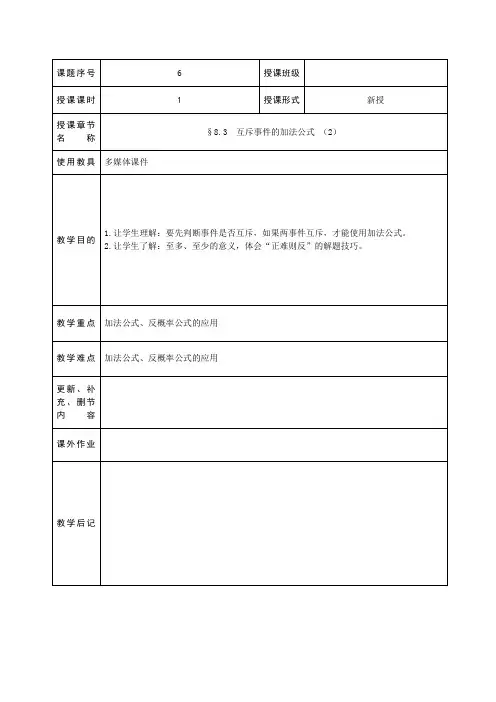
互斥事件的概率加法公式
- 格式:doc
- 大小:15.30 KB
- 文档页数:4
互斥事件的概率加法公式
英文回答:
The Probability Sum Rule for Mutually Exclusive Events.
The probability sum rule for mutually exclusive events
states that if two events, A and B, are mutually exclusive,
then the probability of either A or B occurring is equal to
the sum of the probabilities of A and B occurring. In other
words, if two events cannot occur at the same time, then
the probability of one or the other event occurring is
simply the sum of their individual probabilities.
Mathematically, the probability sum rule for mutually
exclusive events can be expressed as follows:
P(A or B) = P(A) + P(B)。
where:
P(A) is the probability of event A occurring.
P(B) is the probability of event B occurring.
P(A or B) is the probability of either A or B
occurring.
Example.
Suppose you have a bag containing two coins, one red
and one blue. If you draw one coin at random, the
probability of drawing the red coin is 1/2 and the
probability of drawing the blue coin is 1/2. Since the
coins are mutually exclusive (you cannot draw both coins at
the same time), the probability of drawing either the red
or the blue coin is:
P(red or blue) = P(red) + P(blue) = 1/2 + 1/2 = 1。
This means that you are certain to draw either the red
or the blue coin.
中文回答:
互斥事件的概率加法法则。
互斥事件的概率加法法则规定,如果两个事件 A 和 B 是互斥事件,那么 A 或 B 发生的概率等于 A 和 B 发生的概率之和。换句话说,如果两个事件无法同时发生,那么其中一个或另一个事件发生的概率就是它们各自概率的总和。
在数学上,互斥事件的概率加法法则可以表示为:
P(A 或 B) = P(A) + P(B)。
其中:
P(A) 是事件 A 发生的概率。
P(B) 是事件 B 发生的概率。
P(A 或 B) 是事件 A 或 B 发生的概率。
示例。
假设你有一个袋子,里面有两枚硬币,一枚红色一枚蓝色。如果你随机抽取一枚硬币,则抽到红硬币的概率为 1/2,抽到蓝硬币的概率为 1/2。由于硬币是互斥事件(你不可能同时抽到两枚硬币),因此抽到红色或蓝色硬币的概率为:
P(红色或蓝色) = P(红色) + P(蓝色) = 1/2 + 1/2 = 1。
这意味着你肯定能抽到红色或蓝色硬币。