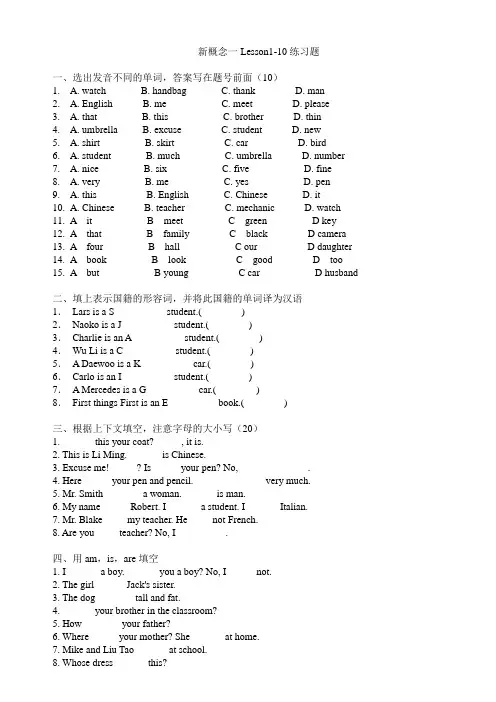
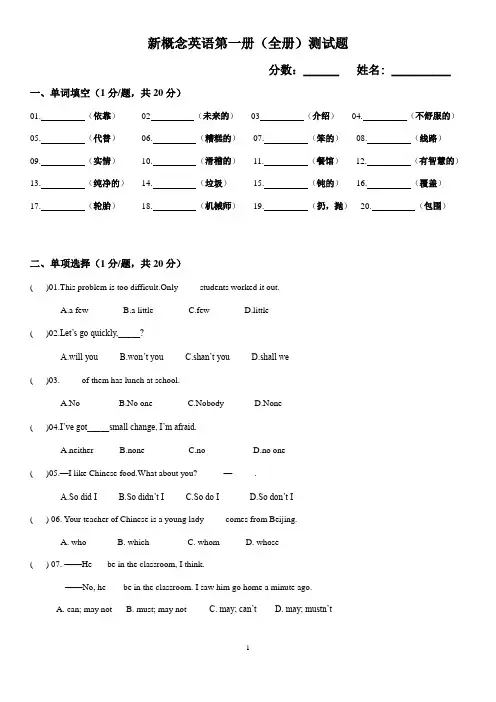
新概念英语第一册测试题
- 格式:docx
- 大小:37.13 KB
- 文档页数:2
新概念英语第一册测试题
Introduction
The New Concept English series, commonly known as the "New
Concept" or "NCE" series, is a popular English language course for non-native speakers. Developed by Louis Alexander, a renowned English
language teacher, the series aims to teach English in an engaging and
practical manner. The first book in the series, "New Concept English 1,"
introduces basic vocabulary, grammar, and language skills to beginners. In
this article, we will explore the testing components of the first book and how
they contribute to the overall learning experience.
1. Reading Comprehension
One of the key components of the testing system in "New Concept
English 1" is the reading comprehension section. The aim of this section is
to assess the students' understanding of the text and their ability to grasp its
main ideas, key details, and inferences. The texts provided in this section
cover a wide range of topics, allowing students to expand their knowledge
while practicing their reading skills in English.
2. Listening Comprehension
In addition to reading comprehension, the "New Concept English 1"
testing system includes a listening comprehension section. This section is
designed to evaluate students' ability to comprehend spoken English.
Various listening exercises are provided, including dialogues,
announcements, and short passages, allowing students to develop their
listening skills and train their ears to understand spoken English effectively. 3. Grammar and Vocabulary
To assess students' understanding of grammar and vocabulary, "New
Concept English 1" incorporates specific testing exercises. These exercises
focus on various aspects of English grammar, such as verb tenses,
prepositions, articles, and sentence structure. Similarly, students encounter
vocabulary-based testing exercises that aim to measure their knowledge and
application of new words introduced throughout the book.
4. Writing
To evaluate students' writing skills, "New Concept English 1" includes
writing tasks in the form of short compositions or essays. These tasks require
students to demonstrate their ability to express ideas, use appropriate
vocabulary and grammar structures, and organize their thoughts coherently.
Writing tasks not only assess students' language skills but also encourage
creativity and critical thinking.
Conclusion
The testing system in "New Concept English 1" plays a crucial role in
assessing students' language proficiency and progress. By incorporating
various components, such as reading comprehension, listening
comprehension, grammar, vocabulary, and writing tasks, the tests provide a
comprehensive evaluation of students' English language skills. Additionally,
the testing materials in "New Concept English 1" are designed to be
engaging and practical, offering students an opportunity to apply what they
have learned in real-life scenarios. This approach ensures that learners not
only achieve academic success but also develop practical language skills that
will benefit them in their daily lives.