新概念英语第二册Lesson19语法
- 格式:docx
- 大小:17.93 KB
- 文档页数:4
新概念英语第二册Lesson19语法
【New words and expressions】
hurry v. 匆忙
in a hurry(n.):匆忙 Cars went past in a hurry to somewhere.
in no hurry(n.):不匆忙 I am in no hurry.
hurry up(v.):快点 Hurry up! We are late.
hurry to:匆匆忙忙地去 They were hurrying to catch their train.
ticket office 售票处
同义词:a ticket booth; a box office
Tickets are available at the box office.
There is a long line at the ticket office
pity n. 令人遗憾的事
What a pity! 真遗憾!
It is a pity.
pity v.
I pity anyone who has to feed a family on such a low income.
I felt sorry for him when he lost his job.
" In everyday English, people usually say that they feel sorry for someone rather than pity them: I feel sorry for his wife.
exclaim v. 大声说
He exclaimed that he was hungry.
return v. 退回
return somewhere:回来
return something to someone 归还;退还
sadly adv. 悲哀地,丧气地
He shook his head sadly.
【课文讲解】
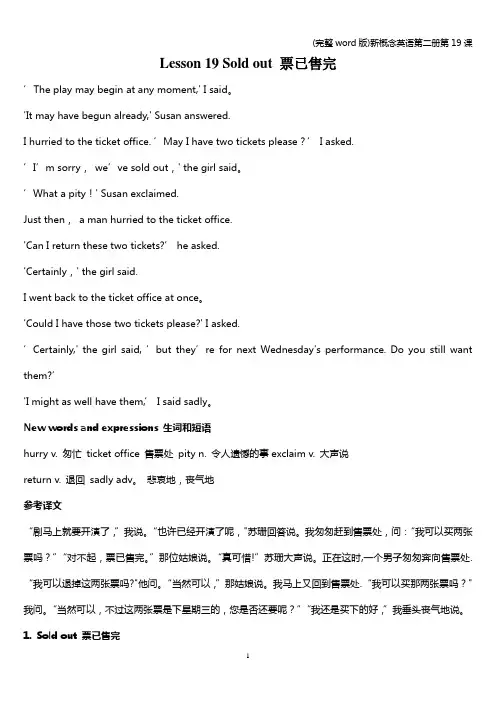
'The play may begin at any moment,' I said.
at any moment 在任何时候, 随时 The guests may arrive at any moment.
It may/might rain (at) any moment.
at the moment =now
at that moment =just then 就在那时
I will help you at any time. 我随时都会帮你
I hurried to the ticket office. 'May I have two tickets please?' I asked.
Can (May) I...? 我……可以吗?(表示"……可以吗?",第一人称可以和can或may相连)
May I have a ticket? (英文中的问句, 常常起礼貌作用)
May I have your name? (比 "What's your name?" 更有礼貌些)
Could I...? 我现在可以...吗?
(在问句中更委婉的说法, 比can I 更礼貌些,但在时间上与can没区别)
Can you...? 你可以...吗? (第二人称不能用may来表示"……可以吗?",只能用can)
have 是最活跃的词, 可以指任何的意思.
have coffee 喝咖啡
have ticket 买票 (习惯用法)
I'll have/take something 我买……(一般不用"buy",用"have"习惯用法)
'I'm sorry, we've sold out,' the girl said.
sell out (店主)售完(某种货物),(货)被售完
Tickets for tonight's performance are sold out.
'Certainly,' the girl said, 'but they're for next Wednesday's performance. Do you still want them?'
for next Wednesday's performance,用名词所有格来取代时间,"……时间的"
用介词for, 起修饰作用
ticket for+事情 ……的票
ticket to+地点 去……的票
May I have a ticket to Shanghai?
May I have a ticket for the 2010 Shanghai World Expo?
'I might as well have them,' I said sadly.
may/might as well+动词原形 还是……好(无可奈何),不妨……
I might as well take the umbrella with me. It's not very far, so we may/might as well go on foot.
had better+动词原形 最好……(积极心态)
【本文重点语法】
原形 过去式 词义 同义词组
can could 能够 be able to
may might 可以;或许 must must 必须;不得不 have / has to
will would 愿意;会 shall should 应该 ought
had
better had better 最好
need needed 需要 dare dared 敢于
基本句型:
肯定句:主语+ can, may, must + 动词原形 ……
否定句:主语+ can, may, must + not + 动词原形 ……
疑问句:Can, May, Must+主语+ 动词原形……
can, could, may, might, must 表推测
当表示对现在及将来状态的推测时,一般用can / could, may / might, must + 动词原形
A: Where's Jackie?
B: It's a fine day. She may / might enjoy sunshine on the lawn.
当表示对现在及将来动作的推测时,一般用can / could, may / might, must + be + doing (动词的进形式)
Dave must be doing his homework now.
当表示对过去状态、动作的推测时, must / may / might 可用在肯定句中表示肯定的推测, 一般用 must / may / might + have done (现在完成时) 表示。
can / could 用在否定句中表示的推测,一般用 can / could + not + have done (现在完成时)表示,can / could 还可以用在疑问句中。
表示轻微的责备或后悔
1)ought to /should + have + done 本来应该做某事(而实际上没做)
2)ought not to /shouldn't + have + done 本来不应该做某事(而实际上却做了)
3)could + have + done 本来能够做某事(而实际上没做) 4)might have + done 本来可以做某事(而实际上没做)
5)needn't + have + done 本来不必做某事(而实际上做了)
十七课:对现在的推测
十九课:对现在和过去的推测不在于must, may, can't是什么时态,而在于后面加的是原形还是have done。 加原形是对现在的推测,加have done对过去的推测