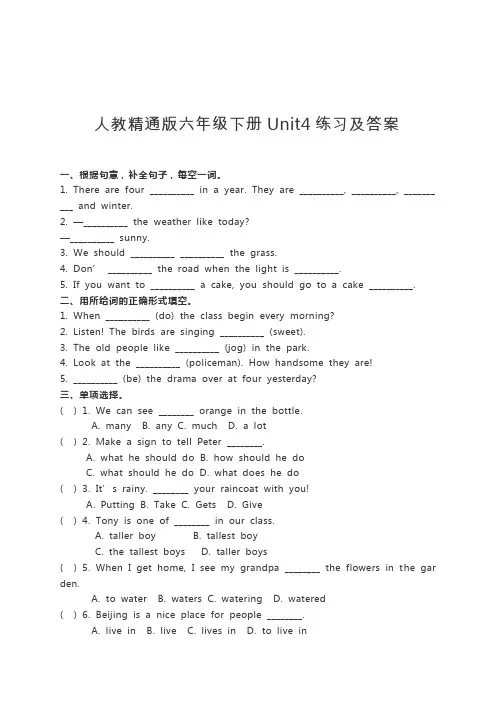
人教精通版小学英语下册六年级四单元知识点
- 格式:doc
- 大小:27.50 KB
- 文档页数:4
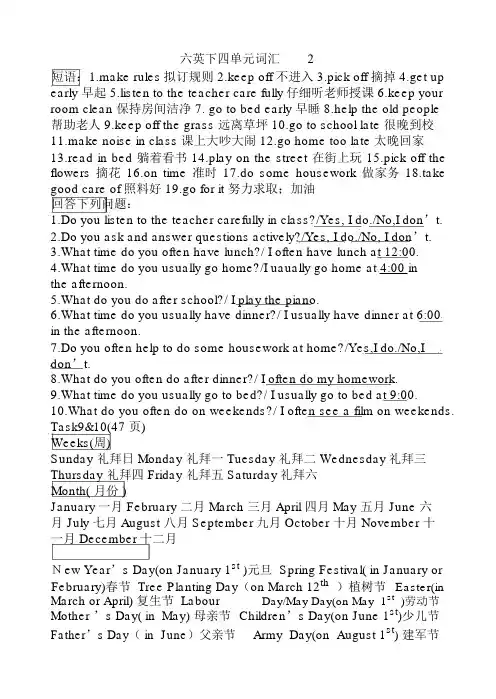
六年下四单元词汇
Task 1&2 单词:1.life生活;生命2.people人们3.family家人4.study学习5.century世纪6.class班级7.grade年级8.begin开始9.over结束10.subject学科11.cinema电影院12.parents.父母亲13.doctor医生14.teacher老师15.farmer家书16.driver司机17.nurse护士18.postman邮递员19.policeman警察20.fireman消防员21.reporter记者22.scientist科学家23.worker工人24.writer作家25.singer歌手26.artist画家27.cook厨师
短语:1.primary school小学2.every morning每天早上3.get up 起床4.have breakfast吃早饭5.go to school去上学6.in the morning在早上7.in the afternoon在下午8.in the evening在晚上9.have lessons上课10.in a week 在一周11.very much非常12.have lunch吃午饭13.at
school在学校14.go home 回家15.do one’s homework做家庭作业16.after school放学后17.have dinner吃晚饭18.watch TV看电视19.play the piano 弹钢琴20.theme park主题公园24.go shopping去购物25.daily life日常生活
日常生活:
1.What’s your name?/My name’s Gao Wei./I’m Wang LIli.
2.How old are you ?/I’m twelve.
3.Whaere are you from?/I’m from China.
4.Which class are you in?/ I’m Class One,Grade Six.
5.What do you do?/ I’m a student.
6. What does your father do?/He’s a doctor.
7. What does your mother do?/ She’s a teacher.
8.How many people are there in your family?Who are they?
There are three people in my family.They are my father,my mother and
I .
9.Which school are you in ? / I study in No.1Primary School.
10.What time do you usually get up in the morning?/I usually get up at
6:00 in the morning.
11.What
time do you usually go to school?/ I usually go to school at
7:30 in the morning.
12.How many subjects do you have? What are they?
We have seven subjects.They are Chinese,maths,English,science,PE,art
and music.
13. How many lessons do you have in a day?/We have six lessons in a
day.
14. How many English lessons do you have in a week?/We are three
lessons in a week.
15.Who is your English teacher?/Mr Wang is our English teacher. 16.Do you like English?/Yes, I do./No, I don’t.
17.What subject do you like best?/I like English best.
18. What time do your classes begin in the morning ?Our classes begin
at 8:00 in the morning.
Task3&4(44页)
单词: 1.China 中国2.English(Britain)英国 3.America(the USA)
美国4. Canada 加拿大5. Australia澳大利亚 6.Japan 日本7.Singapore新加坡 8.Germany 德国9.cool酷的 10. pretty 漂亮的12.age 年纪名字 14.address 地址15.phone电话
16.job工作
短语: 1.speak English 讲英语2.phone number 电话号码3.work
place 办公地点
回答问题:
1. What’s your phone number?/My phone number is 66887799.
2.Where do you live?/ I live at 16 Yongfa village./I live in Wudalianchi
city.
3. What’s your hobby? My hobby is singing./
I like singing./ I’m
interested in singing.
Task 5&6(45页)
场所类词:
1.clothes shop服装店 2.post office邮局 3.supermarket超市 4.
bookshop书店 5. toy shop玩具店 6. cake shop蛋糕店 7.hospital 医院8.restaruant饭店 9. library 图书馆10.hotel 旅馆11.bank 银行12.park公园 13.cinema 电影院14.museum
博物馆15. bus stop 车站16. shopping centre购物中心 17. see a film 看电影munity 社区
方位介词短语:
1.in在…里 2.on 在…上面3.under 在…下面4.behind在…后面 5.
in front of 在...前面6. on the right 在右边7. on the left 在左边8.
across the road马路对面 9.near 在…附近10.beside 在…旁边11.
between.在…之间
Task 7&8(46页)
单词:
1.rule 规则2.keep 保持.3.early 早的4. late晚的 5.noise声音;噪音
6.ask 问7.answer 回答8.question问题 9.actively 积极地10.younger更年轻的
人教精通版小学英语四年级下册Lesson 14教学设计
教学目标:
1. 巩固语言:How many lessons do you have in the afternoon? We have...并引出要学习的目标语言Do you like music? Yes, I do. I like it very much.
2. 运用目标语言在真实的情境中交流,询问课程的多少,讨论有关学科的喜好,创编新的对话;
3. 通过真实的交际,培养学生热爱学习各学科知识的好习惯。
教学重难点:
1. How many ...句型问答;
2. Do you like ...句型的肯定以及否定回答的方式。
教学过程:
一、Warm-up:
1. 互致问候,开始上课;
2. 出示教师的照片,由于是新的老师上课,因此让学生猜一猜有关教师的信息,例如英文名字,年龄,爱好,家庭成员等等;一一回答了学生的提问之后,教师告诉学生今天她是一位记者,一位非常有名的记者,来到学校里面来采访大家。接着介绍自己(记者,有证件,有话筒,有自己所在的电视台CCTV少儿电视台),并展示图片(国内外高校的图片,最好带学生的),采访过很多学校的学生,今天来到这里采访大家,很高兴,问问学生高不高兴,随即进入自由交流环节。注意在这个过程中要渗透Do you like…句型的问答和I like…very
much.
3. Lead-in: 利用上节课句型How many lessons do you have? What are they? How many lessons
do you have in the morning?...进行问答。在这个过程中,教授两个上节课的三会单词,这节课用四会处理:maths& PE,抓住时机问学生下午有几节课,是什么课,板书问句,在学生回答之前直接进课文,让学生看看文章里的孩子下午有几节课,分别是什么,注意提的问题要在板书上,体现任务型教学。(只听前半段)
二、Presentation
1. Watch the video and answer the question: How many lessons do they have in the afternoon?
What are they?
在学生回答这两个问题的时候,再教授两个本节课的新词:music&art,简单操练;
2. 回答学生自己真实的情况:下午有什么课,(可以加入一些生词如科学等等的,贴在副板书部位);
3. 然后将所有的课程单词进行集体游戏操练,如视力表,接龙,Simon says等;
4. 找到一个合适的时机,比如有一个学生在游戏时恰好说到music, 我会及时询问Do you
like music?,一定要和课文问的句型一样,并板书问答,Can you sing a song for us? 教师询问几组学生,说到不喜欢的时候,注意及时将否定回答贴到黑板上,接着进行简单的生生操练(Let’s do a survey. 操练Do you like...? Yes, I do. I like it very much./ No, I don’t. I like...见书29页);在这个过程中追问学生喜欢科目的理由,拓展一些英文词汇,也可以让学生实地表演。然后教师提升本节课的情感目标:We should love all the subjects.
5. 任务型教学,进入对话的后半部分,回答问题之后,让学生观看正片对话的视频,跟读,小组合作并表演。
三、Practice& production
1. 创编新对话并进行表演:教师向学生们发出中央电视台的邀请,邀请小学生们来报名参加 “小小记者”的活动,具体操作:组织学生们将之前活动得到的奖励卡片贴在表格里面,组成自己的“炫彩课程表”,然后两人一组问答,再展示。提供语言支持: