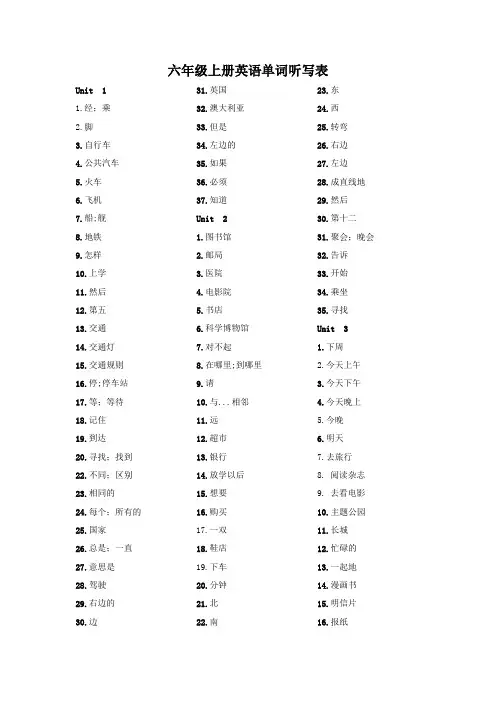
六年级上册英语第六单元听写
- 格式:doc
- 大小:25.62 KB
- 文档页数:5
六年级上册英语第六单元听写练习的重要性与方法
In the sixth unit of the sixth grade English textbook,
the focus is on vocabulary and sentence structure related
to daily life and school activities. The content covers
topics such as school subjects, extracurricular activities,
and daily routines. Mastering this unit is crucial for
students as it prepares them for more complex language
structures and vocabulary in future grades. One of the most
effective ways to reinforce this material is through
dictation exercises.
**The Importance of Dictation in Language Learning**
Dictation, or the process of listening to a word or
phrase and writing it down, is an essential skill in
language learning. It not only helps students improve their
spelling and handwriting skills but also enhances their
listening comprehension. By listening to a word or phrase
and then attempting to write it down, students are forced
to focus on the sound and pronunciation of the language,
which in turn improves their speaking and reading abilities. In the context of the sixth unit, dictation exercises
can be used to test students' knowledge of vocabulary
related to school life. For example, the teacher can read
out a sentence like "I enjoy playing basketball after
school," and the students are required to write down the
correct form of the words "enjoy," "playing," and
"basketball." This activity not only helps students
reinforce their memory of the vocabulary but also teaches
them how to use these words in context.
**Methods for Effective Dictation Practice**
1. **Use a variety of resources:** Teachers can utilize
different audio sources such as textbooks, online resources,
or even their own voices to conduct dictation exercises.
This variety keeps the practice engaging and prevents
students from becoming bored or complacent. 2.
**Incorporate technology:** Modern technology, such as
interactive whiteboards or mobile applications, can be used
to make dictation exercises more interactive and fun. These
tools often include games and quizzes that motivate
students to participate actively. 3. **Progressive
difficulty:** As students progress, teachers can gradually increase the difficulty of the dictation exercises by
introducing longer sentences, more complex vocabulary, or
faster speech rates. This helps students gradually build up
their language skills and prepare them for more challenging
tasks in the future. 4. **Immediate feedback:** Providing
immediate feedback to students during dictation practice is
crucial. This feedback helps students identify their
mistakes and correct them promptly, thus ensuring that they
are learning effectively. 5. **Regular practice:**
Consistent practice is key to improving dictation skills.
Teachers should schedule regular dictation sessions
throughout the semester to ensure that students are
constantly refining their listening and writing abilities.
**Conclusion**
The sixth unit of the sixth grade English textbook
presents a wealth of vocabulary and sentence structures
related to school life and daily routines. By incorporating
dictation exercises into their teaching routine, teachers
can help students master this material and build a solid
foundation for future language learning. By practicing
effectively with a variety of resources, technology, and progressive difficulty, students can improve their
dictation skills and prepare themselves for more advanced
language challenges.
**六年级上册英语第六单元听写练习的重要性与方法**
在六年级英语课本的第六单元中,重点是与日常生活和学校活动相关的词汇和句子结构。内容涵盖了学科、课外活动以及日常例行事务等主题。掌握这一单元对学生来说至关重要,因为它为他们未来更复杂的语言结构和词汇学习打下了基础。巩固这些材料的最有效方式之一是听写练习。
**听写练习在语言学习中的重要性**
听写,即听取单词或短语并将其写下来的过程,是语言学习中的基本技能。它不仅有助于提高学生的拼写和书写技能,而且增强了他们的听力理解能力。通过听取单词或短语并尝试将其写下来,学生被迫专注于语言的发音和读音,这反过来又提高了他们的口语和阅读能力。
在第六单元的语境中,听写练习可用于测试学生对学校生活相关词汇的掌握情况。例如,老师可以读出一个句子,如“我放学后喜欢打篮球”,然后要求学生正确写下“享受”、“玩”和“篮球”等单词的正确形式。这种活动不仅帮助学生巩固词汇记忆,还教会他们如何在上下文中使用这些单词。 **有效的听写练习方法**
1. **利用多种资源:** 教师可以利用不同的音频资源,如教科书、在线资源或他们自己的声音来进行听写练习。这种多样性使练习保持吸引力,并防止学生感到厌烦或自满。 2. **结合技术:** 现代技术,如交互式白板或移动应用程序,可用于使听写练习更具互动性和趣味性。这些工具通常包括游戏和测验,能激励学生积极参与。 3. **难度递增:** 随着学生的进步,教师可以逐渐增加听写练习的难度,通过引入更长的句子、更复杂的词汇或更快的语速来实现。这有助于学生逐步建立语言技能,并为未来的更具挑战性的任务做好准备。 4. **即时反馈:** 在听写练习过程中为学生提供即时反馈至关重要。这种反馈帮助学生识别并立即纠正错误,从而确保他们有效地学习。 5. **定期练习:** 持续的