
topic_thesis
- 格式:ppt
- 大小:48.50 KB
- 文档页数:6
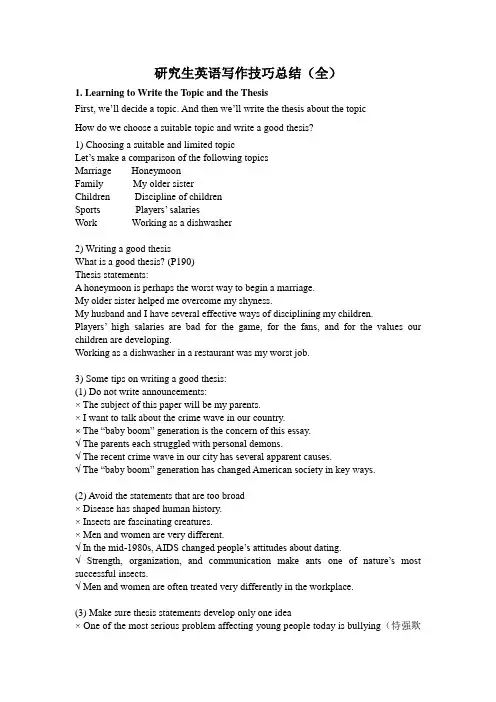
研究生英语写作技巧总结(全)
1. Learning to Write the Topic and the Thesis
First, we’ll decide a topic. And then we’ll write the thesis about the topic
How do we choose a suitable topic and write a good thesis?
1) Choosing a suitable and limited topic
Let’s make a comparison of the following topics
Marriage Honeymoon
Family My older sister
Children Discipline of children
Sports Players’ salaries
Work Working as a dishwasher
2) Writing a good thesis
What is a good thesis? (P190)
Thesis statements:
A honeymoon is perhaps the worst way to begin a marriage.
My older sister helped me overcome my shyness.
My husband and I have several effective ways of disciplining my children.
Players’ high salaries are bad for the game, for the fans, and for the values our
children are developing.
Working as a dishwasher in a restaurant was my worst job.

英语中作文 结构用英语表达
English Answer:
Structure of an Essay.
An essay is a piece of writing in which the author
presents a thesis or argument and provides evidence to
support it. Essays are typically written in a formal style
and are organized into distinct sections.
The first section of an essay is the introduction. The
introduction should provide a brief overview of the topic
and state the thesis statement. The thesis statement is the
main argument of the essay and should be specific and
arguable.
The body of an essay is where the author presents
evidence and develops their argument. The body paragraphs
should each focus on a different aspect of the argument and
provide evidence to support it. The evidence can come from a variety of sources, such as books, articles, personal
experience, or research.

介绍功能英语作文模板
英文回答:
Functional English Essay Structure。
Introduction。
Hook: Begin with a captivating statement, question, or
anecdote that relates to the topic.
Thesis Statement: Clearly state your main argument or
opinion on the topic.
Body Paragraphs。
Topic Sentence: Each body paragraph should begin with
a topic sentence that introduces the main idea of the
paragraph.
Supporting Evidence: Provide specific examples, facts, statistics, or anecdotes to support your thesis.
Analysis: Explain how the evidence supports your main
argument and discuss its implications.
Transition: Conclude each body paragraph by
transitioning to the next paragraph.
Conclusion。
Restatement of Thesis: Briefly restate your main
argument.
Summary of Main Points: Summarize the key points from

Antithesis: A figure of speech which is a contrast of ideas expressed by parallelism of
strongly contrasted words, generally for a tuneful rhythm and wisdom of brevity. It
combines parallelism with contrast so we translate it as “平行对照”. E.g.
The young physician starts life with 20 drugs for each disease, and the old physician
ends life with one drug for 20 diseases. 年轻的医生开始行医时以20种药治一种病,年老的医生结束医业时以一种药治20种病。
A pessimist is one who makes difficulties of his opportunities; an optimist is one who
makes opportunities of his difficulties. 悲观的人把机会变成困难;乐观的人将困难化为机会。
I take thee to my wedded wife, to have and to hold from this day forward, for better or
worse, for richer or poorer, in sickness and in health, to love and cherish, till death do
we part, according to God’s holy ordinance, and thereto I plight thee my troth.