
人教版七年级英语下册Unit2全单元课件
- 格式:pptx
- 大小:26.58 MB
- 文档页数:174

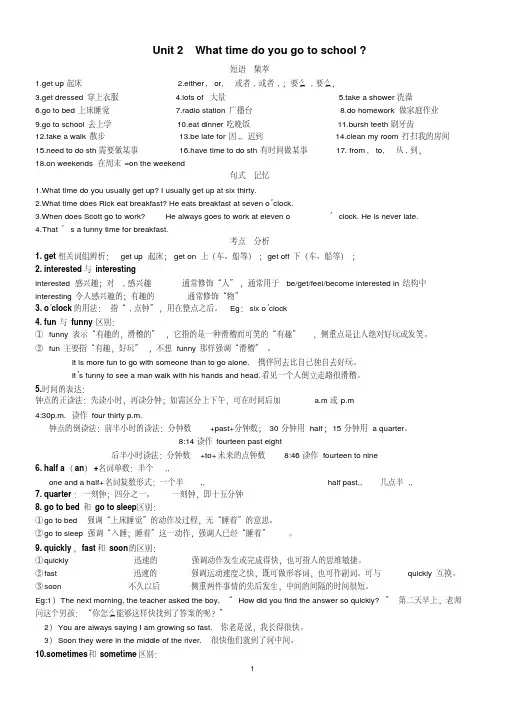
Unit 2 What time do you go to school ?
短语·集萃1.get up起床2.either,or,或者,或者,;要么,要么,3.get dressed 穿上衣服4.lots of 大量5.take a shower洗澡6.go to bed上床睡觉7.radio station广播台8.do homework做家庭作业9.go to school去上学10.eat dinner吃晚饭11.bursh teeth刷牙齿12.take a walk散步13.be late for因,,迟到14.clean my room打扫我的房间15.need to do sth需要做某事16.have time to do sth有时间做某事17. from,to,从,到,18.on weekends 在周末=on the weekend 句式·记忆1.What time do you usually get up? I usually get up at six thirty. 2.What time does Rick eat breakfast? He eats breakfast at seven o’clock. 3.When does Scott go to work? He always goes to work at eleven o’clock. He is never late.4.That’s a funny time for breakfast.考点·分析1. get相关词组辨析:get up 起床;get on 上(车、船等);get off下(车、船等);2. interested与interesting interested 感兴趣;对,感兴趣通常修饰“人”,通常用于be/get/feel/become interested in结构中interesting令人感兴趣的;有趣的通常修饰“物”3. o’clock的用法:指“,点钟”,用在整点之后。Eg:six o’clock 4. fun与funny区别:①funny表示“有趣的,滑稽的”,它指的是一种滑稽而可笑的“有趣”,侧重点是让人绝对好玩或发笑。②fun主要指“有趣,好玩”,不想funny那样强调“滑稽”。It is more fun to go with someone than to go alone. 携伴同去比自己独自去好玩。It’s funny to see a man walk with his hands and head.看见一个人倒立走路很滑稽。5.时间的表达:钟点的正读法:先读小时,再读分钟;如需区分上下午,可在时间后加a.m或p.m 4:30p.m. 读作four thirty p.m. 钟点的倒读法:前半小时的读法:分钟数+past+分钟数;30分钟用half;15分钟用a quarter。8:14读作fourteen past eight 后半小时读法:分钟数+to+未来的点钟数8:46读作fourteen to nine 6. half a(an)+名词单数:半个,,one and a half+名词复数形式:一个半,,half past,,几点半,,7. quarter:一刻钟;四分之一。一刻钟,即十五分钟8. go to bed 和go to sleep区别:①go to bed 强调“上床睡觉”的动作及过程,无“睡着”的意思。②go to sleep 强调“入睡;睡着”这一动作,强调人已经“睡着”。9. quickly,fast和soon的区别:①quickly 迅速的强调动作发生或完成得快,也可指人的思维敏捷。②fast 迅速的强调运动速度之快,既可做形容词,也可作副词。可与quickly互换。③soon 不久以后侧重两件事情的先后发生,中间的间隔的时间很短。Eg:1)The next morning, the teacher asked the boy, “How did you find the answer so quickly?”第二天早上,老师问这个男孩:“你怎么能够这样快找到了答案的呢?”2)You are always saying I am growing so fast. 你老是说,我长得很快。3)Soon they were in the middle of the river. 很快他们就到了河中间。10.sometimes和sometime区别:

一、 用适当的短语填空,补全下面的短文。
Mary usually 1 ____(起床)at six o’clock. She has milk
and bread for breakfast. After breakfast, she 2 ____(洗澡)and then she 3 ______(上学)by bus. She gets to school at a
quarter to eight. She has five classes in the morning. And then he
has lunch at twelve o’clock. In the afternoon she has two classes.
She 4 _____(回家)at half past four. She gets home at 5:00.
She 5 ______(吃晚饭)at about 6:00. After dinner, She 6
____(做作业). She _______(睡觉)at 9:30.
二、 根据句意、首字母或汉语提示,写出正确的单词。
1.Today I want to t_____ a shower.
2. Sally goes to w_____ at seven o’clock every day.
3. What a f______ time to eat fruit after dinner.
4. The soup t______ delicious.
5. Please help the children to get d______; I’m too busy now.
6. They often do morning e________ at school.
7. You can find a good j______ if(如果) you study hard now.
Made of canruohanxing
灿若寒星制作
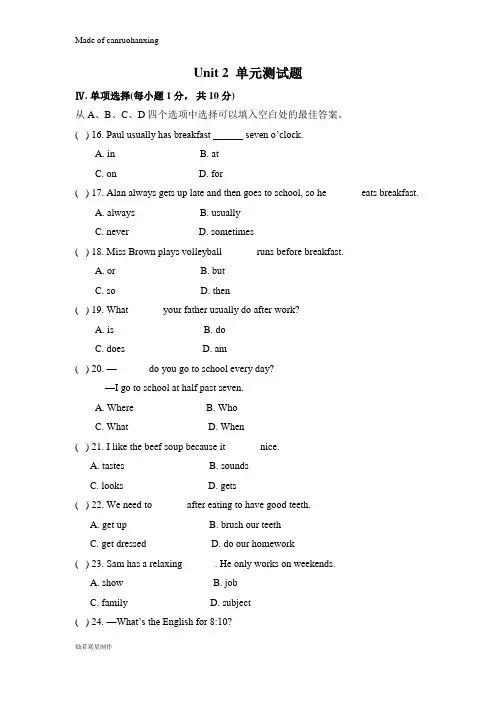
Unit 2 单元测试题
Ⅳ. 单项选择(每小题1分, 共10分)
从A、B、C、D四个选项中选择可以填入空白处的最佳答案。
( ) 16. Paul usually has breakfast ______ seven o’clock.
A. in B. at
C. on D. for
( ) 17. Alan always gets up late and then goes to school, so he ______ eats breakfast.
A. always B. usually
C. never D. sometimes
( ) 18. Miss Brown plays volleyball ______ runs before breakfast.
A. or B. but
C. so D. then
( ) 19. What ______ your father usually do after work?
A. is B. do
C. does D. am
( ) 20. —______ do you go to school every day?
—I go to school at half past seven.
A. Where B. Who
C. What D. When
Made of canruohanxing
灿若寒星制作
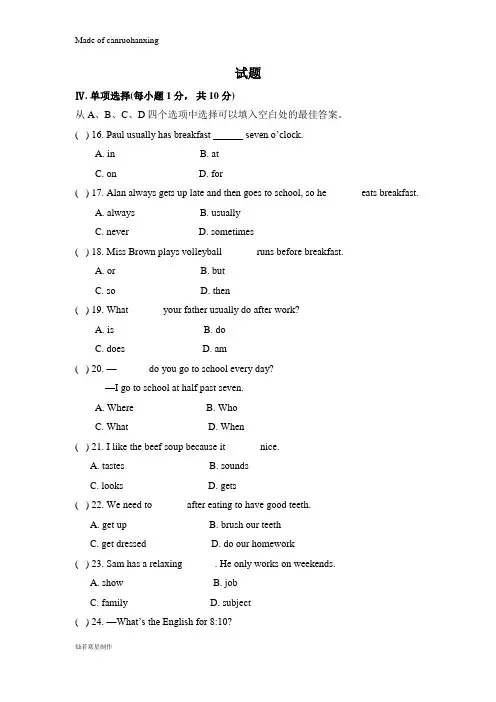
试题
Ⅳ. 单项选择(每小题1分, 共10分)
从A、B、C、D四个选项中选择可以填入空白处的最佳答案。
( ) 16. Paul usually has breakfast ______ seven o’clock.
A. in B. at
C. on D. for
( ) 17. Alan always gets up late and then goes to school, so he ______ eats breakfast.
A. always B. usually
C. never D. sometimes
( ) 18. Miss Brown plays volleyball ______ runs before breakfast.
A. or B. but
C. so D. then
( ) 19. What ______ your father usually do after work?
A. is B. do
C. does D. am
( ) 20. —______ do you go to school every day?
—I go to school at half past seven.
A. Where B. Who
C. What D. When
( ) 21. I like the beef soup because it ______ nice.