
Curriculum Vitea111
- 格式:doc
- 大小:22.50 KB
- 文档页数:2
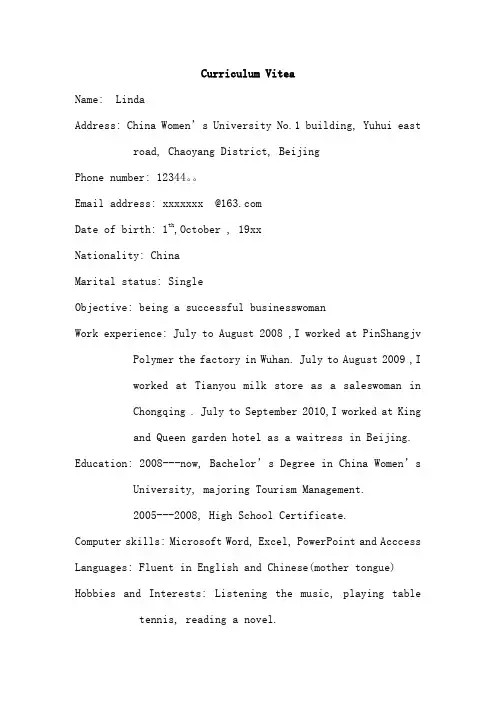

Vita of Jan M. AllbeckSystems Programmer, Center for Human Modeling and SimulationComputer and Information Science DepartmentUniversity of Pennsylvania, Philadelphia, PA 19104-6389215-573-9463; 215-573-7453 (fax); allbeck@Degrees:BA 1995 Mathematics, Bloomsburg University, Bloomsburg, PABS 1995 Computer Science, Bloomsburg University, Bloomsburg, PAMSE 1997 Computer and Information Science, University of Pennsylvania, Philadelphia, PA Ph.D. Candidate Computer and Information Science, University of Pennsylvania (ABD)Employment:All-Byte Consulting, Computer Consultant, 1992-1995University of Pennsylvania, Teaching Assistant, 1996-1997University of Pennsylvania, Systems Programmer, 2001-presentCurrent Responsibilities:•Management of HMS research projects including proposals, reports, software design and deliverables.•Work with HMS Director, Dr. Norman Badler as well as independently to supervise both individual and group projects consisting of both graduate and undergraduate students. •Participate in outreach activities through demonstrations of our immersive VR studio, LiveActor and HMS tours to high school groups, alumni, visiting researchers and teachers, and industry liaisons, as well as, through publications and publicity for HMS, the Digital Media Design program, and the UPenn student SIGGRAPH chapter.•Negotiate with hardware and software vendors and oversee or perform required installations. •Represent HMS at sponsor meetings and research conferences.Brief Research Summary:Research for the Center for Human Modeling and Simulation at the University of Pennsylvania focused on embodied, autonomous agents with individuality, developing behavior-based animation of human movement especially for gesture, gait, and facial expression, constructing a parameterized action representation for real-time simulation and animation, and understanding the relationship between human movement, natural language, and communication.Selected Professional Activities:•Programmer/content designer, ONR Virtual Environments for Training. UPenn, 1996-2001. •Programmer/system designer/project manager, NSF The Actionary: A Dictionary that Portrays Natural Language Expressions as Context-Sensitive Simulations of HumanActions. UPenn, 1999-2001.•Program/system designer, Pedestrians: Creating Agent Behaviors through Statistical Analysis of Observation Data. UPenn, 2000.•Project manager, ACUMEN: Amplifying Control and Understanding of Multiple Entities.UPenn, 2001-2002.•Project manager/programmer, NASA Crew Task Simulation for Maintenance, Training, and Safety. UPenn, 2000-2003.•Project manager/programmer, LMCO Animation test-bed. UPenn, 2002-2004.•Project manager, ONR VIRTE (Virtual Technologies and Environments). UPenn, 2004. •Project manager, NASA RIVET (Rapid Interactive Visualization for Extensible Training).UPenn, 2004.•Reviewer for Computer Graphics International, 2001; SIGGRAPH, 2001; Graphical Models Journal, 2001; Autonomous Agents, 2001; Computer Animation, 2001; Web3D, 2002;Autonomous Agents and Multi-agent Systems, 2002; Computer-Human Interaction, 2003;SIGGRAPH, 2003; Autonomous Agents and Multi-agent Systems, 2003; Intelligent Virtual Agents, 2003; Computer Graphics International, 2004; Autonomous Agents and Multiagent Systems, 2004; Eurographics, 2004; Technologies for Interactive Digital Storytelling and Entertainment, 2004; IEEE Transactions on Visualization and Computer Graphics, 2004•Program committee, Virtual Storytelling 2003, CHI Workshop on Subtle Expressivity for Characters and Robots 2003, AAMAS Workshop on Embodied Conversational Characters as Individuals 2003.Selected Publications:•J. Allbeck and N, Badler. "Embodied Autonomous Agents," In Handbook of Virtual Environments, K. Stanney, Ed., Lawrence Erlbaum Associates, 2002, pp. 313-332.•N. I. Badler and J. M. Allbeck. “Towards Behavioral Consistency in Animated Agents,”Proceedings of Deformable Avatars, Kluwer Academic Publishers, N. Magnenat-Thalmann and D. Thalmann, eds., 2001, pp. 191-205.•J. Allbeck and N. Badler. “Creating Embodied Agents with Cultural Context,” In R. Trappl and S. Payr (Eds.), Agent culture: Designing virtual characters for a multi-cultural world.New York: Lawrence Erlbaum Associates, 2004, pp. 107-126 .•N. Badler, J. Allbeck, L. Zhao, and M. Byun. “Representing and Parameterizing Agent Behaviors”, Proceedings of Computer Animation, IEEE Computer Society, June 2002,Geneva, Switzerland, pp. 133-143.•J. Allbeck and N. Badler. “Toward Representing Agent Behaviors Modified by Personality and Emotion”, "Workshop Embodied conversational agents - let's specify and evaluate them!" at Autonomous Agents and Multiagent Systems 2002, Bologna, Italy.Other Publications:•J. Allbeck and N. Badler. “Representing and Parameterizing Agent Behaviors”. In "Life-like Characters: Tools, Affective Functions and Applications." Helmut Prendinger and Mitsuru Ishizuka, Eds. Springer, Germany, 2003, pp. 19-38 .•R. Bindiganavale. W. Schuler, J. Allbeck, N. Badler, A. Joshi, and M. Palmer. “Dynamically Altering Agent Behaviors Using Natural Language Instructions”. Proceedings ofAutonomous Agents 2000, pp. 293-300.•K. Ashida, S.J. Lee, J. Allbeck, H. Sun, N. Badler, and D. Metaxas. “Pedestrians: Creating Agent Behaviors through Statistical Analysis of Observation Data.” Proceedings of Computer Animation 2001, pp. 84-92.•N. Badler, R. Bindiganavale, J. Allbeck, W. Schuler, L. Zhao, M. Palmer. “Parameterized Action Representation for virtual human agents,” In J. Cassell, J. Sullivan, S. Prevost, and E.Churchill (eds.), Embodied Conversational Agents, MIT Press, 2000, pp. 256-284.•J. Allbeck, K. Kipper, C. Adams, W. Schuler, E. Zoubanova, N. Badler, M. Palmer, and A.Joshi. ACUMEN: Amplifying Control and Understanding of Multiple ENtities, Proceedings of Autonomous Agents and Multi-Agent Systems, ACM Press, July 2002, Bologna, Italy, pp.191-198。

访问学者curriculumvitae模板Curriculum VitaeNameAddress (home) Address (university)Phone number (normally a landline) Phonenumber (normally a landline)E-mail address (make sure this is still in use after PhD completion) Research interestsInclude a briefsummary of your interests. Cover past, current and future research plans.Ideally, this should be targeted to the institution –consider whether they arelooking to broaden departmental research experience or build a specialistreputation.EducationPhDThesis title.A brief summary ofyour thesis, lasting one or two sentences.Name of institution and dates.Name of PhD supervisor.Masters degree (if applicable) and/or first degreeDates, name of institution, degree title and classification.Brief details ofsubjects (optional).A brief summary ofyour dissertation.SchoolDates, name ofschool.Brief details ofA-levels/Higher.Conference papersTitles and dates.Try to include details of highly regarded events. Include and highlight presentationsdelivered or involvement in organizing conferences.PublicationsThe format can be organizedin a variety of ways, for example, by research area –a useful way to highlightinterests and publications in major journals –or chronologically.For details of allpublications, research and articles, normal bibliographic rules apply.Publicationsinvolving collaboration with influential academicsand/or published in majorpeer review journals are very useful to the application process. Distinguishbetween work published,submitted/accepted or under review.Administrative experienceIt is useful toinclude responsibilities within the department for specific lecture courses,degree schemes or groups of students, and any involvement in admissions (forexample open days), producing universityprospectuses, etc. Be specific aboutyour role in examining, tutorial work and exam invigilation, etc.Teaching(Optional –relevant only to those seeking lecturing positions or applying to teaching-led institutions.)It can be usefulto subdivide teaching into seminar and lecture experience and provide brief details.Other subheadings, such as tutorial and supervisory experience, can also beincluded.Additional relevant (research) experiencePresent relevantresearch projects, industrial experience or related practical experiencecoherently formaximum impact (for example, workshopchair/plenary experience).Work experienceDates, job title,name of organization.Briefly describeduties, skills gained and, if appropriate, achievements (bullet points workwell). Information contained here could alternatively be covered in theadministrative section. Academics are normally more interested in your relevantacademic experience, as opposed to student jobs.Professional membershipDetails of body,dates and responsibilities.Prizes and awardsA good indicatorof your potential. Keep relevant and current.Other relevant qualificationsNormallycertificated skills, for example, IT competency, languages, etc.Personal interests/hobbies(Optional –viewsdiffer. Some academic departments like to see it included, others have no preference.)RefereesProvide the name,academic relationship and contact details of three referees. It is usual foryour dissertation or PhD supervisor to be included. Carefully consider theothers –can they comment on a particular aspect of your research interests oryour teaching experience (for example, PhD external examiner or a co-author)?It is often useful to have referees from different institutions. Keep yourreferees informed about what you are applying for and give them a copy of yourCV.Signature:。


cv测试的原理CV(Curriculum Vitae)测试是一种常见的面试环节,用于评估应聘者的能力、经验和个人素质。
CV测试的原理是通过评估应聘者提交的简历中的信息,从而了解他们的教育背景、工作经历、技能和成就。
以下将详细介绍CV测试的原理及其应用。
一、1. 整体评估:CV测试首先会对应聘者的整体简历进行评估,考察其教育背景、工作经历和个人技能等方面的信息。
通过对这些信息的综合分析,可以初步筛选出具备相关要求的应聘者。
2. 详细分析:CV测试还会对简历中的详细信息进行逐一分析,包括应聘者的职责描述、项目经验、技能专长和个人成就等。
通过这些细节,招聘方可以更加全面地了解应聘者,并判断其与职位的匹配度。
3. 正确性验证:CV测试不仅要评估简历的内容,还会对其的真实性进行验证。
通过核对应聘者提供的相关证明和联系形式,确定其简历信息的真实性和准确性。
这有助于排除虚假信息和背景的可能。
4. 参考检查:CV测试还会进行对应聘者的推荐人和以前的雇主的参考检查。
通过联系推荐人,了解应聘者的工作表现和个人品质,进一步确认其适应能力和可信度。
二、CV测试的应用1. 筛选应聘者:CV测试可用作招聘初筛的工具,帮助企业减少面试时间和成本。
通过对候选人简历的综合分析,招聘方可以更准确地挑选出具备相关背景和技能的候选人,使面试更加高效。
2. 评估能力:CV测试可以评估应聘者的能力水平和经验。
通过分析其在过去的教育背景和工作经历中所获得的成就和技能,可以初步判断其能否胜任所应聘的职位。
3. 了解个人素质:CV测试也可以帮助招聘方了解应聘者的个人素质,包括沟通能力、领导能力、团队合作精神和应变能力等。
通过细致评估其简历中所描述的项目经验和个人成就,可以初步揭示其潜在的素质和能力。
4. 确认真实性:CV测试中的信息验证、参考检查等环节,能够帮助招聘方确认应聘者简历的真实性。
这有助于排除虚假信息和背景造假的可能,保证招聘流程的公正性和可靠性。