语法中的连词用法总结
- 格式:docx
- 大小:37.49 KB
- 文档页数:3
语法中的连词用法总结
引言:
语法中的连词是连接句子、短语或单词的重要工具,它们在句子结构和意义的表达上起着关键作用。在本文中,将对常见的连词用法进行总结和解释,帮助读者更好地理解和运用连词。
一、并列连词(Coordinating Conjunctions)
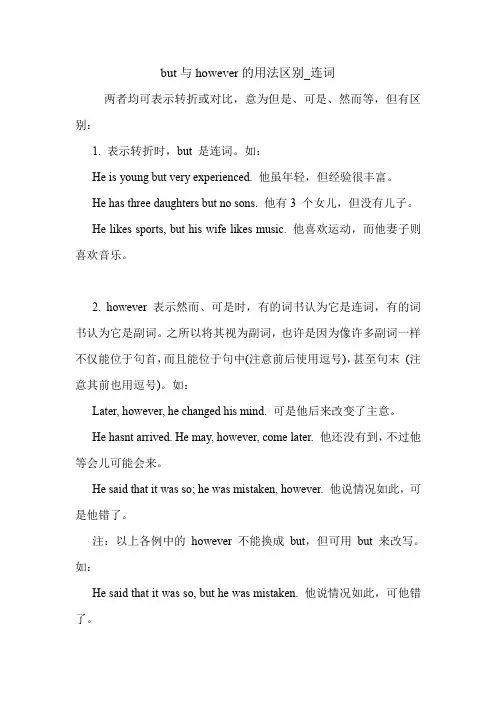
并列连词用于连接并列的句子、短语或单词,常见的并列连词有"and"、"but"、"or"、"for"、"so"等。它们的用法如下:
1. "and":表示并列、且的关系,如"I like coffee and tea."(我喜欢咖啡和茶。)
2. "but":表示转折、但是的关系,如"She is smart, but he is lazy."(她很聪明,但他很懒。)
3. "or":表示选择、或者的关系,如"Do you want coffee or tea?"(你想要咖啡还是茶?)
4. "for":表示原因、因为的关系,如"He couldn't come, for he was
busy."(他不能来,因为他很忙。)
5. "so":表示结果、所以的关系,如"I studied hard, so I passed the
exam."(我努力学习,所以我通过考试。)
二、从属连词(Subordinating Conjunctions) 从属连词用于连接主句和从句,从属连词的选择取决于从句的类型和意义。常见的从属连词有"because"、"although"、"if"、"when"、"while"等。以下是一些常见的从属连词及其用法:
1. "because":表示原因,如"He didn't go to work because he was
sick."(他没上班,因为他生病了。)
2. "although":表示转折,如"She won the game, although she was
injured."(她受伤了,但她还是赢得了比赛。)
3. "if":表示条件,如"If it rains, we will stay at home."(如果下雨,我们会待在家里。)
4. "when":表示时间,如"I will call you when I arrive."(我到了的时候会给你打电话。)
5. "while":表示对比或对立,如"He is reading, while she is watching
TV."(他在读书,而她在看电视。)
三、连接副词(Correlative Conjunctions)
连接副词用于连接相同类型的词、短语或从句,常见的连接副词包括"both...and"、"either...or"、"neither...nor"、"not only...but also"等。以下是一些常见的连接副词及其用法:
1. "both...and":表示两者都,如"She is both intelligent and beautiful."(她既聪明又漂亮。) 2. "either...or":表示二者择一,如"You can either come with us or
stay at home."(你可以要么和我们一起去,要么待在家里。)
3. "neither...nor":表示两者都不,如"Neither Tom nor Jerry came to
the party."(汤姆和杰瑞都没来参加派对。)
4. "not only...but also":表示不仅...而且,如"She is not only
intelligent but also kind."(她不仅聪明而且善良。)
结论:
连词在语法中起着重要的连接作用,它们使句子结构更清晰、语义更准确。通过掌握并正确运用并列连词、从属连词和连接副词的用法,我们可以改进句子的表达,使其更具说服力和逻辑性。在英语学习中,熟悉并正确使用连词是提高语言表达能力的关键一环。