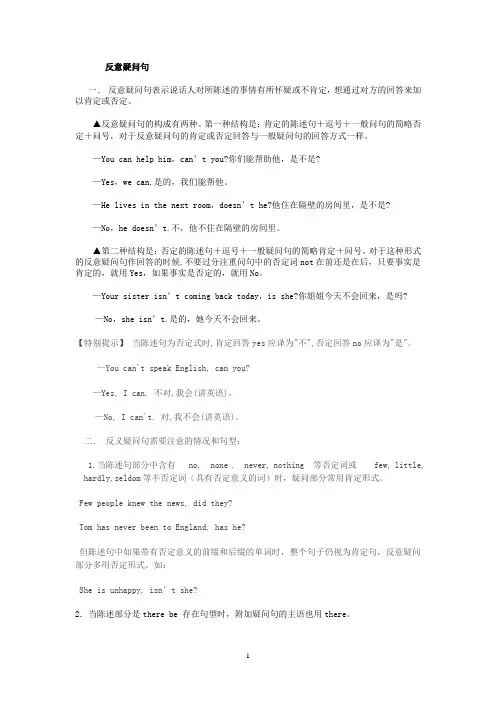
反义疑问句
- 格式:doc
- 大小:34.54 KB
- 文档页数:5
反义疑问句:表示提问人的看法,没有把握,需要对方证实。
反意疑问句由两部分组成:前一部分是一个陈述句,后一部分是一个简短的疑问句,两部分的人称时态应保持一致。
1. 陈述部分肯定式+疑问部分否定式可记为前肯后否。
2. 陈述部分否定式+疑问部分肯定式可记为前否后肯。
例如:This pencil is red, isn’t it? Yes, it is. / No, it isn’t.This pencil isn’t red, is it? Yes, it is. / No, it isn’t.速记:前肯后否,前否后肯,前be后be,前无be后加助,时态一致。
反意疑问句的回答:前肯后否,前否后肯,根据事实从后往前翻译。
如:(1)They work hard,don’t they?他们努力工作,不是吗?Yes, they do.对,他们工作努力。
/No, they don't.不,他们工作不努力(2)They don’t work hard, do they? 他们不太努力工作,是吗?Yes, they do. 不,他们工作努力。
/No, they don't. 是的,他们工作不努力否定反义疑问句的回答当陈述部分为肯定式,反义疑问句为否定式时,其回答一般不会造成困难,一般只需照情况回答即可:"It’s new, isn’t it?" "Yes, it is." “是新的,不是吗?”“是,是新的。
”"He wants to go, doesn’t he?" "No, he doesn’t." “他想去,不是吗?”“不,他不想去。
”此时,"Yes"即是,对前面"It's new."的肯定。
回答反义疑问句的原则回答反意疑问句通常应根据实际情况来确定,如有人问你You are asleep, aren’t you? 你应回答No, I’m not. 因为既然你能回答,肯定你还没有asleep。
但如果别人问你You aren’t asleep, are you?(你还没有睡着,对吗),你也只能回答No, I’m not.(是的,还没有睡着),而不能回答为Yes, I’m not. 也不能回答成Yes, I am.“It is a beautiful flower,isn't it?”“It isn't a beautiful flower,is it?”上述两句句子的回答肯定均为“Yes,it is."否定为“No,it isn't."由上述例子可知,反义疑问句回答与句子本身所包含的中文肯定与否的含义并无太大关联,只需注意事实,肯定即用yes,否定用no,无需考虑句子原本是前否后肯或是前肯后否。
口诀:反意疑问并不难,陈述疑问句中含。
前后肯否恰相反,否定词缀不能算。
主谓时态要一致,特殊情况记心田。
实际情况来回答,再把yes和no拣。
综上所述,反义疑问句回答就是按实际情况回答。
对反意疑问句的回答,无论问题的提法如何,如果事实是肯定的,就用yes,事实是否定的,就要用no。
要特别注意陈述句部分是否定结构,反意疑问句部分用肯定式提问时,回答yes或no与汉语正好相反。
这种省略回答的yes要译成“不”,no要译成“是”。
例:—He likes playing football, doesn’t he? 他喜欢踢足球,不是吗?—Yes, he does. / No, he doesn’t. 是的。
/ 不是。
—His sister didn’t attend the meeting, did she? 他妹妹没有参加会议,是吗?—Yes, she did. / No, she didn’t. 不,她参加了。
/ 是的,她没参加。
快速记忆表:陈述部分的谓语疑问部分I/主语aren't I / are Ino,nothing,nobody,never,few, seldom, hardly,rarely, little等否定含义的词肯定含义含有un-,in-.dis-,im-等否定意义的前缀构成的词语时,视为肯定含义否定含义ought to(肯定的)shouldn't/ oughtn't +主语have to+v.(had to+v.) don't +主语(didn't +主语)used to+v. didn't +主语或usedn't +主语had better + v. hadn't youwould rather + v. wouldn't +主语you'd like to + v. wouldn't +主语must 根据实际情况而定感叹句be +主语指示代词或不定代词everything,that,nothing,this 主语用it并列复合句谓语根据邻近从句的谓语而定定语从句,宾语从句主从复合句根据主句的谓语而定think,believe,expect,suppose,imagine等引导与宾语从句相对应的从句everybody,anyone,somebody,nobody,no one 复数they, 单数he情态动词dare或need need/needn't (dare/daren't ) +主语dare, need 为实义动词do/don't +主语省去主语的祈使句will/won't you?Let's 开头的祈使句Shall we?Let us 开头的祈使句Will you?there be 相应的谓语动词+there(省略主语代词)否定前缀不能视为否定词仍用否定形式.反意疑问句19条:1) 陈述部分的主语是I,疑问部分要用aren't I.I'm as tall as your sister,aren't I?2) 陈述部分的谓语是wish,疑问部分要用may +主语。
I wish to have a word with you, may I?3) 陈述部分用no, nothing, nobody, never, few, seldom, hardly, rarely, little等否定含义的词时,疑问部分用肯定含义。
The Swede made no answer, did he / she?Some plants never blown (开花), do they ?4) 含有ought to 的反意疑问句,陈述部分是肯定的,疑问部分用shouldn't / oughtn't +主语。
He ought to know what to do, oughtn't he? / shouldn't he?5) 陈述部分有have to +v. (had to + v.),疑问部分常用don't +主语(didn't +主语)。
We have to get there at eight tomorrow, don't we?6) 陈述部分的谓语是used to 时,疑问部分用didn't +主语或usedn't +主语。
He used to take pictures there, didn't he? / usedn't he?7) 陈述部分有had better + v. 疑问句部分用hadn't you?You'd better read it by yourself, hadn't you?8) 陈述部分有would rather +v.,疑问部分多用wouldn't +主语。
He would rather read it ten times than recite it, wouldn't he?9) 陈述部分有You'd like to +v. 疑问部分用wouldn't +主语。
You'd like to go with me, wouldn't you?10) 陈述部分有must 的疑问句,疑问部分根据实际情况而定。
He must be a doctor, isn't he?You must have studied English for three years, haven't you? / didn't you?He must have finished it yesterday, didn't he?11) 感叹句中,疑问部分用用否定的助动词加sb/sth?如:1)What a fine day it is today!What a fine day it is today,isn“t it?2)How fast he runs!How fast he runs,doesn”t he?3)What a long time we have been waiting!What a long time we have been waiting ,haven“t we?12) 陈述部分由neither…nor, either…or 连接的并列主语时,疑问部分根据其实际逻辑意义而定。
Neither you nor I am engineer, are we?13) 陈述部分主语是指示代词或不定代词everything, that, nothing, this, 疑问部分主语用it。
Everything is ready, isn't it?14)陈述部分为主语从句或并列复合句,疑问部分有三种情况:a. 并列复合句疑问部分,谓语动词根据邻近从句的谓语而定。
Mr. Smith had been to Beijing for several times, he should have been in China now, shouldn't he?b. 带有定语从句,宾语从句的主从复合句,疑问部分谓语根据主句的谓语而定:He is not the man who gave us a talk, is he?He said he wanted to visit Japan, didn't he?c. 上述部分主句谓语是think, believe, expect, suppose, imagine等引导的定语从句,疑问部分与宾语从句相对应构成反意疑问句。