
bill gates career
- 格式:ppt
- 大小:1.93 MB
- 文档页数:12
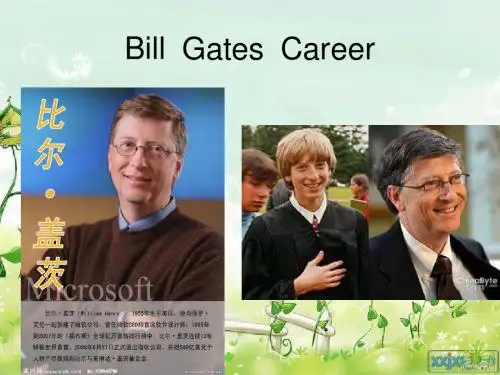

比尔盖茨的个人资料及简介英文_Bill Gatesprofile and profile 2篇导读:关于”比尔盖茨的个人资料及简介“的英语作文范文2篇,作文题目:Bill Gates profile and profile。
以下是关于比尔盖茨的个人资料及简介的小学英语范文,每篇作文均为万能范文带翻译。
关于”比尔盖茨的个人资料及简介“的英语作文范文2篇,作文题目:Bill Gates profile and profile。
以下是关于比尔盖茨的个人资料及简介的小学英语范文,每篇作文均为万能范文带翻译。
高分英语作文1:Bill Gates profile and profileWilliam Henry Gates III, KBE 3. Bill Gates, commonly known as Bill Gates in October, is a famous American entrepreneur, investor, software engineer and philanthropist. He founded Microsoft together with Paul Allen.He is the chairman, chief executive officer and chief software designer of Microsoft. He owns more common stock than the company. Bill Gates has been ranked as the richest person in the world for several consecutive years on the Forbes Global list of billionaires He left Microsoft in June and donated $100 million of personal property to bill.The Melinda Gates Foundation named Bill Gates the richest person in the United States by Forbes magazine. In January this year, gates, the CEO with a fortune of $100 million, resigned as CEO of Microsoft. He remained as chairman and created a new position for himself in June, The chief softwarearchitect.Gates announced that he would change his full-time job to a part-time job at Microsoft, and gradually change his duty to resign as chairman of Microsoft. In February this year, Microsoft continued to serve as a technical consultant to assist the new CEO, Satia NADELLA in, to be elected kbewilliam Henry Gates III -Bill gateochief, a foreign academician of the Chinese Academy of Engineering in November.中文翻译:威廉·亨利·盖茨三世,KBE(英文:William Henry Gates III,xx 月俗称比尔·盖茨),是著名的企业家、投资者、软件工程师、慈善家,他与保罗·艾伦一起创立了微软,他是微软的董事长、首席执行官和首席软件设计师,他拥有超过公司的普通股比尔·盖茨是福布斯全球亿万富翁排行榜上连续几年蝉联全球最富有的亿万富翁,他于xx月离开微软,并向比尔捐赠了亿美元的个人财产,梅琳达·盖茨基金会《福布斯》杂志将比尔盖茨评为最富有的人今年xx月,身家亿美元的首席执行官盖茨辞去了微软首席执行官的职务,他仍然担任董事长,并在xx月为自己创造了一个新的职位,即首席软件架构师。
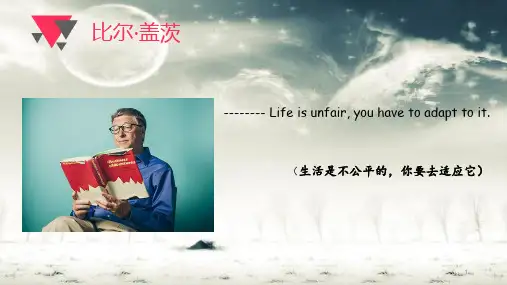

Bill Gates: A Life Dedicated to InnovationWilliam Henry "Bill" Gates III (born October 28, 1955) is an American business magnate, software developer, investor, author, and philanthropist. He co-founded Microsoft Corporation with Paul Allen in 1975. Through his technological innovation, business acumen, and strategic thinking, he has become one of the wealthiest individuals in modern history.Gates' passion for computers began at a young age. As a teenager, he spent countless hours programming on mainframe computers. After dropping out of Harvard University in 1975, he teamed up with childhood friend Paul Allen to start Microsoft. The company revolutionized the personal computer industry with its operating system MS-DOS, which became the standard operating system for IBM-compatible PCs.Under Gates' leadership, Microsoft continued to grow and innovate. In 1985, they released Windows 1.0, a graphical user interface that made computers more accessible to the average person. Over time, Windows became the most widely used operating system in the world.In addition to his work at Microsoft, Gates has also been known for his philanthropic endeavors. In 2000, he and his wife Melinda established the Bill & Melinda Gates Foundation, which focuses on improving global health and reducing poverty. The foundation has donated billions of dollars towards initiatives such as eradicating polio, providing vaccines for children in developing countries, and improving access to education.Gates has received numerous accolades throughout his career, including being named Time Magazine's Person of the Year in 1995 and Forbes' Richest Man in the World multiple times. He has written several books, including "The Road Ahead," which explores the future of technology and its impact on society.Today, Bill Gates continues to be a leading voice in the tech industry, advocating for issues such as climate change and education reform. His legacy as a visionary leader and dedicated humanitarian will undoubtedly inspire generations to come.。

关于比尔盖茨自学成才的英语作文全文共3篇示例,供读者参考篇1How Bill Gates Became a Self-Made ManIt's hard to imagine a world without Microsoft and itsco-founder Bill Gates. From the operation systems that most computers run on to the Microsoft Office suite of software that people use for work every day, Gates and his company have fundamentally shaped how we use technology in the modern era. But what's even more remarkable than his business success is how Gates was able to achieve so much without a college degree through self-directed learning and an incredible amount of drive and passion.Gates was born in 1955 in Seattle into a family with a strong tradition of entrepreneurship and civic engagement on both sides. His father William was a prominent lawyer while his mother Mary was a schoolteacher and chairwoman at several corporate giants like First Interstate BancSystem. Growing up, Gates showed an early aptitude and enthusiasm for math,science, and machines that his parents enthusiastically encouraged and nurtured.The formative experience of Gates's childhood occurred when he was just 13 years old. That year, his school formed one of the first computer clubs in the country and installed a terminal connected to a massive timesharing computer. Gates quickly became obsessed with programming, spending hours at a time writing code and learning everything he could about the emerging field of computer science. Over the next few years, Gates continued to voraciously read books and manuals about software and operating systems, even before taking a formal computer science class in high school.When it came time to apply to colleges, Gates set his sights on Stanford, enamored with the university's reputation and location in the heart of Silicon Valley. But he never made it to the West Coast. After scoring a near-perfect 1590 out of 1600 on the SAT, Gates ended up attending Harvard, arriving on campus in the fall of 1973. However, his academic career was short-lived as his passion for computers and entrepreneurship ultimately led him to drop out after just two years.While at Harvard, Gates's coding hobby started turning into a viable business. He began developing software for the firstmicrocomputers that were just starting to enter homes and small businesses. In 1975, Gates got his big break when he was hired to build an operating system for the Altair 8800, one of the earliest personal computers. Along with his friend Paul Allen, Gates spent the next eight weeks feverishly writing code for their new Disk Operating System (DOS), working late nights in their dorm room at Harvard.That summer, Gates left Harvard behind for good, officially co-founding Microsoft with Allen and fully dedicating himself to growing their fledgling operating system business. In Gates's own words later on, "If there had been a good computer science program at Harvard and I had been fully exposed to it, you know, I might have stayed." But the university couldn't keep up with Gates's immense drive and self-directed learning when it came to the latest computer innovations happening in the private sector.Over the next 20 years, Gates would steer Microsoft's strategic direction as it transformed from a startup into a globe-spanning software empire. He oversaw the development of the Windows operating system that would eventually dethrone market leaders like IBM and Apple. He drove Microsoft's expansion into productivity software with productslike Word, Excel, and PowerPoint that have become ubiquitous office tools. His management and leadership during those boom years cemented Microsoft's monopolistic market power and made Gates one of the wealthiest people on the planet.However, despite his stratospheric wealth and success in business, Bill Gates never did complete a formal degree in computer science or any other subject for that matter. While enrolled at Harvard, he took math, computer science, and economics classes but never met the requirements to graduate before leaving for Microsoft. He was always too busy teaching himself the latest programming languages and computing concepts to worry about finishing his coursework.In interviews, Gates has said how reading became his main mode of self-education after dropping out. He would devour piles of computer manuals and programming books, mastering new skills through sheer force of will and countless hours spent coding. His obsessive autodidactism set him apart from his peers and allowed him to become a pioneer in developing software for personal computers when few others had that expertise.Looking back on Gates's journey, it's clear that his insatiable curiosity, competitive drive, and willingness to immerse himself in self-directed study were the keys to his success. While Harvardand other elite universities provided ample learning opportunities, Gates proved that with enough dedication and passion, the traditional university path wasn't strictly necessary to reach the cutting edge of an emerging field like computing.Of course, Gates's incredibly privileged upbringing and circumstances can't be ignored. His prep school had one of the country's first computer clubs, giving him a huge head start. And after dropping out, he had access to family resources that allowed him to pursue entrepreneurship without worrying about debt or earning a steady income right away. Most people don't have those advantages.Still, Gates's story shows that with an insatiable thirst for knowledge and the hard work to gain expertise through reading and practice, it's possible to achieve great things throughself-education alone. While the resources and support he had set him up for success, it was his self-driven mastery of software engineering as a teenager that put him on the path toco-founding Microsoft and becoming a world-changing entrepreneur.So while a university credential can open many doors, it's not the only route to expertise and career success. Bill Gates proved that passion, curiosity, and committed self-learning can allowsomeone to join or even create the cutting edge of a new industry. It's a powerful example that continues to inspire students today who want to follow a nontraditional educational path, just like the college dropout who revolutionized personal computing.篇2Bill Gates: A Self-Made Tech TitanIt's hard to imagine a world without Microsoft's ubiquitous software and products. From Windows powering most PCs to Office being a workplace staple, the company has an unmistakable presence in our digital lives. At the center of this tech juggernaut is Bill Gates, the college dropout turned billionaire entrepreneur. His unwavering passion, incredible mind for coding, and fearless entrepreneurial spirit allowed him to shepherd a tiny startup into one of the world's largest and most influential corporations. Gates' inspiring journey proves you don't need a fancy degree or connections to achieve greatness - just unshakable determination and a willingness to bet on yourself.Gates was born in 1955 in Seattle to an upper-middle-class family. While they had means, he didn't inherit his staggeringwealth and success - he built it himself through relentless hard work and an early love of computer programming. In the 1960s, Gates developed an interest in computers at the precocious age of 13 after being given access to a huge computer time-sharing system. From those first coding lessons in elementary school, he was hooked.During his years at Seattle's prestigious Lakeside prep school, Gates spent countless hours pursuing his coding passion rather than participating in typical teenage activities. He epic computer benders programming in various languages, devouring computer science books, and honing his skills into the wee hours of the morning. Gates even landed a summer job writing code for a software group, foreshadowing his future career as a tech entrepreneur.Despite his incredible talent and insatiable appetite for coding, Gates didn't initially have aspirations to start his own company after graduating from Lakeside in 1973. He followed a conventional path by enrolling at Harvard, one of America's elite universities. However, Gates' time as a student was short-lived. After just two years, he dropped out in 1975 to pursue his burning desire to revolutionize the burgeoning personal computer industry. It was an extremely risky gamble, but Gatespossessed supreme confidence in his abilities as a programmer and visionary businessman.In 1975 at age 20, Gates went into business with his childhood friend Paul Allen, calling their new company "Micro-soft." Their first product was an implementation of the programming language BASIC for the Altair 8800 microcomputer. While it was just a simple interpreter, their software was an early catalyst for the incredible boom in personal computers and programming that was about to occur. From these humble beginnings, Gates methodically built Microsoft into a tech empire over the next few decades.One of the pivotal moments that set Microsoft on its path to domination was their 1980 partnership with IBM for a new operating system. Gates cannily realized the importance of securing rights to market the software to other manufacturers, allowing Microsoft to supply the OS for numerous computer models rather than being limited to IBM's hardware. This forward-thinking deal gave Microsoft a stranglehold in the PC market that would last for decades. They renamed their Operating System "MS-DOS" (Microsoft Disk Operating System) and soon it was running on the vast majority of personal computers.In my opinion, Gates' keen foresight and emphasis on software over hardware was absolutely brilliant and encapsulates his visionary mindset. At a time when hardware manufacturers like IBM were still the dominant players, Gates appreciated the importance of the microprocessor and saw limitless potential for software to power the next generation of user-friendly, affordable personal computers. His recognition that "software is the magic ingredient" made Microsoft a juggernaut while their hardware counterparts like IBM eventually languished.With the wild success of MS-DOS and the dawn of the PC revolution, Microsoft's growth exploded throughout the 1980s and 1990s. They debuted their iconic Windows operating system in 1985 with an improved graphical user interface. While later versions like Windows 3.0 and 95 faced plenty of criticism for bugs and performance issues, they cemented Microsoft's OS dominance. The brilliant move to bundle applications like Word and Excel into the affordable Office suite further drove adoption for both consumers and enterprise users.During this period of breakneck growth and mounting influence, Gates proved himself to be a ruthlessly competitive businessman willing to employ aggressive tactics to squash rivals. His uncompromising commitment to coming out on top led tolegal battles and antitrust investigations from regulators concerned about Microsoft's monopolistic behavior. While these hardball business practices were controversial, they reflected Gates' tireless appetite for victory and domination of the entire software stack.Throughout the tech world's frequent boom-and-bust cycles, Gates stayed laser focused on steering Microsoft to ever-greater heights. He transitioned from a hard-driving CEO to more of a visionary chairman role starting in 2000, eventually stepping away from day-to-day operations in 2008 to devote more time to his philanthropic endeavors. Yet through it all, Gates remained the heart and soul of Microsoft, leaving an indelible mark on the entire technology industry.When stepping back and examining Gates' tremendous impact and influence, it's almost unfathomable that he achieved such incredible heights through sheer force of will andself-taught coding skills rather than formal training. He lacked a prestigious computer science degree or fancy pedigree, yet his raw talent, passion, competitiveness and prescient vision allowed him to build one of the biggest companies on the planet from just a few scrappy software projects.Gates' inspirational journey proves that no dream is too big if you have the courage and determination to pursue it relentlessly. You don't need connections, capital or a fancy degree to achieve greatness - just the audacity to bet on yourself. Gates personifies the archetypal self-made entrepreneur who scratched and clawed his way from modest beginnings to the pinnacle of success through sheer grit and will. For anyone aspiring to start their own business or blaze a new trail, I hope Bill Gates' story motivates you to take that first leap of faith in yourself. You just might end up forever changing the world in the process.篇3Bill Gates: A Self-Made Tech TitanIf someone asked me who my biggest role model is, I wouldn't hesitate before answering – Bill Gates. The renowned co-founder of Microsoft is a true inspiration, especially for studious nerds like me. While many look up to celebrities or athletes, Gates represents the ideal of applying one's intellect and perseverance to create something revolutionary that impacts the whole world.What makes Gates so impressive to me is that he is largely self-taught and didn't even graduate from college! He was born in 1955 in Seattle to a wealthy family, which gave him privileged access to computers and programming at an early age. However, he still had to teach himself most of what he knows through voraciously reading and experimenting on his own.In my middle school days, I was a huge computer nerd too (I haven't changed much!). I remember spending countless hours teaching myself programming languages like BASIC and Pascal from library books. So I can relate to Gates' intense passion and willingness to devote himself fully to his interests from a young age. And like Gates, I wasn't just messing around - I was determined to truly understand and master the skills.When Gates was just 13, he coded his first program – a game that allowed users to play tic-tac-toe against the computer! While not exactly revolutionary, for a teenager in the 1960s to create a computer program at all was tremendously impressive. It showed his remarkable aptitude for logic and problem-solving.In 1968, the humanistic talents of Gates were on display when his private prep school obtained a time-share for one of the first computer terminals. The young Bill Gates became enthralled and addicted to programming on the terminal. Heeven slickly negotiated with the computer company to get additional free coding time by helping debug their software!By the time Gates started at Harvard in 1973, he was already well ahead of most college students' computer abilities. He could easily have coasted through and just enjoyed the socializing aspect of university. Instead, Gates' laser-sharp focus rarely wavered from coding. He spent so much time in the computer lab that he was nicknamed "the beast" for his obsessive work ethic.Although Harvard's computers at the time were nowhere near as powerful as today's laptops, Gates dove deep into studying operating systems and computer languages. He grew frustrated at the lack of quality software for hobbyists back then. That frustration proved motivational – he saw the untapped potential and began dreaming about starting a software company.Those potent dreams crystallized in 1975. Gates read one of the first issues of Popular Mechanics that featured the Altair 8800, which was the first affordable personal computer kit aimed at hobbyists. Over that fateful winter break, Gates and his friend Paul Allen collaborated furiously to develop a BASIC interpreter for the Altair. Their achievement caught the eye of MITS, theAltair's manufacturer. MITS hired the young coders to keep developing languages, and Microsoft was born.From such humble origins of two teenagers writing code on a rudimentary computer, Microsoft rapidly grew into a tech titan. But Gates never lost the scrappy innovator's mentality and drive that fueled those early days. He pushed Microsoft to keep expanding into new territory like operating systems for PCs, office productivity suites, computer peripherals, and more.What might be Gates' greatest achievement was spearheading the shift to software becoming a product in its own right, not just an accessory for hardware. He helped make software into a multi-billion dollar industry. That innovative leap enabled the monumental growth of the entire modern tech world we live in today.The harder thing than dreaming big is actually putting in the work to make those dreams reality. Gates exemplified this through his endless capacity for work. Former Microsoft employees recount seeing Gates still coding away at 2 or 3 in the morning, only resting his head on his desk for a couple hours before diving back into it!Of course, Gates was extremely fortunate to have wealthy parents and attend elite schools that gave him access tocomputers at an early stage. But he showed the proverbial millionaire's mindset – he didn't squander those opportunities. Instead, he maximized them through tireless pursuit of coding, even in the era when few projected the full scope of how transformative software would become.Gates fully deserved the staggering billions he amassed by playing such a pivotal role in developing the foundations of modern computing. Yet to his immense credit, he didn't hoard that wealth for himself. Starting in the 1990s, Gates and his wife began The Bill and Melinda Gates Foundation to tackle global issues like poverty, disease, education, and more. To date, Gates has donated over 35 billion to charitable causes!At age 66, Gates stepped down as chairman of Microsoft in 2020 to devote more time to philanthropy. While no longer as involved, he left behind his philosophy of embracing innovation and hiring smart, eccentric people to keep Microsoft at the industry's cutting edge.I'll conclude by circling back to what makes Gates so admirable to me. Despite his colossal wealth and success, he's still endearingly dorky at his core. He embodies the spirit of academic curiosity, intellectual rigor, and self-motivated learning that I try to emulate. Gates proved you don't need a fancycollege degree – with enough passion and hard work, you can blaze your own trail through self-teaching. That resonates deeply with me as an aspiring autodidact following my own unique path through life.。