
【初中英语】英语七年级上册Unit9教案+同步讲解+同步练习 人教版5
- 格式:doc
- 大小:40.00 KB
- 文档页数:2
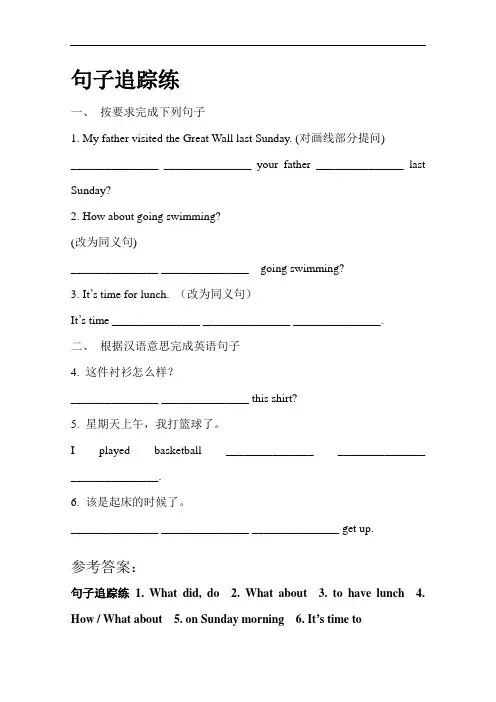

Unit 9 How was your weekend?Language goal:●In this unit students learn to talk about recent past events.New languages:1. Master the new vocabulary words.2. Master the past forms of the regular and irregular verbs.3. New target language:What did you do last weekend?On Saturday morning, I cleaned my room.On Saturday evening, I went to the movies.What did he/she/they do last weekend? He/she/they played tennis. How was your weekend? It was great/OK.4. Be able to talk about the recent past events.Difficult points:1. Master the past forms of the regular and irregular verbs.2. Use the new language to talk about recent past events.Teaching aids:●recorder●some pictures of activitiesTeaching periods:●Period 1: Section A 1a—Grammar focus●Period 2: Section A3a—4●Period 3: Section B 1a—2c●Period 4: Section B 3a—Self-checkPeriod 1Teaching aims:1. Learn the new vocabulary words:2.Target language:What did you do last weekend? I played soccer/we went to the beach.What did he do last weekend? He played tennis.What did they do last weekend? They visited the library.3. Master the past forms of the regular and irregular verbs.4. Learn to talk about recent past events.Teaching procedures:Step 1. Warm-upTalk about the activities:—What’s your favorite sport?—My favorite sport is…—Do you play soccer/tennis/basketball? Yes/no…—Do you do your homework/clean your room? Yes/no...Ask and answer more activities.Step 2. Learn the new vocabulary words1. Get the students to read the new words in the vocabulary. Try to readthem by themselves.2. Practice reading the new words: (A) Ask the class to repeat the newwords after the teacher. (B) Then read them together/in parts/one by one.3. Read and remember the new words.4. Explain some words:The past forms of some irregular verbs: was; did; wentUseful expressions: have a test; stay at home; what about=how about;practice doing sth.Step 3. Presentation1. Teacher asks students: “What did you do last weekend?” Help thestudents to answer the question with the past tense. For example: Icleaned my room/ washed the clothes/played basketball/went to themovies… Accept one word answers and rephrase the answers incompleted sentences.2. Have the students work in pairs, ask the question. And try to answerwith complete sentences. Then practice asking and answering theconversation.Step 4. 1a Look and match1. The teacher reads the instructions to the students.2. Have students read the list of the activities first. Read each one and askstudents to repeat.3.Then look at the pictures and try to match the answers.4. Check up the answers.Step 5. 1b Listening practice1. The teacher reads the instructions to the students.2. Get the students to look at the pictures, and then tell what the person didin each picture inactivity1a.3. Play the recording for the first time, students only listen.4. Play the recording again. Students listen to the recording, try to fill in theday and “morning, afternoon, evening” by themselves.5. Check up the answers.6. Play the recording, let the students repeat after the recording. Thenpractice reading the conversation.Step 6. 1cPair work1. The teacher explains the instructions to the students.2.Ask two students to read the example conversation in class.3. Roles play the conversation about Lucy’s weekend in pairs.4. Have some pairs of students work to the class.Step 7. 2a Listening practice1.The teacher explains the instructions to the students.2. Get students to read the sentences in activity 2a. And explain: “You willhear a conversation. The people will talk about some activities and people. Now listen and try to underline the words you hear.3. Play the recording for the first time, students only listen.4. Play the recording again, students listen and try to underline the words.5. Check up the answers.Step 8. 2b Listening practice1. The teacher explains the instructions to the students. Look at the picturein activity 2a, learn the names of Carol; Ben and Emma. Ask students to identify each person by name.2. Look through the sentences in activity 2a.3. Play the recording. Listen and try to fill their names in the blanks.4. Listen again and check up the answers.5. Play the recording and get students to repeat after the recording.Step 9. 2cPair work1. The teacher explains the instructions to the students. Practice theconversation with the words given in the box.2. Students read the example and the words in the box. Do the activity inpairs and make their conversation.3.Ask some pairs to present the conversations in class.Step 10.Grammar focusReview the grammar box first. Then students read the sentences and find if there are some questions. If have, explain them: the past forms of theregular verbs and irregular verbs.Step 11. Summary1. The new vocabulary words.2. The new target language.3. The regular and irregular verbs.Step 12.Homework1. Remember the vocabulary words.2. Write a passage about your last weekend by using the past tense.Period 2Teaching aims:Learn to talk about the past events using the past tense.Teaching procedures:Step 1. Warm-up1. Check up the homework.2. Get some students to read their passages about the past events.3. Talk about your last weekend in pairs.Step 2. Presentation1. Show the picture of a mountain. Teach the word “mountain”.Have the students read the word.2. Make a conversation between the teacher and the students.For example: T: How was your weekend?S: It was great/OK/ not very good.T: What did you do last weekend?S: I…3. Then practice the conversation.Step 3. 3a Writing and speaking practice1. The teacher reads the instructions to the students.Get the students to read three sentences first.2. Students look at the picture and complete the conversation bythemselves.3. Check up the answers.4. Practice the conversations in pairs.Step 4. 3b Pair work1. The teacher reads the instructions to the students.2. Get two students to read the conversation in speech bubbles.3. Practice asking and answering the questions about Ming’s, Tony’s andSarah’s weekends. Practice in pairs.A: How was Ming’s weekend?B: It was …A: What did she do?B: She …4. Have some pairs work in class.Step 5.Game-What did you do?1. Teacher explains the instructions to the students. Be sure the studentscan know what to do.2. Do an example for the students.Draw a picture of a TV, students guess “watched TV”.Draw a picture of a book, studen ts guess “did some reading”.3. Ask students to work in groups. Each student draws two things.Then take turns to make sentences about each other’s picture with pasttense.4. Get some students to work it to the class.Step 6.Summary●Talk about the past events.Step 7.Homework●Interview a friend of yours, ask what he/she did last weekend and write apassage on your notebook.Period 3Teaching aims:1. Learn the new vocabulary words and useful expressions.2. Learn the past forms of some irregular verbs.3. Learn to talk about the past events.Teaching procedures:Step 1.Warm-up1. Check up the homework.2. Get some students to read their passages about what your friend did lastweekend.Step 2. 1a 1b Match and say1. Get the students to look at the pictures, read the phrases and try tomatch.2. Look at the pictures and check up the answers.3. 1b. Teacher explains the instructions to the students. Be sure thestudents can know what to do. Draw a happy face under the picture if you think the activity is fun. Draw an unhappy face if not fun.4. Let the students say it to the class.He played the guitar. It was fun.He did his homework. It wasn’t fun.Step 3. 2a 2b Listening, writing and speaking practice2a1. The teacher reads the instructions to the students. Tell the students: Youwill listen to a conversation between Jim and Sally. They are talking about what they did last weekend. Listen and write the activities in the chart.2. Play the recording for the first time, students only listen. Play therecording,3. Play the recording again, try to fill in the chart when you hear.4. Check up the answers.Students look at the typescript, and repeat after the recording.2b5.The teacher explains the instructions to the students.6. Look at the example in the speech bubbles. Ask two students to read theconversation.7. Practice talking about what Sally and Jim did last weekend in pairs.8. Ask some pairs of students to work in class.Step 4. 2cPair work1.The teacher reads the instructions to the students.2. Get two students to read the conversation in the speech bubbles.3. Have the students work in pairs. Ask your partner “what did you do lastweekend?” and make a conversation.4.Ask some pairs of students to present the conversation in class.Step 5.SummarySummarize the useful expressions and the past forms of the irregular verbs. Step 6.Homework1. Remember the useful expressions and the past forms of the irregular verbs.2. Write down a passage about what your partner did last weekend.Period 4Teaching aims:1. Learn the new vocabulary words and useful expressions.2. Learn the past forms of the irregular verbs.3. Learn to talk about the past events.4. Train the reading and writing abilities.Teaching procedures:Step 1. Warm-up1. Check up the homework.2. Get some students to read their passage about what your partner didlast weekend.Step 2. Learn the new vocabulary words1. Get all the students to look at the vocabulary words. Try to read the newwords by themselves. Then the teacher gets one student to read the new words.2. Practice reading the new words. (A) Read the words after the teacher.(B) Read them together/in parts/one by one.3. Read the new words and remember them.Step 3. 3a Reading practice1. The teacher reads the instructions to the students.2. Ask the students to read the article. Circle the activities you like andunderline the activities you don’t like.3. The teacher reads the article to the students and checks up theanswers.4. Students read the article again and find their questions. Explain to themif they have.Step 4. 3b Writing practice1. Get the students to look at the pictures first. Then read the passage andtry to fill in the blanks according to the pictures. Attentions to use thepast tense.2. Get one student to read the passage and check up the answers.3. Students read the article again and find their questions. Explain to themif they have.Step 5. 3cWriting practice1.The teacher explains the instructions to the students.2. Get the students to write their own passages. Get help from activity 3b.3. Then correct your ads with your partner. The teacher can help them ifthey have some questions. Get a few students to read their passage to the class.Step 6.GameActivity 41.The teacher explains the instructions to the students.2. Have students work in groups of four. Ask one student to write theactivities he did last weekend. Then talk to the others about his weekend activities. And the others try to guess who he is.3. Have students to work in groups. Take turns to talk about the weekendactivities and guess who he/she is.4. Have some groups of students present their conversations in class.Step 7. Review the words Self-check 1&21. Students read the words in the box and check all the words they know.They can circle the words they don’t know. Then ask them.2. Make their Chinese meanings clear.Then ask and answer the Chinese meanings in pairs or in groups.3.Ask each student to write five new words on their notebooks.Then share them with the others in groups.Step 8.Self-check 3 Reading and writing practice1. The teacher explains the instructions to the students. Tell the studentswhat to do.2. Students read th e passage about “Old Henry”. And find his problems.3. Tell students that they have to image that they went and helped OldHenry last weekend. Think about the activities they could help him. They can get some help from the suggestion box.4. Students write their own answers. After finishing, ask some students toread their passages to the class.Step 9.Summary1. Summarize the new words and the useful expression2. The past forms of the irregular verbs.3. Talk about the past events.Step 10.Homework1. Remember the words and expressions.2. Write a passage about the activities your family members did last weekend.。

Unit9 My favorite subject is science.授课班级授课日期授课类型新授课学时数The 1st period (Section A 1a—1c)教学目标1.Learn to talk about somebody’s favorite subjects and give reasons.2. Revise some adjectives.教学内容✧New words: subject, ., science, history, biology, because ✧--- What’s your favorite subject?--- My favorite subject is …✧--- Why do you like …?--- Because it’s …重点难点✧--- What’s your favorite subject?--- My favorite subject is …✧--- Why do you like …?--- Because it’s …学情分析教学方法任务型教学、分级评价法、直观教学法、模仿示范法、情景教学和合作学习法学习方法课前预习、课堂内外练习、听说读写结合教学过程设计备注课题引入I. Warming-up and revisionT: How are you today?S: We are fine. (show a picture of Chinese teacher)T: Who is this woman/man?S: She/he is Miss/ Mr. …. She/He is our Chinese teacher.T: Do you have a Chinese lesson today?S: Yes,…./No, ….T: Do you have a math lesson today?S: Yes, …./No,…T: Who is your math teacher?S: ….教学步骤及主要内容II. PresentationT: Chinese and math are subjects. what other subjects do we have today? Do we have math/art/ music/ PE/science/ history/ biology lesson today?S: …T: What subjects do we have this year?S: We have math/English/Chinese ….T: What subjects do we have in middle school?S: We have math/English/Chinese….Focus attention on the word list and the example: Say: Number 1 is C, tennis racket. Match the words and picture. check the answers.III. Work on 1aT: Look at the pictures on P71. Please match the words with the pictures.S: Picture c is a class. Picture d is an art class. Picture b is a science class.Picture e is a music class. Picture a is a math class. Picture f is a Chinese class.IV. Work on 1bT: Let’s listen to the tape and circle the subjects in 1a you hear.S: Now let’s check the answers. The boy’s favorite subject is science. And the girl likes art and math, but her favorite subject is music.V. Listen and repeat.T: Listen to the tape and repeat.课堂练习VI. Work on 1cT: The boy’s favorite subject is science. And the girl’s favorite subject is music. What about you? What’s your favorite subject?S: My favorite subject is…T: What’s Tom’s favorite subject? Ask him, please.S: What’s your favorite subject, Tom?Now talk about your favorite subject.VII.Presentation1. S1: What’s your favorite subject?S2: My ….S1: Why do you like…?S2: Because….2 T:Is … your favorite subject?S: No, ….T: Why don’t you like …?S: Because it’s difficult/ boring….VIII. Work on 2c,2dT: I think English is interesting. What do you think?S: ….T: what about other subjects?Look at your books, match the subjects with the description words.T / S: What do you think of these subjects?S: I think art is interesting.T / S: So is it your favorite subject? S: Yes, you’re right.T / S: What do you think of science? S: ….IX. Work on 2aT: Look at the four sentences in the picture. Now listen and put the conversation in order.Answer:From left to right: 4-1-2-3X. Work on 2bT: The girl likes ., because it is fun. How about the other subjects? Nowlisten again and match the subjects with the description words you hear.T: What’s the gir l’s / boy’s favorite subject? Why does she / he like it?S: Her / His favorite subject is . / music, because it is fun / relaxing.XI.Listen and repeat.T: Now let’s listen to the tape and repeat. Please try to read like the tape.Tapescript:A: What’s your favorite subject?B: My favorite subject is .A: Why do you like .?B: Because it’s fun. How about you? What’s your favorite subject.A: Hmm. My favorite subject is music.B: Really? Why?A: Because it’s relaxing.XII. Group workS1:What’s your favorite subject?S2: My favorite subject is …S1: Why do you like …?S2: Because…. What about you?S1: ….(S3 and S4 make a similar conversation in turns)S1:What’s S4’s favorite subject?S3: His/ Her ….S1:Why does he/she….S3: Because…小结与作业课堂小结本课作业XIII. Homework1.Listen and read after the tape for thirty minutes.2.Recite the first converstaion of Section A, 2c.3. Write down the Chinese meaning of the new words and key sentences, then translate them into English.Unit9 My favorite subject is science. 授课班级授课日期授课类型对话课学时数The 2nd period (Section A,3a –Section B, 2b)教学目标1.Learn to talk about ss’ favorite subjects and give reasons. 2.Learn to talk about ss’ favorite things and give reasons.教学内容✧New words: city, mom ,dad✧--- What’s your favorite… (subject, color, city …)?--- My favorite … is …✧--- Why do you like … ?--- Because it’s …✧--- Who is your … teacher…?--- Mr / Miss …重点难点✧--- What’s your favorite… (subject, color, city …)?--- My favorite … is …✧--- Why do you like … ?--- Because it’s …✧--- Who is your … teacher…?--- Mr / Miss …学情分析教学方法任务型教学、分级评价法、直观教学法、模仿示范法、情景教学和合作学习法学习方法课前预习、课堂内外练习、听说读写结合教学过程设计备注课题引入I. Warming- up and revisionDaily greeting and revision.T: How are you today?S: I am fine.T: How many subjects do you have today?S: Seven.T: What are they?S: They are Chinese/math/English .…T: What’s your favorite subject?S: My favorite subject is ….T: Why do you like it?S: Because it’s ….教学步骤及主要内容II. PresentationT: What’s your favorite subject?S: My favorite subject is (math)?T: Why do you like (math)?S: Because it is (interesting).T: I’m your English teacher. Who is your math teacher?S: Mr/ Mrs/ Miss…is my math teacher.T: Ask your friend about his /her favorite subject and teacher, please.S1: What’s your favorite subject?S2: My….S1: Who’s your …teacher?S2: Mr/ Mrs/ Miss…is my math teacher./ My … teacher is ….S1: What’s S3’s favorite subject?S2: …S3:…III. Grammar focusT: I think games are interesting. Let’s play a guessing game. A come here and have a look at a note in the box. Then ask others questions: What’s Mary’s favorite subject? Why does she like it? Others try to find the answer by guessing like this: Is …her favorite subject? Is her favorite subject …? …A: What’s Mary”s favorite subject?S1: Is Chinese her favorite subject?A: No, it isn’t.S2: Is English her favorite subject?A: No, it isn’t.…S: Is math her favorite subject?A: Yes, it is. Why does she like it?S: Because it is relaxing?A: No, it isn’t.…S: Because it is interesting?A: Yes, it is.IV.Work on 3aT: How about this girl? Now complete the conversation. You can use the words in the box. Then tell me something about the girl.S1: What is your favorite subject?S2: My favorite subject is art.S1: Who is your art teacher?S2: My art teacher is Mrs Jones.T: Now tell me something about the girl. What’s her favorite subject and who is the teacher?S: The girl’s favorite subject is art. Her art teacher is Mrs Jones.V .Work on 3bT: How about your partner? Do you know want to know about your classmates? Now ask your classmates about his/her questions and complete the chart, then give a report.Report:My name is __________.My favorite subject is __________ because it is ________.My ________ teacher is _________. I like her/him very much.She/He is really ___________.______’s favorite subject is___________.Name: Favorite subject Reaso n teacher Description of teacherI: S1: S2:课堂练习VI .PairworkT: I know your favorite subject is …. But what ’s your favorite city? Is Linhai / Hangzhou / Shanghai … your favorite city? S: My favorite city is … S1: … S2: … …T: Now I ’d like you to talk about your favorite things in pairs. VII .SurveyT: Now we know a lot about our classmates. But do you knowanything about your mom and dad? Complete the chart with their favoritethings. Then talk about them with your classmates.Favorite city Favorite food Favorite color Favorite TV show Mom DadS1: What ’s your mother ’s favorite city? S2: Her favorite city is …Report like this: S: ___’s mom ’s favorite city is ... Her favorite food is … Butt her/his dad ’s favorite is …小结与作业课堂小结本课作业VIII. Homework1.Listen and read after the tape for thirty minutes.2.Recite the second converstaion of Section A, 2c.3.Write down the Chinese meaning of the new words and key sentences, thentranslate them into English.本课教学后记(课堂设计理念,实际教学效果及改进设想)Unit9 My favorite subject is science.授课班级授课日期授课类型巩固课学时数The 3rd period (Section B 1a –2c)教学目标1.Learn to talk about ss’ favorite subjects and give reasons.2.Learn the seven days of the week.教学内容✧New words: Sunday,Monday,Tuesday, Wednesday, Thursday, Friday, Saturday ✧--- When do you have (math)?--- On Monday.✧--- When does he/she have …?--- On …重点难点✧--- When do you have (math)?--- On Monday.✧--- When does he/she have …?--- On …学情分析教学方法任务型教学、分级评价法、直观教学法、模仿示范法、情景教学和合作学习法学习方法课前预习、课堂内外练习、听说读写结合教学过程设计备注课题引入I. Warming-up and revision1. One-minute talk. Topic: My Favorite …. I have many subjects at school, they are … My favorite subject is …. I like it because it is … And … is my … He/She is … I like him/her very much, too. My favorite city is …, because it is….)2. After the talk get the students ask and answer questions about it.教学步骤及主要内容II. Presentation1. Daily greeting and revisionT: …(name) just says you have many subjects at school.T: What classes do you have today?S: We have English/Chinese,/science .…T: Oh, so many classes today. What day is it today?T: What’s the date today?S: It’s (January 7th).T: Today is (January 7th). But what day is it today?S: It’s (Friday).T: Then what day is January 8th?S: January 8th is Saturday.…2. T: There are seven days in a week. But which day is the first day of the week?Is it Monday?S: No, it’s Sunday.T: Good! The first day of the week is …S: The first day of the week is Sunday. The second day of the week is Monday.The third day of the week is Tuesday. The fourth day of the week is Wednesday. The fifth day of the week is Thursday. The sixth day of the week is Friday. The seventh day of the week is Saturday.T: Let’s say the days of the week quickly, clapping our hands.T:Now let’s sing the song: Days of the week.课堂练习III. Work on 1aT: Now look at 1a. These days are out of order. Please put them in order by numberin the boxes 1 – 7.S1: No. 1. September 30. S2: Sunday.S3: No. 2. October 1. S4: Monday.S5: No. 3. October 2. S6: Tuesday.S7: No. 4. October 3. S8: Wednesday.S9: No. 5. October 4. S10: Thursday.S11: No. 6. October 5. S12: Friday.S13: No. 7. October 6. S14: Saturday.IV.Work on 1bT: Quite good. There are seven days in a week. And we come to school five daysa week. In these five days we have to study at school. But what subjects dowe study? Now check the subjects in 1b quickly.T: What subjects do you study at school?S: We have art, science, music, math, . and Chinese. But we don’t have historyor biology now.V. Work on 1cT: When (What time) do you have art?Do you have art on Monday?S: Yes, we have art on Monday morning. / No, we have art on Tuesdayafternoon.T:When do we have English?S: We have English on Monday, Tuesday…./We have it every day.T: OK. Look at the chart ask and answer about the time of subjects in pairs.VI.Work on 2aT: We have different subjects on different days. What about Ming, Selina and Ken?What subjects do they study? Please listen to the tape and write down theschool subjects they talk about in the tape.T: What subjects do they talk about?S: Biology, history, art and science.VII.Work on 2bT: What subjects do Ming, Selina and Ken like? When do they have thesesubjects? Listen again and fill in the chart of 2b.VIII.Work on 2cT: Now we know something about Ming, Selina and Ken. Please make aconversation about them. You can use the information from the chart. You maymake up dialogues like 2c on P74. (What’s … favorite …? Why…? When…?)小结与作业课堂小结本课作业IX. HomeworkMake a survey:T: Now it’s your turn to make up your own dialogues. Please work with your group (four students in one group) and finish this chart.A: Hi/Hey,… What subject doesn’t… like?B: He/She doesn’t like …A: Why doesn’t he/she like…B: Because …A: When does he/she have …B: On ……NameSubjectdoesn’t likeWhy? When?FavoritesubjectWhy? When?S1S2S3Report:In my group, there are _________ ________ and _________._________ doesn’t like _________, because _____________.He/She has __________ on ___________. But his/her favoritesubject is __________. _________________________________________________________________________________________________________________________________________X. Homework1.Listen and read after the tape for thirty minutes.2.Recite the second conversation of Section B, 1b.3.Write down the Chinese meaning of the new words and sentences, translatethem into English.本课教学后记(课堂设计理念,实际教学效果及改进设想)。

精品"正版〞资料系列,由本公司独创 .旨在将"人教版〞、〞苏教版"、〞北师大版"、〞华师大版"等涵盖几乎所有版本的教材教案、课件、导学案及同步练习和检测题分享给需要的朋友 .本资源创作于2021年8月,是当前最|新版本的教材资源 .包含本课对应内容,是您备课、上课、课后练习以及寒暑假预习的最|正确选择 .Unit 9 What does he look like ?Section A (1a -2d)一、教学目标:1. 语言知识目标:1) 能掌握以下单词:curly, straight, tall, medium, thin, heavy, build, tonight, little, cinema, glasses, later能掌握以下句型:-What does he look like?-He ,s of medium/build.-What does he look like?-She has long straight hair.-Is he tall or short ?2. 情感态度价值观目标:让学生学会友好、客观地描述人的形象.二、教学重难点1. 教学重点:掌握单词,熟练掌握描述人的形象的句型.2. 教学难点:掌握描述人的形象的句型.三、教学过程Ⅰ. Warming -up and revision找出三名外貌差异较大的学生来做比较,一个胖而高大的男生(a fat and tall boy ) ,一个瘦而较矮的男生(a thin and short boy ) ,一个中等身材(of medium height ) .目的:引起学生的学习兴趣,了解人物的外貌特征, (即不管外貌如何在不同的游戏中都能获胜)的比照培养学生的情感和态度:不要以貌取人(Don ,t judgeby appearance ) .然后用这两名学生为例教heavy,tall, thin, short引出句型:1.What do you look like? He ,s really tall. He has long straight hair.2.What does she look like? She ,s of medium/build.…Ⅱ. Presentation (SectionA1a)1. Match the words with the people in the picture. (1a)学习课本的第|一局部P49,1a先看图片,然后搭配图片和相关的外貌特征的词.Now please look at P49, Use the letters to match the people in the picture with one of the numbered words. Write each letter next to a numbered word. You can use some letters more than once. Point out the sample answer. (Keys: c, f, a, a, d, h, e, b, g, e)留2 -3分钟读写1a中的单词、短语.2.引导学生熟悉有关描述人的外貌特征的词(1).用漫画画人物教有关height ,curly等单词.然后操练"What does he look like? He is really tall.〞注意be 动词的用法.(2).一个cartoon girl 教身体的各部位(ear, face, hair, eye, nose, mouth ) .然后操练"What does he look like? He has long straight hair.〞注意has的用法.(3).pictures 来教有关头发的词汇,注意has的用法.接着教a beard, a moustache, glasses .Ⅲ.Practice(Section A 1c)1. Read the conversation and recite it.2.Practice like the conversation according to some pictures.Ⅳ. Listening (1b, 2a&2b)1. Look at the picture of 1a, listen and fill the blanks in the picture. (1b)Listen carefully and fill in the blanks and find Amy ,s friend? We will listen twice.The first time, just listen.The second time ,listen and fill in the blanks.And say the lookof Amy ,s friend.( He's really tall.And he has curly hair.)2. Listen and answer the questions. (2a)3.Listen again and fill in the chart.(2b)4.Listen a third time to understand the key words.Ⅴ. Practice (2c)1.Student A looks at the chart in 2b. Student B asks Student A questions about one of the people and then draws a picture of the person quickly.2. Act the dialogue.Ⅵ.Role -play the conversation.(2d)1.Read the conversation to answer the questions:(1 )When are they meeting?(2 )Where are they meeting?(3 )What does David look like?(4) Is he tall or short?2. Read the conversation.3.Role -play the conversation.4. Explanation:(1) may be(2) a littleⅦ.Guessing game (李咏潘长江)全班同学分为两组,每组选出一名同学作为组代表到黑板前面来,这两位同学面向其他同学,背向黑板,不许回头.老师将两幅名人图片粘到黑板上或打在屏幕上等,然后分别请这两组同学向本组的组代表描述本组图片上人的外貌、工作(第四单元知识点)或其他相关情况,让本组的组代表最|快猜到本组图片上名人是谁的小组获得胜利.在游戏过程中注意:描述的同学每人只能描述一次,并且只能描述一句,并尽可能多的描述人物外貌,在很难猜出时,可以描述工作或其他相关情况.Ⅷ. Homework1.熟记本节课所学单词,预习P51& P52 .2.Describe your friends in the class and draw a picture of them.板书设计:①He ,s of medium/build.②What does he look like? He ,s really tall.③What does he look like? She has long straight hair.④Is he tall or short ?2. 情感态度价值观目标:学习让学生学会友好、客观地描述人的形象.二、教学重难点1. 教学重点:学习单词、句型.2. 教学难点:让学生学会友好、客观地描述人的形象.三、教学过程Ⅰ. Warming - up and revision1.Say what your friends in the class look like and show the pictures of them.2. Work in pair. One student describe one of his friends in class, the other student guess who he/she is.3. Write these words in the correct box.Read and write these words about 2 minutes.Ⅱ.Grammar Focus1. 学生阅读Grammar Focus中的句子,并完成以下句子填空练习.2. 指导.注意提醒、区分单复数,is 与has .①他长的什么样子?_____________________他个子很高. _______________________②她长的什么样子? ___________________她长着长的直发. ____________________③他们长的什么样子?___________________他们中等身材. ___________________④他们长着直发还是卷发?__________________他们长着卷发.______________________⑤他个头是高还是矮? ____________________他不高也不矮.他是中等身高. _____________________________ Ss finish off the sentences and check the answers.3. 自主探究一、描述人物外貌的问句.1.她/他长得什么样子?What does he/she ____ _______?2. 他们长得什么样子?What _____ they _____ ________?3. 她个子是高还是矮?______ she tall ______ _______?4. 他长着长发还是短发?_____ he have ______ hair _____ short hair?二、描述人物形象的表达方式.1.描述身高、体重等整体特征时用be动词.如:他很高/矮/中等身高.He _____ tall/ _____/ ____ _______ height.她长得很瘦/胖/中等身材.She ____ thin/ _____/ of _______ ______.2. 表示留着何种发型等用have/has .她留着长的直发.She ______ _________ long hair.3. 表示穿着、戴着眼镜(帽子)用wear .他戴着一幅眼镜.He _____ a pair of _______.Ⅲ. Reading(Work on 3b) Read the sentences and circle the correct words to complete the conversation.1. 阅读指导:首|先,应读每个句子,理解句子的意思;然后,应根据主语的单复数形式来确定谓语动词或助动词的单复数形式.之后,还要看动词后面是形容词还是名词,这样来确定是用is还是has/have; 最|后,通读一遍本句子,看是否通顺.2. Ss read the sentences and chose the correct words quickly.3. Check the answers.Ⅳ.Writing1. Show some photos of the famous singer or actor (actress)Ask Ss: Who is your favorite singer/actor/actress?Ss think and answer this question.2. Then ask them these two questions:What does your favorite actor or actress look like?3. Ss think and answer:4. Now write down your answers on the line.5. Work in groups. Talk abou t your favorite teacher/friend… What does she/he look like?Think and write down your sentences.Ⅳ.Practice学生分小组谈论自己感兴趣的名人长相,后填写下表帮助学生具体问答,板书thin ,blonde, good -looking ,basketball team ,straight hair.Ⅷ. Homework1.熟记本节课所学单词,预习P53 .2.Describe your family members and draw a picture of them.板书设计:正确、熟练地描述人物相貌.三、教学过程Ⅰ. Warming - up and revision1.Who does best ?Say what your family members look like and show the picture of them to the class.2.Say what your favorite singer or athlete looks like, others guess who he/she is.Ⅱ. Presentation1. Write the words describing the people as many as possible, e.g. tall, thin, …black hair, round face…(Show some pictures on the big screen, and present the new words and expressions in this period)(blonde, mouth, round, face, eye, singer, artist, crime, criminal…)2. Work on 1a: Match the words with the pictures.3. Read and write these words about 2 minutes.Ⅲ.Writing1. Read the phrases in the box in 1b and make sentences about famous people with the words.e.g. Zhao Benshan has a long face.2.Fill in the blanks and check each other.Ⅳ. ListeningWork on 1c:You will hear Maria and Danny talking about Tina Brown and Johnny Dean.1.Your job is to write the job each person does. Point to the heading "Job" on the chart. Listen again and check the answers.2.This time your job is to write what each person looks like. Point to the heading "looks like".Check the answers.3. Listen a third time to understand the key words.Ⅴ. Practice1. Complete the chart with the words of the opposite meaning.2. Ss discuss with their partners, then check the answers.Ⅵ.Thinking about what you will look like in 20 years.1. Write what you look like now.I ,m …I have…2.设计一下自己的新形象.I ,m …I have…Ⅶ.Reading & writing (2b & 2c )1. Look at the pictures of 2b and say what the three people look like.2. Fast reading:Read the article and find the real criminal.3. Careful reading:Read the article again and find the words describing what the three people look like in the article.Let some Ss read out the sentences.Work on 2c:1. Read the article again and write what the words in bold refer to.1 )He =2 )it =3 )him =…2. 阅读指导:(见课件)3. Read the article to find the language points and try to translate into Chinese.4. Explaining the language points:1) talk to2) in the endHomework1. Read the article of 2b.2.Write your new look and draw on a piece of paper.板书设计:2.能力目标:1)能熟练的用英语进行对人外表特点的描述,并根据描述画出人像.2)能掌握本单元出现的表示人外观的词组及句型,并能结合实际生活进行灵活运用这些词组及句型描述别人的外表,提高写作水平.2. 情感态度价值观目标:情感态度目标:能在小组活动中积极与他人合作,相互帮助,共同完成学习任务, 尽情享受学习的乐趣.二、教学重难点1. 教学重点:掌握本单元单词、短语,描述人物外貌特征.2. 教学难点:准确、熟练地描述人物外貌特征三、教学过程Ⅰ. Warming - up and revisionShow the picture of your new look and tell it to the class to find who does best.Ⅱ. Presentation1. Who remembers best?(检测本单元单词)2. Write more words in each box.(Self Check 1).To find who writes most right words.3. Read and write these words about 3 minutes.Ⅲ. Fill the blanks with the words in the box.(3a)1. Look at the picture of 3a to say what Jack looks like.2. Fill in the blanks quickly.3. Check the answers.4. Read the passage and translate into Chinese.5. Language points1) first of all2) be good atⅣ. Writing (3b)1.Read the questions in the form of 3b.2.写作指导:(见课件)3. Write a passage about your best friend.4. Check the passages each other to correct them in the group.4. Read the best passage for the class.Ⅴ. Self Check 21. What do you parents look like? Describe them like this:My dad is tall. He has… He wears…He likes…My mum is …She has… She wears…She likes…2. Check the passages each other to correct them in the group.3. Read the best passage for the class.Ⅴ.Game任务:车站接人目的:模拟交际,稳固用英语描述人物外形特征的词汇,强化"区分人物〞的语言功能.材料:卡片数张语言技能:Listening, reading, speaking and writing语言知识:What does he/she look like? He is tall and thin/medium height/medium build. His hair is straight/curly/black/brown/blonde/short/long. He has big eyes/a round f ace… He is wearing…活动形式:Whole -class activity(1 )教师布置任务:接人者在车站并根据卡片上的描述找到所要找的客人.提出具体要求,并对教室进行适当的布置,创设一个模拟车站的情景.(2 )教师发给每位同学一张卡片,让其在卡片的正面用英语描述自己的外貌特征,在反面做记号,完成后,教师把卡片收回.(3 )教师选出十名学生去车站接人,每人从收集的卡片中抽取一张,并根据卡片的描述找到所要找的"客人〞;(假设时间允许可进行第二、三轮. )(4 )学生评委和老师根据找出所接客人的时间和准确性,选出"火眼金睛〞数名.这些活动使学生置身于自然、真实的语言环境中,进行大胆、合理的想象,创造性地使用课文中学到的有关人物外貌特征的知识,这样,不仅稳固了所学内容,训练了语言组织能力,而且还联系与接触社会实际,拉进了学生与社会、与生活的距离,拓宽了学习内容.Ⅵ.Homework1. To master the words and expressions of this unit.2. To master the sentences of Grammar Focus.板书设计:|。

新人教版七年级英语上册精美教案Unit 9 教案(共计21页)----ec96e5d2-6eb3-11ec-ac1e-7cb59b590d7d新人教版七年级英语上册精美教案unit9教案(共计21页)第九单元我最喜欢的主观性。
一、单元教材分析本单元以“谈论你最喜欢的话题”为主题,开展听、说、读、写等多种学习活动。
主要学习一周中从周一到周日的表达方式;掌握纪律的表达;学会用因为和形容词来表达品质来表达理性;学习由什么、为什么和谁引导的特殊问题。
通过本单元的学习,学生可以学会谈论自己喜欢的话题或其他事情,并给出理由;学会一周说七天;学会合理安排工作和休息时间。
2、单元学习情境分析本单元的主题是“谈论自己所喜欢的学科”,主要是学习学科的表达、表示品质的形容词、一周中星期一到星期天的表达方式;学习用because表示理由。
在询问“对方所喜欢的学科和人物”、“星期几”时,要使用以前所学过的what、who疑问句,再学习“询问理由”所用的why疑问句。
教师可引导学生通过比较、对照的方法掌握所学疑问句的结构和使用以及回答。
三、单元教学建议本单元可完成4学时的教学任务:a部分(1a-2d)1学时sectiona(grammarfocus-3c)用1课时sectionb(1a-2c)用1课时sectionb(3a-selfcheck)用1课时A部分(1a-2d)一、教学目标:1.语言知识目标:1)能够掌握以下词汇:最喜欢的、学科、体育科学、音乐、数学、语文、地理、历史、为什么、因为、星期一、星期五、星期六2)能够掌握以下句型:①―what'syourfavoritesubject?―myfavoritesubjectisscience.②―what'syourfavor iteday?―it'smonday.③―whydoyoulikep.e.?―becauseit'sfun.④―how'syourday?―很好。