
3.Export Price
- 格式:ppt
- 大小:591.00 KB
- 文档页数:36


高三英语经济词汇单选题30题1.The price of oil has been fluctuating recently. What does "fluctuating" mean?A.rising steadilyB.falling steadilyC.changing up and downD.remaining constant答案:C。
“fluctuating”的意思是波动、起伏不定。
选项 A 是稳步上升;选项B 是稳步下降;选项C 是上下变化;选项D 是保持不变。
根据题干中“price of oil has been fluctuating recently”可知油价最近一直在波动,所以选C。
2.In international trade, what is a "tariff"?A.a tax on importsB.a subsidy for exportsC.a restriction on domestic productionD.an incentive for foreign investment答案:A。
“tariff”在国际贸易中是关税的意思,即对进口商品征收的税。
选项B 是出口补贴;选项C 是对国内生产的限制;选项D 是对外资的激励。
所以选A。
3.The stock market is very volatile. What does "volatile" mean?A.stableB.unpredictableC.gradualD.consistent答案:B。
“volatile”的意思是易变的、不稳定的、波动的。
选项A 是稳定的;选项B 是不可预测的;选项C 是逐渐的;选项D 是一致的。
题干中说股票市场很不稳定,所以选B。
4.What is "inflation"?A.a decrease in the general price levelB.an increase in the general price levelC.a stable price levelD.a decline in economic growth答案:B。

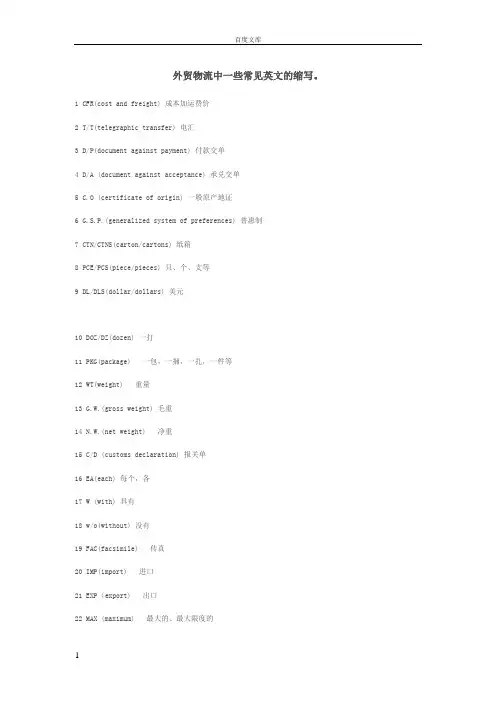
外贸物流中一些常见英文的缩写。
1 CFR(cost and freight) 成本加运费价2 T/T(telegraphic transfer) 电汇3 D/P(document against payment) 付款交单4 D/A (document against acceptance) 承兑交单5 C.O (certificate of origin) 一般原产地证6 G.S.P.(generalized system of preferences) 普惠制7 CTN/CTNS(carton/cartons) 纸箱8 PCE/PCS(piece/pieces) 只、个、支等9 DL/DLS(dollar/dollars) 美元10 DOZ/DZ(dozen) 一打11 PKG(package) 一包,一捆,一扎,一件等12 WT(weight) 重量13 G.W.(gross weight) 毛重14 N.W.(net weight) 净重15 C/D (customs declaration) 报关单16 EA(each) 每个,各17 W (with) 具有18 w/o(without) 没有19 FAC(facsimile) 传真20 IMP(import) 进口21 EXP(export) 出口22 MAX (maximum) 最大的、最大限度的23 MIN (minimum) 最小的,最低限度24 M 或MED (medium) 中等,中级的25 M/V(merchant vessel) 商船26 S.S(steamship) 船运27 MT或M/T(metric ton) 公吨28 DOC (document) 文件、单据29 INT(international) 国际的30 P/L (packing list) 装箱单、明细表31 INV (invoice) 发票32 PCT (percent) 百分比33 REF (reference) 参考、查价34 EMS (express mail special) 特快传递35 STL.(style) 式样、款式、类型36 T或LTX或TX(telex) 电传37 RMB(renminbi) 人民币38 S/M (shipping marks) 装船标记39 PR或PRC(price) 价格40 PUR (purchase) 购买、购货41 S/C(sales contract) 销售确认书42 L/C (letter of credit) 信用证43 B/L (bill of lading) 提单44 FOB (free on board) 离岸价45 CIF (cost,insurance&freight) 成本、保险加运费价AAA制自动许可制AAC 亚非会议A.A.R 保综合险(一切险)ABCコ-ドABC商业密码ac. 英亩a/c(或A/C) 银行往来存款acpt 承兑;接受a/cs pay. 应付帐款a/cs rec. 应收帐款ACU 亚洲清算同盟A/D 出票后ADB 亚洲开发银行a.f. 预付运费AFA 自动外汇分配制度AFDB 非洲开发银行A.F.E.B. 核准的外汇银行agcy 代理公司agt. 代理人AIQ制自动进口配额制A.M. 互相保险A.N. 到货通知A/P 委托付款证A/P 委托购买证A/P 附加保险费A/P 付讫APO 亚洲生产率组织APU 亚洲支付同盟A/R 综合险,一切险A/S 销货帐单A/S 见票后A/S 见票即付ASEAN 东南亚国家联盟ASP 美国销售价格ATAカルネ暂时许可簿册,临时过境证A.T.L. 实际全损A/V 从价A/W 实际重量A.W.B. 空运单BB/Aレ-ト银行承兑利率B/B 买入汇票B/C 托收汇票B/D 银行贴现B/D 银行汇票B/E 入港申报单B/E 汇票BETRO 英国出口贸易研究组织BIS 国际清算银行B/G 保税货物B/L 提单B/N 钞票B/N 交货记录B.O. 分公司B.P. 应付票据B.R. 应收票据B/S 再进口免税证B/St 即票BTN 布鲁塞尔税则分类B.T.T. 银行电汇CC.A.D. 凭单付款C.B.D. 交货前付款C.B.S. 装船前预付货款C/C 商会C.C. 时价CCC 关税合作理事会CCCN 关税合作理事会税则分类表C.F.S. 集装箱货运站C.H. 货舱C.H. 票据交换所C.H. 海关Chq. 支票C.I. 领事签证发票C/I 保险证书CIF関税込条件成本,保险费,运费加关税条件CIF条件成本,保险加运费条件CIF通関费用込条件成本,保险费,运费和一切进口费用条件CIF&C条件成本,保险费,运费加佣金条件CIFに関する国际统一规则CIF买卖契约统一规则C.L.货物「コ」(集装箱)整箱货CLP 装箱单C/N 发货通知单C/N 贷记通知书C/O 转交C/O 产地证明书C.O.D. 交货付款C.O.F.C. 平板车装运集装箱COGSA 海洋货物运输法cont. 合同c.o.s. 装船时付款C/P 租船合同C.Q.D. 习惯快速装卸C.T. 载货吨位C.t.l. 推定全损C.W.O. 订货付款DD/A 承兑交单D/C 绕航条款D/C 贴现,折扣D/D 码头交货D/D 即期汇票,跟单汇票D/F 空舱运费D/M 速遣费D/N 借记通知D/O 交货单,出货单D/P 付款交单D.P.V. 完税价格D.R. 码头收据d.t. 交货时间DW 载重量D/W 码头栈单D.W.T. 载重吨位DWTC 载货吨EECAFE(UN) 亚洲及远东经济委员会ECE 欧洲经济委员会ECM 欧洲共同市场E/D 出口申报单EEC 欧洲经济共同体EFTA 欧洲自由贸易联盟E/L 出口许可证EMA 欧洲货币协定EPU 欧洲支付同盟ESCAP(UN) 亚洲及太平洋经济社会委员会ETA 预计到达时间TTD 预计离港时间ETE 预计开航时间exch. 兑换,汇兑;交易所exd 已查,已检验作者:夜半一点钟2006-2-9 02:38 回复此发言-------------------------------------------------------------------------------- 2 国际贸易术语英文缩写FFA 外汇配额制度F.A 货物运送代理行f.a.a. 一切海损不赔F.A.K.「コ」同一费率F.A.Q. 良好平均质量,大路货F.A.S. 启运地船边交大货价F.B. 运费单F.B.E. 外国汇票FC&S约款「保」捕获拘留除外条款FCL 整箱货FCL 整装集装箱f/d 自由港FEFC 远东水脚公会f.f.a 船边交货f.g.a 共同海损不赔F/L 运价表F.M. 不可抗力f.q. 实盘FOB 船上交货价FOR 火车上交货价FOT 卡车上交货价F.P.A. 单独海损不赔frt.pd. 运费已付frt.ppd. 运费预付F.W.D. 淡水损失fy.pd. 付讫GG.A 共同海损g.b.q. 故障货物G.M.Q. 上好可销品质G.N.P. 国民生产总值Gr.R.T. 注册总吨grs.wt. 毛重GT 总吨位G.T.C. 撤销前有效G.T.M. 本月中有效G.T.W. 本周中有效HHKD 港币H.O. 总公司Hr 港口II.B.R.D. 联合国国际复兴开发银行I.C.C. 国际商会ICHCA 国际货物装卸协调联合会I/D 进口申报单IFC 国际金融公司I/L 进口许可IMF 国际货币基金组织IMF借款国际货币基金信贷IMF引出権国际货币基金组织提款权INCOTERMS 国际贸易条件解释通则INTRADE 国际贸易发展协会I.O.P. 不论损失率如何全部赔偿IQ制进口配额制I/R 汇入汇款ITC 国际贸易中心ITC 国际贸易宪章ITO 国际贸易组织IUMI 国际海上保险联盟LL/A 卸货代理行L/A 授权书LASH 载驳船L/C 信用证L/G 保证书L/H 质押证书L/I 赔偿保证书Lkg 漏损LT 书信电报l.t.,L/T 长吨,英吨LWL 载重线Mmarg. 保证金m/d 出票日后……个月(付款)MEA 制造厂商外销代理人M/F 舱单,载货单MFN 最惠国M.I 海上保险min. 最低限度M.I.P. 海上保险单mk 包装标志M/Lクロ-ズ溢短装条款M/O 汇款单M/R 大副收据M/T 公吨Nn/a 拒绝承兑,不接受N/C 新租船契约N.C.V. 无商业价值N/F (银行)无存款N.G. 纯收益N.L. 纯损,净损失N/M 无装运标志N.N. (票据)无签名N/R 备装通知NRクロ-ズ免责条款N/S 无存货N.S.F. 存款不足NTB 非关税壁垒N.U. 船名不详NW,N.wt. 净重OOAEC 亚洲经济合作组织O/B 开证银行O/C 货港未定租船合同O/D 见票即付O.E.C.D. 经济合作与发展组织O.F. 海运运费O.G.L. 公开一般许可证OR 船舶所有人承担风险O/R 汇出汇款ovld. 过载PP/A 单独海损P.&L. 损益payt. 支付,付款pd 付讫,通过P.D. 港务费pm. 保费P/N 期票P.O.C. 停靠港P.O.D. 交货时付款P.O.R. 避难港QQ 检疫Q/D 快递件,快速装卸qlty. 品质quotn 报价,行市quty. 数量Rrd. 收讫R/D 与出票人接洽R.D.C. 碰撞条款rept. 收据R.F.W.D. 雨淋淡水损害SS.C. 救助费S.D. 海损S.D. 装运单据s.d. 交货不足S/D 即期汇票SDR 特别提款权sgd 已签署SHEX 星期日和假日除外SHINC 星期日和假日包括在内sig. 签署SITC 标准国际贸易分类S.L. 海难救助损失S/N 装船通知单S.O. 卖方选择S/O 装货单百度文库SP 起运港spec. 说明书,规格S.R. 本船收货单S.R. 货运收据,装货收据S/S 轮船S.S.B.C. 沉没,触碓,火灾和碰撞S.T. 短吨stg. 英镑stor. 存仓费,栈租Ttfr. 转帐,过户T.L. 全损T.L.O. 仅保全损T.M.O. 电汇票T.P.N.D. 偷窃及提货不着险T/R 信托收据T/T 电汇T.T.B. 买入电汇T.T.P. 应付电汇T.T.R. 应收电汇WW.A. 承保单独海损,水渍险W/R 战争险w.r. 仓库收据W/W 仓单W/Wクロ-ズ仓至仓条款W.W.D. 晴天工作日17 11。

Chapter 6The Standard Trade Model⏹Chapter OrganizationA Standard Model of a Trading EconomyProduction Possibilities and Relative SupplyRelative Prices and DemandThe Welfare Effect of Changes in the Terms of TradeDetermining Relative PricesEconomic Growth: A Shift of the RS CurveGrowth and the Production Possibility FrontierWorld Relative Supply and the Terms of TradeInternational Effects of GrowthCase Study: Has the Growth of Newly Industrializing Countries Hurt Advanced Nations?Tariffs and Export Subsidies: Simultaneous Shifts in RS and RDRelative Demand and Supply Effects of a TariffEffects of an Export SubsidyImplications of Terms of Trade Effects: Who Gains and Who Loses?International Borrowing and LendingIntertemporal Production Possibilities and TradeThe Real Interest RateIntertemporal Comparative AdvantageSummaryAPPENDIX TO CHAPTER 6: More on Intertemporal Trade⏹Chapter OverviewPrevious chapters have highlighted specific sources of comparative advantage that give rise to international trade. This chapter presents a general model that admits previous models as special cases. This “standard trade model” is the workhorse of international trade theory and can be used to address a wide range of issues. Some of these issues, such as the welfare and distributional effects of economic growth, transfers between nations, and tariffs and subsidies on traded goods, are considered in this chapter.28 Krugman/Obstfeld/Melitz •International Economics: Theory & Policy, Tenth EditionThe standard trade model is based upon four relationships. First, an economy will produce at the point where the production possibilities curve is tangent to the relative price line (called the isovalue line). Second, indifference curves describe the tastes of an economy, and the consumption point for that economy is found at the tangency of the budget line and the highest indifference curve. These two relationships yield the familiar general equilibrium trade diagram for a small economy (one that takes as given the terms of trade), where the consumption point and production point are the tangencies of the isovalue line with the highest indifference curve and the production possibilities frontier, respectively.You may want to work with this standard diagram to demonstrate a number of basic points. First, an autarkic economy must produce what it consumes, which determines the equilibrium price ratio; and second, opening an economy to trade shifts the price ratio line and unambiguously increases welfare. Third, an improvement in the terms of trade (ratio of export prices to import prices) increases welfare in the economy. Fourth, it is straightforward to move from a small country analysis to a two-country analysis by introducing a structure of world relative demand and supply curves, which determine relative prices.These relationships can be used in conjunction with the Rybczynski and the Stolper-Samuelson theorems from the previous chapter to address a range of issues. For example, you can consider whether the dramatic economic growth of China has helped or hurt the United States as a whole and also identify the classes of individuals within the United States who have been hurt by China’s particular growth biases. In teaching these points, it might be interesting and useful to relate them to current events. For example, you can lead a class discussion on the implications for the United States of the provision of forms of technical and economic assistance to the emerging economies around the world or the ways in which a world recession can lead to a fall in demand for U.S. exports.The example provided in the text considers the popular arguments in the media that growth in China hurts the United States. The analysis presented in this chapter demonstrates that the bias of growth is important in determining welfare effects rather than the country in which growth occurs. The existence of biased growth and the possibility of immiserizing growth are discussed. The Relative Supply (RS) and Relative Demand (RD) curves illustrate the effect of biased growth on the terms of trade. The new termsof trade line can be used with the general equilibrium analysis to find the welfare effects of growth. A general principle that emerges is that a country that experiences export-biased growth will have a deterioration in its terms of trade, while a country that experiences import-biased growth has an improvement in its terms of trade. A case study argues that this is really an empirical question, and the evidence suggests that the rapid growth of countries like China has not led to a significant deterioration of the U.S. terms of trade nor has it drastically improved China’s terms of trade.The second area to which the standard trade model is applied is the effects of tariffs and export subsidies on welfare and terms of trade. The analysis proceeds by recognizing that tariffs or subsidies shift both the relative supply and relative demand curves. A tariff on imports improves the terms of trade, expressed in external prices, while a subsidy on exports worsens terms of trade. The size of the effect depends upon the size of the country in the world. Tariffs and subsidies also impose distortionary costs upon the economy. Thus, if a country is large enough, there may be an optimum, nonzero tariff. Export subsidies, however, only impose costs upon an economy. Internationally, tariffs aid import-competing sectors and hurt export sectors, while subsidies have the opposite effect.The chapter then closes with a discussion of international borrowing and lending. The standard trade model is adapted to trade in consumption across time. The relative price of future consumption is defined as 1/(1 r), where r is the real interest rate. Countries with relatively high real interest rates (newly industrializing countries with high investment returns for example) will be biased toward future consumption and will effectively “export” future consumption by borrowing from established developed countries with relatively lower real interest rates.Chapter 6 The Standard Trade Model 29Answers to Textbook Problems1.If the relative price of palm oil increases in relation to the price of lubricants, this would increase theproduction of palm oil, because Indonesia exports palm oil. Similarly, an increase in relative price of lubricants leads to a shift along the indifference curve, towards lubricants and away from palm oil for Indonesia. This is because Palm oil is relatively expensive, hence reducing palm oil consumption in Indonesia.Expensive palm oil increases the relative income of Indonesia. The income effect would induce more for the consumption of palm oil whereas the substitution effect acts to make the economy consume less of palm oil and more of lubricants. However, if the income effect outweighs the substitution effect, then the consumption of palm oil would increase in Indonesia.2.In panel a, the re duction of Norway’s production possibilities away from fish cause the production of fish relative to automobiles to fall. Thus, despite the higher relative price of fish exports, Norway moves down to a lower indifference curve representing a drop in welfare.In panel b, the increase in the relative price of fish shifts causes Norway’s relative production of fish to rise (despite the reduction in fish productivity). Thus, the increase in the relative price of fish exports allows Norway to move to a higher indifference curve and higher welfare.3. The terms of trade of the home country would worsen. This is because a strong biased productiontowards cloth would increase the home country’s supply of cloth and shifts the supply curve to the right. At the same time, the production of wheat would decline relative to the production of cloth. An increased supply of cloth would reduce the price at the domestic and at the international market. The reduction in international price of cloth would worsen the terms of trade of the home country as the home country exports. On the other hand, if the home country’s production grows in favor of wheat, the terms of trade would improve in favor of the home country. This is because wheat is imported by the home country.30 Krugman/Obstfeld/Melitz •International Economics: Theory & Policy, Tenth Edition4. The difference from the standard diagram is that the indifference curves are right angles rather thansmooth curves. Here, a terms of trade increase enables an economy to move to a higher indifference curve. The income expansion path for this economy is a ray from the origin. A terms of tradeimprovement moves the consumption point further out along the ray.5. The terms of trade for Japan, a manufactures (M) exporter and a raw materials (R) importer, is the worldrelative price of manufactures in terms of raw materials (p M/p R). The terms of trade change can be determined by the shifts in the world relative supply and demand (manufactures relative to raw materials) curves. Note that in the following answers, world relative supply (RS) and relative demand (RD) are always M relative to R. We consider all countries to be large, such that changes affect the worldrelative price.a. An oil supply disruption from the Middle East decreases the supply of raw materials, whichincreases the world relative supply of manufactures to raw materials. The world relative supplycurve shifts out, decreasing the world relative price of manufactured goods and deterioratingJapan’s terms of trade.b. Korea’s increased automobile production increases the supply of manufactures, which in creasesthe world RS. The world relative supply curve shifts out, decreasing the world relative price ofmanufactured goods and deteriorating Japan’s terms of trade.c. U.S. development of a substitute for fossil fuel decreases the demand for raw materials. Thisincreases world RD, and the world relative demand curve shifts out, increasing the world relative price of manufactured goods and improving Japan’s terms of trade. This occurs even if no fusion reactors are installed in Japan because world demand for raw materials falls.d. A harvest failure in Russia decreases the supply of raw materials, which increases the world RS.The world relative supply curve shifts out. Also, Russia’s demand for manufactures decreases,which reduces world demand so that the world relative demand curve shifts in. These forcesdecrease the world relative price of manufactured goods and deteriorate Japan’s terms of trade.e. A reduction in Japan’s tariff on raw materials will raise its internal relative price of manufactures(p M/p R). This price change will increase Japan’s RS and decrease Japan’s RD, which increases the world RS and decreases the world RD (i.e., world RS shifts out and world RD shifts in). The worldrelative price of manufactures declines, and Japan’s terms of tr ade deteriorate.6. The declining price of services relative to manufactured goods shifts the isovalue line clockwise sothat relatively fewer services and more manufactured goods are produced in the United States, thus reducing U.S. welfare.Chapter 6 The Standard Trade Model 31 7. These results acknowledge the biased growth that occurs when there is an increase in one factor ofproduction. An increase in the capital stock of either country favors production of good X, while an increase in the labor supply favors production of good Y. Also, recognize the Heckscher-Ohlin result that an economy will export that good that uses intensively the factor which that economy has in relative abundance. Country A exports good X to country B and imports good Y from country B. The possibility of immiserizing growth makes the welfare effects of the terms of trade improvement due to export-biased growth ambiguous. Import-biased growth unambiguously improves welfare for the growing country.a. The relative price of good X falls, causing country A’s terms of trade to worsen. A’s welfare mayincrease or, less likely, decrease, and B’s welfare increases.b. The relative price of good Y rises, causing A’s terms of trade to improve. A’s welfare increases,and B’s welfare decreases.c. The relative price of good X falls, causing country B’s terms of trade to improve. B’s welfareincreases, and A’s welfare decreases (they earn less for the same quantity of exports).d. The relative price of good X rises, causing country B’s terms of trade to worsen. B’s welfare mayi ncrease or, less likely, decrease, and A’s welfare increases.8. Immiserizing growth occurs when the welfare deteriorating effects of a worsening in an economy’sterms of trade swamp the welfare improving effects of growth. For this to occur, an economy must undergo very biased growth, and the economy must be a large enough actor in the world economy such that its actions spill over to adversely alter the terms of trade to a large degree. This combination of events is unlikely to occur in practice.9. India opening its markets to world trade should be good for the United States if the change reducesthe relative price of goods that China sends to the United States and hence increases the relative price of goods that the United States exports. Obviously, any sector in the United States hurt by trade with China would be hurt again by India, but on net, the United States wins. Note that here we are making different assumptions about what India produces and what is tradable than we are in Question 6. Here we are assuming India exports products that the United States currently imports and China currently exports. China will lose by having the relative price of its export good driven down by the increased production in India.10. An import tariff makes the imported goods more expensive in the domestic market as compared tothe world market. In a two commodity system e.g. food and cloth, an imposition of import tariff on cloth makes the cloth more expensive for people in the domestic market. Eventually, the internal price of food is cheaper than the relative price in the external market. This pushes the domesticproducers to produce cloth as the relative price is higher. The home consumers shift theirconsumption from cloth to food. Hence, the relative supply of food will fall and the relative demand will increase. With an increase in the world’s relative price for food the homes terms of trade also increases.Similarly, an export subsidy on food makes the opposite effect on the relative supply and demand than the import tariff on cloth. The effect is that the relative supply of food rises while the relative demand for the world declines. Hence, this reduces the home’s terms of trade as the relative price of food falls in the world market.32 Krugman/Obstfeld/Melitz •International Economics: Theory & Policy, Tenth EditionThe parties emphasize on the reduction of tariff to increase its trade with the partner country under the free trade agreements. When a tariff is reduced by both the partner countries, it increases the trade volume between the two countries. The reduction of tariff and free flow of commodities between the partner countries reduces the market price of the commodity and increases the purchasing power of the consumers in both countries. The agreement on the reduction of tariff is bilateral, meaning both countries agree to reduce the tariff, which ultimately increases the terms of trade for both.11. When a country borrows for the present consumption, it is liable to make the payment in future bysacrificing its future consumption. This means, in future the country has to return the principalborrowing amount with some interest rate. If a country borrows 1 unit at present, it has to return (1+ r) times in future, where r is the real interest rate. Hence, the relative price of future consumption is1/(1+r). This shows there is an inverse relation between the interest rate and the relative price offuture consumption. Higher the real interest rate, lower will be the relative price of futureconsumption and vice-versa.12. Comparative advantage in international borrowing and lending is driven by the relative price of futureconsumption and, more specifically, the real interest rate. As the real interest rate rises, the relative price of future consumption 1/(1 r) falls. Effectively, a country with a high real interest rate is one that has high returns on investment. Such a country will prefer to borrow today and take advantage of the high return on investment and enjoy the fruits of current investment with high returns in the future.a. Countries like Argentina and Canada should have high real interest rates as there are largeinvestment opportunities that have yet to be exploited. These countries will have a low price offuture consumption and will be biased toward exporting future consumption, preferring toborrow today.b. Countries like the United Kingdom in the 19th century or the United States today will haverelatively lower real interest rates as they already have a high level of capital and limited returnson new investments. As a result, the relative price of future consumption is high, and they will be biased toward exporting present consumption, preferring to lend today.c. The discovery of large oil reserves that do not require a significant investment to extract will causereal interest rates in Saudi Arabia to fall (large increase in wealth). This will cause the relativeprice of future consumption to rise, making it more likely that Saudi Arabia will have a PPFbiased toward exporting present consumption. Saudi Arabia will increase their current lending as a result of these oil discoveries.d. Oil discovered in Norway that requires a significant investment to extract will have the oppositeeffect as in answer c. This oil cannot turn into wealth until a significant investment is made, soreal interest rates in Norway will rise with this increased demand for investment funds. Higher real interest rates drive the relative price of future consumption down. As a result, Norway will bemore likely to export future consumption, borrowing today.e. High levels of productivity in South Korea imply that South Korean real interest rates are highgiven the lucrative investment opportunities in the country. As in answer d, higher real interestrates should drive the relative price of future consumption down and bias South Korea’sintertemporal PPF toward exporting future consumption.。