
国家国籍英文对照之欧阳歌谷创作
- 格式:doc
- 大小:26.51 KB
- 文档页数:1
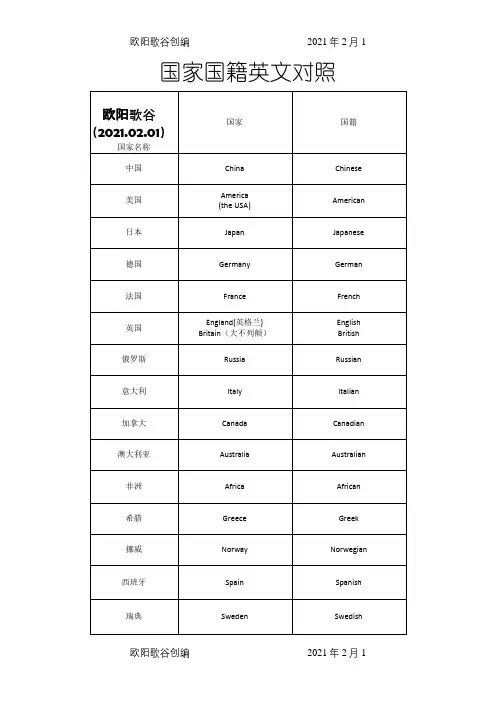
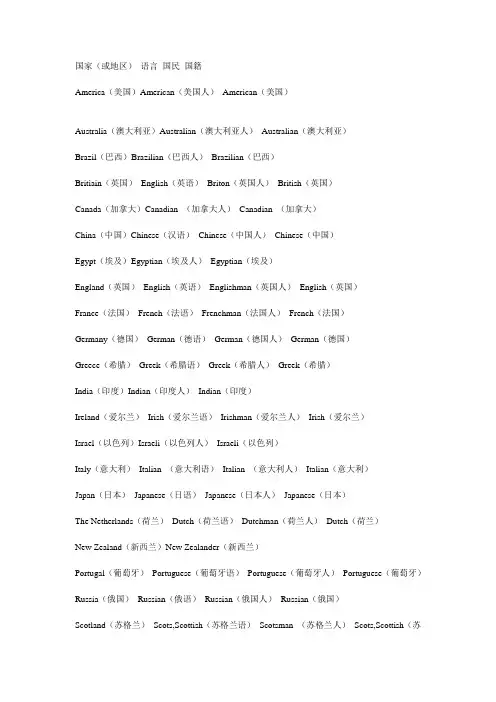
国家(或地区)语言国民国籍America(美国)American(美国人)American(美国)Australia(澳大利亚)Australian(澳大利亚人)Australian(澳大利亚)Brazil(巴西)Brazilian(巴西人)Brazilian(巴西)Britiain(英国)English(英语)Briton(英国人)British(英国)Canada(加拿大)Canadian (加拿大人)Canadian (加拿大)China(中国)Chinese(汉语)Chinese(中国人)Chinese(中国)Egypt(埃及)Egyptian(埃及人)Egyptian(埃及)England(英国)English(英语)Englishman(英国人)English(英国)France(法国)French(法语)Frenchman(法国人)French(法国)Germany(德国)German(德语)German(德国人)German(德国)Greece(希腊)Greek(希腊语)Greek(希腊人)Greek(希腊)India(印度)Indian(印度人)Indian(印度)Ireland(爱尔兰)Irish(爱尔兰语)Irishman(爱尔兰人)Irish(爱尔兰)Israel(以色列)Israeli(以色列人)Israeli(以色列)Italy(意大利)Italian (意大利语)Italian (意大利人)Italian(意大利)Japan(日本)Japanese(日语)Japanese(日本人)Japanese(日本)The Netherlands(荷兰)Dutch(荷兰语)Dutchman(荷兰人)Dutch(荷兰)New Zealand(新西兰)New Zealander(新西兰)Portugal(葡萄牙)Portuguese(葡萄牙语)Portuguese(葡萄牙人)Portuguese(葡萄牙)Russia(俄国)Russian(俄语)Russian(俄国人)Russian(俄国)Scotland(苏格兰)Scots,Scottish(苏格兰语)Scotsman (苏格兰人)Scots,Scottish(苏格兰)Spain(西班牙)Spanish(西班牙语)Spaniard(西班牙人)Spanish(西班牙)Sweden(瑞典)Swedish(瑞典语)Swedish(瑞典人)Swedish(瑞典)Switzerland(瑞士) Swiss(瑞士人)Swiss(瑞士)Wales(威尔士)Welsh(威尔士语)Welshman(威尔士人)Welsh(威尔士),,,,,,,国家(或地区)语言国民国籍,,America(美国)American(美国人)American(美国),,,Australia(澳大利亚)Australian(澳大利亚人)Australian(澳大利亚),,Brazil(巴西)Brazilian(巴西人)Brazilian(巴西),,Britiain(英国)English(英语)Briton(英国人)British(英国),,Canada(加拿大)Canadian (加拿大人)Canadian (加拿大),,China(中国)Chinese(汉语)Chinese(中国人)Chinese(中国),,Egypt(埃及)Egyptian(埃及人)Egyptian(埃及),,England(英国)English(英语)Englishman(英国人)English(英国),,France(法国)French(法语)Frenchman(法国人)French(法国),,Germany(德国)German(德语)German(德国人)German(德国),,Greece(希腊)Greek(希腊语)Greek(希腊人)Greek(希腊),,India(印度)Indian(印度人)Indian(印度),,Ireland(爱尔兰)Irish(爱尔兰语)Irishman(爱尔兰人)Irish(爱尔兰),,Israel(以色列)Israeli(以色列人)Israeli(以色列),,Italy(意大利)Italian (意大利语)Italian (意大利人)Italian(意大利),,Japan(日本)Japanese(日语)Japanese(日本人)Japanese(日本),,The Netherlands(荷兰)Dutch(荷兰语)Dutchman(荷兰人)Dutch(荷兰),,New Zealand(新西兰)New Zealander(新西兰),,Portugal(葡萄牙)Portuguese(葡萄牙语)Portuguese(葡萄牙人)Portuguese(葡萄牙),,Russia(俄国)Russian(俄语)Russian(俄国人)Russian(俄国),,Scotland(苏格兰)Scots,Scottish(苏格兰语)Scotsman (苏格兰人)Scots,Scottish(苏格兰),,Spain(西班牙)Spanish(西班牙语)Spaniard(西班牙人)Spanish(西班牙),,Sweden(瑞典)Swedish(瑞典语)Swedish(瑞典人)Swedish(瑞典),,Switzerland(瑞士) Swiss(瑞士人)Swiss(瑞士),,Wales(威尔士)Welsh(威尔士语)Welshman(威尔士人)Welsh(威尔士),,,,,,,国家(或地区)语言国民国籍,,America(美国)American(美国人)American(美国),,,Australia(澳大利亚)Australian(澳大利亚人)Australian(澳大利亚),,Brazil(巴西)Brazilian(巴西人)Brazilian(巴西),,Britiain(英国)English(英语)Briton(英国人)British(英国),,Canada(加拿大)Canadian (加拿大人)Canadian (加拿大),,China(中国)Chinese(汉语)Chinese(中国人)Chinese(中国),,Egypt(埃及)Egyptian(埃及人)Egyptian(埃及),,England(英国)English(英语)Englishman(英国人)English(英国),,France(法国)French(法语)Frenchman(法国人)French(法国),,Germany(德国)German(德语)German(德国人)German(德国),,Greece(希腊)Greek(希腊语)Greek(希腊人)Greek(希腊),,India(印度)Indian(印度人)Indian(印度),,Ireland(爱尔兰)Irish(爱尔兰语)Irishman(爱尔兰人)Irish(爱尔兰),,Israel(以色列)Israeli(以色列人)Israeli(以色列),,Italy(意大利)Italian (意大利语)Italian (意大利人)Italian(意大利),,Japan(日本)Japanese(日语)Japanese(日本人)Japanese(日本),,The Netherlands(荷兰)Dutch(荷兰语)Dutchman(荷兰人)Dutch(荷兰),,New Zealand(新西兰)New Zealander(新西兰),,Portugal(葡萄牙)Portuguese(葡萄牙语)Portuguese(葡萄牙人)Portuguese(葡萄牙),,Russia(俄国)Russian(俄语)Russian(俄国人)Russian(俄国),,Scotland(苏格兰)Scots,Scottish(苏格兰语)Scotsman (苏格兰人)Scots,Scottish(苏格兰),,Spain(西班牙)Spanish(西班牙语)Spaniard(西班牙人)Spanish(西班牙),,Sweden(瑞典)Swedish(瑞典语)Swedish(瑞典人)Swedish(瑞典),,Switzerland(瑞士) Swiss(瑞士人)Swiss(瑞士),,Wales(威尔士)Welsh(威尔士语)Welshman(威尔士人)Welsh(威尔士),,,,,,,国家(或地区)语言国民国籍,,America(美国)American(美国人)American(美国),,,Australia(澳大利亚)Australian(澳大利亚人)Australian(澳大利亚),,Brazil(巴西)Brazilian(巴西人)Brazilian(巴西),,Britiain(英国)English(英语)Briton(英国人)British(英国),,Canada(加拿大)Canadian (加拿大人)Canadian (加拿大),,China(中国)Chinese(汉语)Chinese(中国人)Chinese(中国),,Egypt(埃及)Egyptian(埃及人)Egyptian(埃及),,England(英国)English(英语)Englishman(英国人)English(英国),,France(法国)French(法语)Frenchman(法国人)French(法国),,Germany(德国)German(德语)German(德国人)German(德国),,Greece(希腊)Greek(希腊语)Greek(希腊人)Greek(希腊),,India(印度)Indian(印度人)Indian(印度),,Ireland(爱尔兰)Irish(爱尔兰语)Irishman(爱尔兰人)Irish(爱尔兰),,Israel(以色列)Israeli(以色列人)Israeli(以色列),,Italy(意大利)Italian (意大利语)Italian (意大利人)Italian(意大利),,Japan(日本)Japanese(日语)Japanese(日本人)Japanese(日本),,The Netherlands(荷兰)Dutch(荷兰语)Dutchman(荷兰人)Dutch(荷兰),,New Zealand(新西兰)New Zealander(新西兰),,Portugal(葡萄牙)Portuguese(葡萄牙语)Portuguese(葡萄牙人)Portuguese(葡萄牙),,Russia(俄国)Russian(俄语)Russian(俄国人)Russian(俄国),,Scotland(苏格兰)Scots,Scottish(苏格兰语)Scotsman (苏格兰人)Scots,Scottish(苏格兰),,Spain(西班牙)Spanish(西班牙语)Spaniard(西班牙人)Spanish(西班牙),,Sweden(瑞典)Swedish(瑞典语)Swedish(瑞典人)Swedish(瑞典),,Switzerland(瑞士) Swiss(瑞士人)Swiss(瑞士),,Wales(威尔士)Welsh(威尔士语)Welshman(威尔士人)Welsh(威尔士),,,,,,,国家(或地区)语言国民国籍,,America(美国)American(美国人)American(美国),,,Australia(澳大利亚)Australian(澳大利亚人)Australian(澳大利亚),,Brazil(巴西)Brazilian(巴西人)Brazilian(巴西),,Britiain(英国)English(英语)Briton(英国人)British(英国),,Canada(加拿大)Canadian (加拿大人)Canadian (加拿大),,China(中国)Chinese(汉语)Chinese(中国人)Chinese(中国),,Egypt(埃及)Egyptian(埃及人)Egyptian(埃及),,England(英国)English(英语)Englishman(英国人)English(英国),,France(法国)French(法语)Frenchman(法国人)French(法国),,Germany(德国)German(德语)German(德国人)German(德国),,Greece(希腊)Greek(希腊语)Greek(希腊人)Greek(希腊),,India(印度)Indian(印度人)Indian(印度),,Ireland(爱尔兰)Irish(爱尔兰语)Irishman(爱尔兰人)Irish(爱尔兰),,Israel(以色列)Israeli(以色列人)Israeli(以色列),,Italy(意大利)Italian (意大利语)Italian (意大利人)Italian(意大利),,Japan(日本)Japanese(日语)Japanese(日本人)Japanese(日本),,The Netherlands(荷兰)Dutch(荷兰语)Dutchman(荷兰人)Dutch(荷兰),,New Zealand(新西兰)New Zealander(新西兰),,Portugal(葡萄牙)Portuguese(葡萄牙语)Portuguese(葡萄牙人)Portuguese(葡萄牙),,Russia(俄国)Russian(俄语)Russian(俄国人)Russian(俄国),,Scotland(苏格兰)Scots,Scottish(苏格兰语)Scotsman (苏格兰人)Scots,Scottish(苏格兰),,Spain(西班牙)Spanish(西班牙语)Spaniard(西班牙人)Spanish(西班牙),,Sweden(瑞典)Swedish(瑞典语)Swedish(瑞典人)Swedish(瑞典),,Switzerland(瑞士) Swiss(瑞士人)Swiss(瑞士),,Wales(威尔士)Welsh(威尔士语)Welshman(威尔士人)Welsh(威尔士),,,,,,,国家(或地区)语言国民国籍,,America(美国)American(美国人)American(美国),,,Australia(澳大利亚)Australian(澳大利亚人)Australian(澳大利亚),,Brazil(巴西)Brazilian(巴西人)Brazilian(巴西),,Britiain(英国)English(英语)Briton(英国人)British(英国),,Canada(加拿大)Canadian (加拿大人)Canadian (加拿大),,China(中国)Chinese(汉语)Chinese(中国人)Chinese(中国),,Egypt(埃及)Egyptian(埃及人)Egyptian(埃及),,England(英国)English(英语)Englishman(英国人)English(英国),,France(法国)French(法语)Frenchman(法国人)French(法国),,Germany(德国)German(德语)German(德国人)German(德国),,Greece(希腊)Greek(希腊语)Greek(希腊人)Greek(希腊),,India(印度)Indian(印度人)Indian(印度),,Ireland(爱尔兰)Irish(爱尔兰语)Irishman(爱尔兰人)Irish(爱尔兰),,Israel(以色列)Israeli(以色列人)Israeli(以色列),,Italy(意大利)Italian (意大利语)Italian (意大利人)Italian(意大利),,Japan(日本)Japanese(日语)Japanese(日本人)Japanese(日本),,The Netherlands(荷兰)Dutch(荷兰语)Dutchman(荷兰人)Dutch(荷兰),,New Zealand(新西兰)New Zealander(新西兰),,Portugal(葡萄牙)Portuguese(葡萄牙语)Portuguese(葡萄牙人)Portuguese(葡萄牙),,Russia(俄国)Russian(俄语)Russian(俄国人)Russian(俄国),,Scotland(苏格兰)Scots,Scottish(苏格兰语)Scotsman (苏格兰人)Scots,Scottish(苏格兰),,Spain(西班牙)Spanish(西班牙语)Spaniard(西班牙人)Spanish(西班牙),,Sweden(瑞典)Swedish(瑞典语)Swedish(瑞典人)Swedish(瑞典),,Switzerland(瑞士) Swiss(瑞士人)Swiss(瑞士),,Wales(威尔士)Welsh(威尔士语)Welshman(威尔士人)Welsh(威尔士),,,,,,,国家(或地区)语言国民国籍,,America(美国)American(美国人)American(美国),,,Australia(澳大利亚)Australian(澳大利亚人)Australian(澳大利亚),,Brazil(巴西)Brazilian(巴西人)Brazilian(巴西),,Britiain(英国)English(英语)Briton(英国人)British(英国),,Canada(加拿大)Canadian (加拿大人)Canadian (加拿大),,China(中国)Chinese(汉语)Chinese(中国人)Chinese(中国),,Egypt(埃及)Egyptian(埃及人)Egyptian(埃及),,England(英国)English(英语)Englishman(英国人)English(英国),,France(法国)French(法语)Frenchman(法国人)French(法国),,Germany(德国)German(德语)German(德国人)German(德国),,Greece(希腊)Greek(希腊语)Greek(希腊人)Greek(希腊),,India(印度)Indian(印度人)Indian(印度),,Ireland(爱尔兰)Irish(爱尔兰语)Irishman(爱尔兰人)Irish(爱尔兰),,Israel(以色列)Israeli(以色列人)Israeli(以色列),,Italy(意大利)Italian (意大利语)Italian (意大利人)Italian(意大利),,Japan(日本)Japanese(日语)Japanese(日本人)Japanese(日本),,The Netherlands(荷兰)Dutch(荷兰语)Dutchman(荷兰人)Dutch(荷兰),,New Zealand(新西兰)New Zealander(新西兰),,Portugal(葡萄牙)Portuguese(葡萄牙语)Portuguese(葡萄牙人)Portuguese(葡萄牙),,Russia(俄国)Russian(俄语)Russian(俄国人)Russian(俄国),,Scotland(苏格兰)Scots,Scottish(苏格兰语)Scotsman (苏格兰人)Scots,Scottish(苏格兰),,Spain(西班牙)Spanish(西班牙语)Spaniard(西班牙人)Spanish(西班牙),,Sweden(瑞典)Swedish(瑞典语)Swedish(瑞典人)Swedish(瑞典),,Switzerland(瑞士) Swiss(瑞士人)Swiss(瑞士),,Wales(威尔士)Welsh(威尔士语)Welshman(威尔士人)Welsh(威尔士),,,,,,,国家(或地区)语言国民国籍,,America(美国)American(美国人)American(美国),,,Australia(澳大利亚)Australian(澳大利亚人)Australian(澳大利亚),,Brazil(巴西)Brazilian(巴西人)Brazilian(巴西),,Britiain(英国)English(英语)Briton(英国人)British(英国),,Canada(加拿大)Canadian (加拿大人)Canadian (加拿大),,China(中国)Chinese(汉语)Chinese(中国人)Chinese(中国),,Egypt(埃及)Egyptian(埃及人)Egyptian(埃及),,England(英国)English(英语)Englishman(英国人)English(英国),,France(法国)French(法语)Frenchman(法国人)French(法国),,Germany(德国)German(德语)German(德国人)German(德国),,Greece(希腊)Greek(希腊语)Greek(希腊人)Greek(希腊),,India(印度)Indian(印度人)Indian(印度),,Ireland(爱尔兰)Irish(爱尔兰语)Irishman(爱尔兰人)Irish(爱尔兰),,Israel(以色列)Israeli(以色列人)Israeli(以色列),,Italy(意大利)Italian (意大利语)Italian (意大利人)Italian(意大利),,Japan(日本)Japanese(日语)Japanese(日本人)Japanese(日本),,The Netherlands(荷兰)Dutch(荷兰语)Dutchman(荷兰人)Dutch(荷兰),,New Zealand(新西兰)New Zealander(新西兰),,Portugal(葡萄牙)Portuguese(葡萄牙语)Portuguese(葡萄牙人)Portuguese(葡萄牙),,Russia(俄国)Russian(俄语)Russian(俄国人)Russian(俄国),,Scotland(苏格兰)Scots,Scottish(苏格兰语)Scotsman (苏格兰人)Scots,Scottish(苏格兰),,Spain(西班牙)Spanish(西班牙语)Spaniard(西班牙人)Spanish(西班牙),,Sweden(瑞典)Swedish(瑞典语)Swedish(瑞典人)Swedish(瑞典),,Switzerland(瑞士) Swiss(瑞士人)Swiss(瑞士),,Wales(威尔士)Welsh(威尔士语)Welshman(威尔士人)Welsh(威尔士),,,,,,,国家(或地区)语言国民国籍,,America(美国)American(美国人)American(美国),,,Australia(澳大利亚)Australian(澳大利亚人)Australian(澳大利亚),,Brazil(巴西)Brazilian(巴西人)Brazilian(巴西),,Britiain(英国)English(英语)Briton(英国人)British(英国),,Canada(加拿大)Canadian (加拿大人)Canadian (加拿大),,China(中国)Chinese(汉语)Chinese(中国人)Chinese(中国),,Egypt(埃及)Egyptian(埃及人)Egyptian(埃及),,England(英国)English(英语)Englishman(英国人)English(英国),,France(法国)French(法语)Frenchman(法国人)French(法国),,Germany(德国)German(德语)German(德国人)German(德国),,Greece(希腊)Greek(希腊语)Greek(希腊人)Greek(希腊),,India(印度)Indian(印度人)Indian(印度),,Ireland(爱尔兰)Irish(爱尔兰语)Irishman(爱尔兰人)Irish(爱尔兰),,Israel(以色列)Israeli(以色列人)Israeli(以色列),,Italy(意大利)Italian (意大利语)Italian (意大利人)Italian(意大利),,Japan(日本)Japanese(日语)Japanese(日本人)Japanese(日本),,The Netherlands(荷兰)Dutch(荷兰语)Dutchman(荷兰人)Dutch(荷兰),,New Zealand(新西兰)New Zealander(新西兰),,Portugal(葡萄牙)Portuguese(葡萄牙语)Portuguese(葡萄牙人)Portuguese(葡萄牙),,Russia(俄国)Russian(俄语)Russian(俄国人)Russian(俄国),,Scotland(苏格兰)Scots,Scottish(苏格兰语)Scotsman (苏格兰人)Scots,Scottish(苏格兰),,Spain(西班牙)Spanish(西班牙语)Spaniard(西班牙人)Spanish(西班牙),,Sweden(瑞典)Swedish(瑞典语)Swedish(瑞典人)Swedish(瑞典),,Switzerland(瑞士) Swiss(瑞士人)Swiss(瑞士),,Wales(威尔士)Welsh(威尔士语)Welshman(威尔士人)Welsh(威尔士),,,,,,,国家(或地区)语言国民国籍,,America(美国)American(美国人)American(美国),,,Australia(澳大利亚)Australian(澳大利亚人)Australian(澳大利亚),,Brazil(巴西)Brazilian(巴西人)Brazilian(巴西),,Britiain(英国)English(英语)Briton(英国人)British(英国),,Canada(加拿大)Canadian (加拿大人)Canadian (加拿大),,China(中国)Chinese(汉语)Chinese(中国人)Chinese(中国),,Egypt(埃及)Egyptian(埃及人)Egyptian(埃及),,England(英国)English(英语)Englishman(英国人)English(英国),,France(法国)French(法语)Frenchman(法国人)French(法国),,Germany(德国)German(德语)German(德国人)German(德国),,Greece(希腊)Greek(希腊语)Greek(希腊人)Greek(希腊),,India(印度)Indian(印度人)Indian(印度),,Ireland(爱尔兰)Irish(爱尔兰语)Irishman(爱尔兰人)Irish(爱尔兰),,Israel(以色列)Israeli(以色列人)Israeli(以色列),,Italy(意大利)Italian (意大利语)Italian (意大利人)Italian(意大利),,Japan(日本)Japanese(日语)Japanese(日本人)Japanese(日本),,The Netherlands(荷兰)Dutch(荷兰语)Dutchman(荷兰人)Dutch(荷兰),,New Zealand(新西兰)New Zealander(新西兰),,Portugal(葡萄牙)Portuguese(葡萄牙语)Portuguese(葡萄牙人)Portuguese(葡萄牙),,Russia(俄国)Russian(俄语)Russian(俄国人)Russian(俄国),,Scotland(苏格兰)Scots,Scottish(苏格兰语)Scotsman (苏格兰人)Scots,Scottish(苏格兰),,Spain(西班牙)Spanish(西班牙语)Spaniard(西班牙人)Spanish(西班牙),,Sweden(瑞典)Swedish(瑞典语)Swedish(瑞典人)Swedish(瑞典),,Switzerland(瑞士) Swiss(瑞士人)Swiss(瑞士),Wales(威尔士)Welsh(威尔士语)Welshman(威尔士人)Welsh(威尔士),,,,,,,国家(或地区)语言国民国籍,,America(美国)American(美国人)American(美国),,,Australia(澳大利亚)Australian(澳大利亚人)Australian(澳大利亚),,Brazil(巴西)Brazilian(巴西人)Brazilian(巴西),,Britiain(英国)English(英语)Briton(英国人)British(英国),,Canada(加拿大)Canadian (加拿大人)Canadian (加拿大),,China(中国)Chinese(汉语)Chinese(中国人)Chinese(中国),,Egypt(埃及)Egyptian(埃及人)Egyptian(埃及),,England(英国)English(英语)Englishman(英国人)English(英国),,France(法国)French(法语)Frenchman(法国人)French(法国),,Germany(德国)German(德语)German(德国人)German(德国),,Greece(希腊)Greek(希腊语)Greek(希腊人)Greek(希腊),,India(印度)Indian(印度人)Indian(印度),,Ireland(爱尔兰)Irish(爱尔兰语)Irishman(爱尔兰人)Irish(爱尔兰),,Israel(以色列)Israeli(以色列人)Israeli(以色列),,Italy(意大利)Italian (意大利语)Italian (意大利人)Italian(意大利),,Japan(日本)Japanese(日语)Japanese(日本人)Japanese(日本),,The Netherlands(荷兰)Dutch(荷兰语)Dutchman(荷兰人)Dutch(荷兰),,New Zealand(新西兰)New Zealander(新西兰),,Portugal(葡萄牙)Portuguese(葡萄牙语)Portuguese(葡萄牙人)Portuguese(葡萄牙),,Russia(俄国)Russian(俄语)Russian(俄国人)Russian(俄国),Scotland(苏格兰)Scots,Scottish(苏格兰语)Scotsman (苏格兰人)Scots,Scottish(苏格兰),,Spain(西班牙)Spanish(西班牙语)Spaniard(西班牙人)Spanish(西班牙),,Sweden(瑞典)Swedish(瑞典语)Swedish(瑞典人)Swedish(瑞典),,Switzerland(瑞士) Swiss(瑞士人)Swiss(瑞士),,Wales(威尔士)Welsh(威尔士语)Welshman(威尔士人)Welsh(威尔士)..。

(第1关)欧阳歌谷(2021.02.01)1、原谅(打扰)2、我3、是的4、是5、这6、你的7、手提包8、原谅9、它10、感谢你11、非常地12、钢笔13、铅笔14、书15、手表16、衬衫17、上衣18、连衣裙19、裙子20、小汽车(第2关)1、房子2、雨伞3、请4、这里5、我的6、票7、数字8、五9、对不起10、先生11、衣帽间12、一套衣服13、学校14、教师15、儿子16、女儿17、先生18、好19、早上20、小姐(第3关)1、新的2、学生3、法国人4、德国人5、美好的6、遇见7、日本人8、工程师9、中国人10、也11、我12、是13、是14、名字15、什么16、国籍17、工作18、键盘19、操作员20、工程师(第4关)1、警察2、女警察3、出租车司机4、空姐5、邮递员6、护士7、机械师8、理发师9、家庭主妇10、送牛奶的人11、喂12、嗨13、怎样14、今天15、身体好16、美好的17、谢谢18、再见19、看见20、肥的(第5关)1、女人2、瘦的3、高的4、矮的5、脏的6、干净的7、热的8、冷的9、老的10、年轻的11、忙碌的12、懒惰的13、谁的14、蓝色的15、或许16、白色的17、抓住18、父亲19、母亲20、女衬衫(第6关)1、姐、妹2、领事3、兄弟4、他的5、她的6、颜色7、绿色8、来9、楼上10、漂亮的11、帽子12、相同的13、可爱的14、箱子15、地毯16、狗17、海关18、官员19、女孩20、丹麦的(第7关)1、朋友2、挪威的3、护照4、棕色的5、旅游者6、俄罗斯的7、荷兰的8、这些9、红色的10、灰色的11、黄色的12、黑色的13、橙色的14、雇员15、勤奋的16、推销员17、男人18、办公室19、助手20、事情(第8关)1、孩子们2、累的3、男孩4、口渴的5、坐下6、好,可以7、冰淇淋8、大的9、小的10、开着的11、关闭的12、轻的13、重的14、长的15、鞋子16、祖父17、祖母18、给19、一个20、哪一个(第9关)1、空的2、满的3、大的4、小的5、锐利的6、小的7、大的8、钝的9、盒子10、玻璃杯11、茶杯12、瓶子13、罐头14、刀子15、叉16、勺子17、在…之上18、架子19、课桌20、桌子(第10关)1、杯子2、在哪里3、在…里4、客厅5、靠近6、窗户7、扶手椅8、门9、图片10、墙11、裤子12、关上13、卧室14、不整齐15、必须16、打开17、通风18、放19、衣服20、大衣柜(第11关)1、盘子2、食橱3、香烟4、电视5、地板6、梳妆台7、杂志8、床9、报纸10、立体声音箱11、夫人12、厨房13、冰箱14、右边15、带电的16、左边17、炉子18、中间19、…的20、房间(第12关)1、掸掉地上的灰尘2、扫3、倒空4、读5、削尖6、穿上7、脱掉8、开(电灯)9、关(电灯)10、花园11、之下12、树13、爬14、谁15、跑16、草地17、之后18、穿过19、猫20、打字(第13关)1、信2、篮子3、吃4、骨头5、清洗6、牙齿7、做饭菜8、牛奶9、饭10、喝11、(水)龙头12、日子13、云14、天空15、太阳16、照耀17、和一起18、家庭19、走路20、跨越(第14关)1、桥2、船3、河4、轮船5、飞机6、飞7、睡觉8、刮脸9、哭10、洗11、等12、跳13、照片14、村庄15、之间16、小山17、另一个18、妻子19、沿着20、河岸(第15关)1、水2、游泳3、大楼4、公园5、进入6、在…旁7、离开8、工作9、努力地10、做11、书橱12、锤子13、涂14、粉色15、最喜欢的16、作业17、听18、碟子19、前面20、小心的(第16关)1、花瓶2、掉下3、花4、给看5、送给6、带给7、奶酷8、面包9、肥皂10、巧克力11、糖12、咖啡13、茶14、烟草15、鸟16、一些17、一些18、当然19、水壶20、在…后面(第17关)1、茶壶2、现在3、找到4、沸腾5、能够6、老板7、分钟8、请求9、书写10、糟糕的11、拿起12、蛋糕13、饼干14、喜欢15、想16、新鲜的17、鸡蛋18、黄油19、纯净的20、蜂蜜(第18关)1、成熟的2、香蕉3、果酱4、甜的5、橙6、英格兰威士忌7、上等的8、苹果9、果酒10、啤酒11、黑板12、卖肉的13、肉14、牛肉15、羔羊肉16、丈夫17、牛排18、肉馅19、鸡20、告诉(第19关)1、事实2、也3、西红柿4、土豆5、卷心菜6、莴苣7、豌豆8、豆角9、梨10、葡萄11、桃12、希腊13、气候14、国家15、宜人的16、天气17、春季18、有风的19、温暖的20、下雨(第20关)1、有时2、春季3、秋天4、冬天5、下雪6、一月7、二月8、三月9、四月10、五月11、六月12、七月13、八月14、九月15、十月16、十一月17、十二月18、美国19、巴西20、荷兰(第21关)1、英国2、法国3、德国4、意大利5、挪威6、俄罗斯7、西班牙8、瑞典9、温和的10、总是11、北方12、东方13、西方14、南方15、季节16、最好17、夜晚18、升起19、早20、落下21、晚,迟22、有趣的23、话题24、谈话25、澳大利亚26、澳大利亚人27、奥地利28、奥地利人29、加拿大30、加拿大人(第22关)1、中国2、芬兰3、芬兰人4、印度5、印度人6、日本7、土耳其8、土耳其人9、韩国10、波兰人11、波兰12、泰国人13、泰国14、住15、呆在16、家17、家务18、午饭19、下午20、通常21、一起22、晚上23、到达24、点钟25、商店26、片刻27、信封28、信纸29、售货员30、尺寸(第23关)1、信笺簿2、胶水3、粉笔4、零钱5、感觉6、看起来7、必须8、叫9、医生10、电话11、记住12、嘴13、舌头14、严重的15、感冒16、新闻17、头痛18、阿司匹林19、耳痛20、头痛21、牙痛22、胃痛23、药24、温度25、流感26、麻疹27、腮腺炎28、更好的29、当然30、起床(第24关)1、还2、油腻的3、食物4、保持5、玩6、火柴7、谈话8、图书馆9、驾驶10、如此地11、快地12、身体探出13、打破14、喧闹声15、爸16、钥匙17、婴儿18、听见19、玩得快活20、你自己21、我们自己22、妈妈23、我自己24、他们自己25、他自己26、她自己27、水果零售商28、缺席的29、星期一30、星期二(第25关)1、星期三2、星期四3、保持4、度过5、周末6、星期五7、星期六8、星期日9、乡村10、幸运的11、教堂12、乳品店13、面包师傅14、杂货商15、年16、比赛17、城镇18、人群19、站立20、使人激动的21、正好22、结束23、获胜者24、之后25、路途26、文具商27、丹麦28、坏的29、电话30、次(数)(第26关)1、接(电话)2、最后的3、电话4、又一次5、说6、周7、伦敦8、突然地9、公共汽车站10、微笑11、愉快地12、明白13、说14、手15、衣袋16、短语手册17、短语18、缓慢地19、匆忙地20、切21、口渴地22、走23、问候24、以前25、买26、对27、流行28、不舒服的29、穿着30、约会(第27关)1、紧急的2、直到为止3、购物4、单子5、蔬菜6、需要7、希望8、事情9、钱10、杂货11、水果12、文具13、报刊商14、药剂师15、洗澡16、几乎17、正餐18、饭馆19、烤的20、早餐21、理发22、聚会23、假日24、杂乱25、包装26、手提箱27、离开28、已经29、巴黎30、电影院(第28关)1、电影2、美丽的3、城市4、从不5、任何时候6、接待员7、带来8、修理厂9、碰撞10、灯杆11、修理12、努力13、相信14、可以15、多长16、自从17、为什么18、卖19、因为20、退休21、花费22、英磅23、值…钱24、便士25、仍旧26、搬家27、想念28、邻居29、人30、人们(第29关)1、可怜的2、飞行员3、返回4、纽约5、东京6、马德里7、飞行8、雅典9、罗马10、莫斯科11、首尔12、悉尼13、往返14、火车15、站台16、大量17、酒吧18、火车站19、收票员20、赶上21、错过22、遗留23、描述24、拉链25、标签26、把手27、地址28、便士(复数)29、属于30、哎哟(第30关)1、滑倒2、落下3、下楼4、伤害5、背6、站立7、帮助8、立即9、确信的10、X光透视11、执照12、苏格兰13、明信片14、青年15、招待所16、协会17、不久18、写19、考试20、通过21、数学22、问题23、容易的24、足够地25、考卷26、失败27、回答28、分数29、其他的30、困难的(第31关)1、讨厌2、低的3、振作4、家伙5、上方6、聪明的7、笨的8、便宜的9、贵的10、新鲜的11、变馊的12、矮的13、大声的14、高的15、硬的16、甜的17、软的18、酸的19、拼写20、聪明的21、错误22、礼物23、词典24、携带25、改正26、保留27、夫人28、漂亮的29、同样30、适于(第32关)1、漂亮的2、主意3、少许4、一满茶匙5、较少的6、几个7、遗憾8、代替9、建议10、最多的11、最少的12、最好的13、更坏的14、最好的15、型号16、付得起17、预付定金18、分期付款19、价格20、百万富翁21、售票员22、车费23、兑换24、纸币25、乘客26、没有27、也不28、下车29、流浪汉30、除外(第33关)1、任何人2、敲打3、一切事物4、安静的5、不可能的6、邀请7、任何东西8、没有东西9、柠檬水10、开玩笑11、睡着的12、眼镜13、餐厅14、硬币15、嘴16、吞下17、后来18、厕所19、故事20、发生21、贼22、进入23、黑暗的24、手电筒25、声音26、鹦鹉27、顾客28、忘记29、经理30、服务(第34关)1、柜台2、认出3、路4、期间5、旅行6、旅行7、提供8、工作9、猜10、生长11、胡子12、小猫13、浇水14、非常15、干燥的16、讨厌的人17、意味着18、惊奇19、立即地20、著名的21、女演员22、至少23、男演员24、读25、招手26、跑道27、英里28、超车29、速度30、做梦(第35关)1、标记2、驾驶执照3、罚款4、亲爱的5、埃及6、国外7、担忧8、记者9、爆炸性的10、貂皮大衣11、未来的12、结婚13、饭店14、最新的15、介绍16、足球17、赌注18、赢19、世界20、贫穷的21、依靠22、额外的23、国外的24、工程25、公司26、线路27、兴奋的28、登上29、中年的30、对面(第36关)1、好奇地2、可笑的3、香粉4、化装盒5、和蔼地6、丑陋的7、有趣的8、微笑9、尴尬的10、担心的11、经常地12、包围13、树林14、风景点15、百30、依法处理16、城市17、穿过18、参观者19、整齐的20、垃圾21、放22、扔23、垃圾24、数25、覆盖26、碎片27、轮胎28、生锈的29、在之间。

判断题第一单元1、Britain is no longer an imperial(帝国) country(T)2、The Commonwealth(英联邦)of Nations includes all European countries(F)3、1 in 10 of the British population are of non-European ethnicity(种族)(F)4、The stereotype(刻板印象) of the English gentleman never applied to the majority of the British people(T)5、When people outside the UK talk about England, they mistake it as Britain sometimes(T)6、The Scots and Welsh(苏格兰和威尔士)have a strong sense of being British(F)7、Scotland(苏格兰)was never conquered by the Romans (罗马人)(T)8、Most people in Scotland speak the Celtic(凯尔特)language, called “Gaelic”(F)9、Scotland was unified with England through peaceful means(T)10、Wales(威尔士) is rich in coal(煤炭) deposits(存款)(T)11、Cardiff(卡迪夫), the capital of Wales, is a large city(F)12、The title of Prince(王子) of Wales is held by a held by a Welsh according to tradition(F)第二单元1、Ireland is part of Great Britain(F)2、“Ulster(阿尔斯特)”, referring to Northern Ireland, was once an ancient Irish Kingdom(王国)(T)3、The capital of Belfast(贝尔法斯特) is a large city with halfa million people(F)4、Northern Ireland is significant(重要的)because of its manufacturing(制造业) industry(F)5、The majority of Irish people were descendants(后代)of the original Celtic(凯尔特) people who inhabited British Isles (群岛) before the Romans arrived 2000 years ago(T)6、Most British people are Protestants(新教徒)while most Irish people are Catholics(天主教徒)(T)7、The British government does not have direct rule from London over Northern Ireland(T)8、Sinn Fein(新芬党)is a legal political party in Northern Ireland(T)9、The Anglo-Irish(岗格鲁-爱尔兰)Agreement of 1985 guaranteed the loyalist(政府军)Protestant community(社区) their to decide their future in Northern Ireland(T)10、The Good Friday Agreement(协议) was approved on 10 April 1998(T)11、Northern Ireland today is governed by separate jurisdictions(司法管辖区): thatf Republic(共和国)of Ireland that of Great Britain(F)第三单元1、It is no doubt that Britain is the oldest representative democracy(民主) in the world(F)2、In Britain, the process of state-building(国家建设)has been one of evolution rather than revolution, contrast to France and the US(与法国和美国相比)(T)3、The oldest institution(机构)of government in Britain is the Monarchy(君主政体)(T)4、The divine(神圣的) right of the king means the sovereign (主权)derived(派生的)his authority(权威)from his subjects(主题)(F)5、As the king in theory had God on his side, it was thought that he should exercise absolute(绝对) power(F)6、The term “parliament(议会)”was first officially used in 1066 to describe the gathering of feudal barons(封建贵族)and representatives from counties and towns(F)7、Britain is both a parliamentary democracy(议会民主制)and a constitutional monarchy(君主立宪制)(T)8、Britain, like Israel, has a written constitution of the sort which most countries have(F)9、Common laws are laws which have been established(建立) through common practice(实践) in the courts(法院)(T)第四单元1、In the UK, a government cannot stand for longer than five years except in exceptional circumstances(情况下)(T)2、Anyone who is eligible(符合条件的)to vote with 500 pounds as deposit(存款) can stand as an MP(国会议员)(F)3、Each main party is given some time on national TV to “sell”their policies. The time is not given free and has to be paid by the party(T)4、The amount spent in national campaign(运动)is not limited other than that on TV(F)5、Secrecy(保密)is not an important part of the voting process(T)6、There are two major national parties in the U.K. according to the text(F)7、Liberal Democratic(自由民主)party is the newest of themajor national parties(F)8、Children from the upper-middle-class(中上层阶级)usually have a better education than those from the working or middle-class(T)9、The majority of middle-class people today have working class parents or grandparents(T)10、One of the distinctive features(独特的特征)about the British class-system is that it has also retained(保留) a hereditary aristocracy(世袭的贵族)(T)11、The majority of Britain’s recent immigrants have mainly come from North Asia(北亚)and Caribbean(加勒比)countries(F)12、Most immigrants earn a living by opening restaurants or becoming musicians(F)13、The majority have problems of unemployment published its Household Energy Management Strategy(家庭能源管理策略)(T)14、On March 2, 2010, the British government publish its Household Energy Management Strategy(T)15、On December 27, 2009 the TN Climate(气候)Change Conference was held in Copenhagen(T)16、According to the Kyoto Protocol(京都议定书), thegovernment has agreed that the UK will meet tough targets(艰难的目标)to reduce carbon emissions incrementally(增量)between now and 2020(F)第五单元1、By the 1880’s the British economy was dominant(主导) in the world(T)2、Both the US and Canada overtook Britain in economy by 1900(F)3、By the end of World War II, Britain had gone heavily into debt(债务)in order to develop its manufacturing industry and borrowed large amounts from the US and France(F)4、Another reason for British decline is the loss of its colonies (殖民地), especially India, which gained its independence in 1947(T)5、In the 1970s, with the soaring(飙升的)price of oil and high rates of inflation(通货膨胀), Britain went through a bad period. In 1979, the Labour party had to step down(下台)from the government (T)6、The leader of the Conservatives(保守派), Margaret Thatcher(玛格丽特-撒切尔)started a series of reforms. An extensive(广泛的)programme of privatization(私有的)was carried out, and she was successful in an all-round(全面的) way (F)7、Tertiary(三级)industries include banking, insurance(保险), tourism(旅游), agriculture and the selling of goods (F) 8、Britain has a large sector(部门)of agriculture producing 11.6% of its national wealth (F)9、According to the text, the tertiary(三级)industry produces approximately(大约)two-thirds of the national wealth (T)10、The service industry in the UK employs 70% of the total work force (T)11、As a member of the World Trade Organization, the UK is playing a very important role in the world trade (T)12、The UK is the third biggest international investor(投资者) in the world (F)第六单元1、Much early British literature was concerned with Christianity (基督教), and Anglo-Saxons(盎格鲁-撒克逊人) produced many versions(版本) of the Bible(圣经) (T)2、Beowulf(贝奥武夫) was a sea monster(海怪) killed by a Swedish warrior(瑞典战士) (F)3、“The Wife of Bath(浴的妻子)” is one of the tales(故事)contained in The Canterbury Tales(坎特伯雷故事集) (T)4、There was a general flowering of culture and intellectual(知识)life in Europe during the 17th and 18th century which is known as “The Renaissance(文艺复兴时期)”(F)5、William Shakespeare(威廉·莎士比亚)is a great poet and much is known of his life (F)6、Keats, Shelley and Byron(济慈、雪莱和拜伦) brought the Romantic Movement(浪漫主义运动) to its height (T)7、Robinson Crusoe(鲁宾逊漂流记)tells the story of a shipwreck and solitary survival(海难和孤独的生存) (T)8、Writers of romantic literature(浪漫主义文化)are more concerned with imagination and feeling than with the power of reason (T)9、Don Juan(唐璜)is an epic poem(史诗)composed by John Milton(约翰·弥尔顿) (F)10、Thomas Hardy(托马斯·哈代), the author of Tess of the D’Urbervilles(德伯家的苔丝), was also a first-class(一流的)poet (T)第七单元1、The purpose of British education is not only to provide children with literacy(读写能力) and the other basic skills but also to socialize(社交) children (T)2、The state seldom interferes(干扰)with the decision ofwhen, where, how and what children are taught (F)3、The enduring feature(持久特征) of British education is the continuing debate over what should be taught in schools (F)4、The 1944 Education Act made entry to secondary schools (中学) and universities “meritocratic(精英)” (T)5、Public schools are part of the national education system and funded by the government (F)6、British universities are public bodies which receive funds from central government (T)7、All secondary schools in Britain are run and supervised(监督) by the government (T)8、In Oxford and Cambridge the BA converts to an MA several years later, upon payment of a fee (T)9、Independent schools get money mainly through the private sector(部门)and tuition(学费)rates, with some government support (T)10、Grammar schools select children at the age of 11 and provide them with a general education (F)第八单元1、When the Second World War ended, Britain no longer was the largest military(军事) power in Western Europe (F)2、The UK was awarded(授予) a seat on the UN(联合国)Security Council(安理会)in recognition(识别)of its contribution in setting up the United Nations (F)3、According to the text, the most important single factor which influences British policy-maker is its history (T)4、The Prime Minister and Cabinet(内阁)decide on the general direction of Britain’s foreign policy (T)5、The main government department involved is the Foreign and Commonwealth Office(外交和联邦事务部)(FCO) (T)6、Britain is a parliamentary monarch(议会君主) (F)7、There are about 60 members of the Commonwealth(英联邦) (F)8、The British host a large American Military(军事) presence and there are 63 American military bases in the UK (T)9、Britain is not a member of the NATO(北约)due to its disagreement with some European countries on defence policy (F)第九单元1、On an average day, an overwhelming(压倒性的) majority of Britons over the age of 15 red a nation or local paper(报纸) (T)2、The British media play an important role in shaping(塑造)a national culture (T)3、In the late seventeenth and early 18th century, as the British economy began to industrialise, and as literacy levels rose through the introduction of mass education, more and newspapers began to appear (F)4、Free press has the function of keeping an eye on the government, and therefore it is called the watchdog(监管机构) of parliamentary democracy(议会民主制) (T)5、The Advertising Code(广告代码)ensures that advertisements are legal, decent(体面地), honest and truthful; have a sense of responsibility for consumer and society; and respect the principles of fair competition(竞争) (T)6、It is incorrect to say that class and educational differences are reflected in the newspapers people read (F)7、The Telegraph readers, for example, will be soft on crime (犯罪), be quite feminist(女权主义)and interested in green politics (F)8、The tabloids(小报)are smaller format(格式)newspapers with colour photos and catchy headlines(吸引人的标题). They are often called “the gutter press(黄色小报)” (T) 9、The British Broadcasting Corporation is funded by licence (许可证)fees and viewers must buy a licence each year for their TV set (T)10、The BBC(英国广播公司) World Service, the international branch of the BBC, broadcasts in English and 42 other languages throughout the world (T)第十单元1、The tradition of having Sunday off derived from(来自) the Christian Church(基督教堂) (T)2、The origin of Bowling(打保龄球)lies in the victory celebration ceremony(仪式) by the ancient warriors (T)3、Tennis(网球)is usually regarded as a winter and spring sport (F)4、The game of golf was invented by the Scottish(苏格兰) (T)5、The animal-lovers’groups would like to have horse racing banned(禁止) (T)6、Easter(复活节)is the biggest and best loved British holiday (F)7、Christmas Pantomime(哑剧) is one of the three Christmas traditions that are particularly British (T)8、It is commonly believed that Boxing Day involves the sport of boxing (F)9、The biggest Bonfire Night(篝火之夜) celebration is held in London (F)10、In Ireland, New Year’ Eve called Hogma除夕) (December31st) is the major winter celebration (T)选择题第一单元1、which of the following is NOT considered a characteristic of London? (D/The sports centre)2、Which of the following is NOT true about the characteristics of Britain? (B/Differences of social systems between Scotland and Wales(威尔士))3、Which of the following is NOT True about Britain? (D/It used to be one of the superpowers in the world)4、Three of the following are characteristics of London. Which of the four is the EXCEPTION? (C/London is not only the largest city in Britain, but also the largest in the world)5、The Tower of London, a historical sight, located in the centre of London, was built by (D/William the Conqueror)6、Who were the ancestors of the English and the founders of England? (A/The Anglo-Saxons(盎格鲁-撒克逊人))7、Which is the largest city in Scotland? (C/Glasgow(格拉斯哥))8、Why did the Scottish Kings decide to form an independent singular Scottish(奇异的苏格兰) state in the century? (A/They needed a unified independent nation to fight against Vikingraids(维京人袭击))9、Where do the majority of people in Scotland live? (B/In the Lowlands(低地))10、Which of the following statements is NOT true? (B/Wales was occupied by the Anglo-Saxons(盎格鲁-撒克逊人))11、Which of the following parties in Scotland still wants an independent Scotland? (C/The Scottish Nationalist(民族主义)Party)12、When did Scotland join the Union by agreement of the English and Scottish parliaments(议会)?(D/In 1701)13、Llywelyn ap Gruffudd is not a simple historical figure for the Welsh. He is almost considered the legendary(传奇) hero of Welsh nationalism because (D/he unified Wales as an independent nation)第二单元1、In the 17th century the English government encouraged people from Scotland and Northern England to emigrate to the north of Ireland, because (A/they wanted to increase its control over Ireland)2、In 1969, the first British soldiers were seen on Northern Ireland street. They came first (B/to protect Catholics(天主教徒))3、Northern Ireland is the smallest of the four nations, but is quite well-known in the world for (D/its endless political problems)4、Faced with conflicting demands the British government chose a compromise(妥协)and organized a partition of Ireland in 1921, because (B/the British government intended to satisfy both sides-Catholics(天主教)and Protestants(新教))5、Which of the following statements is NOT true? (C/The Social Democratic(社会民主党) and Labour Party(劳动党)is a very important political party in Britain)6、In the early 1970s, the IRA(爱尔兰共和军) (D/carried outa series of bombing and shooting and attacked the security force as their main target)7、1972 was the worst year of the political troubles in Northern Ireland, because (B/468 people were killed in Northern Ireland) 8、Why did the British government decide to replace the power-sharing policy with “direct-rule(直接统治)”from London? (D/All the above)9、Which of the following statements is NOT true? (C/Margaret Thatcher(玛格丽特-撒切尔)’s government gave in to their political demand)10、How many counties are there in Northern Ireland? (B/6)11、Which of the following agreement is accepted by both Catholics and Protestants in Northern Ireland? (C/The Good Friday Agreement)12、According to the Good Friday Agreement, Northern Ireland today should be governed by the following jurisdictions(司法管辖区) except (B/the jurisdiction of loyalist minist(部长))第三单元1、Which of the following is NOT a characteristic of British government? (A/It offers the Queen high political status and supreme power)2、Which of the following kings was executed(执行) in the civil war? (C/Charles(查尔斯) 1)3、What happened in 1215? (B/Forced by barons(贵族), King John signed the Magna Carta(大宪章))4、Which of the following is NOT true about the Great Council? (C/It later developed into what we now know as the Cabinet(内阁))5、Under whose reign(统治)was the Bill of Rights passed? (B/William of Orange)6、Which of the following is NOT related to the Constitution? (A/It is a written document which lists out the basic principles for government)7、Which of the following statements is NOT correct? (D/Parliament(议会)has no power to change the terms of the Constitution)8、Which of the following is NOT a true description of the Queen’s role? (A/The Queen selects the Prime Minister and the Cabinet(内阁))9、Which of the following is NOT a feature of the House of Lords(上议院)? (C/The lords(领主)are expected to represent the interests of the public)10、Which of the following is NOT based on the fact? (A/Members of Parliament(议会)elect the Prime Minister and the Cabinet)第四单元1、Which group of people cannot vote in the general election? (B/Lords(领主) in the House of Lords)2、By whom is a “vote of no confidence”decided? (A/The House of Commons)3、Which of the following is NOT true about the electoral campaigns(选举活动)? (A/Big parties can buy time to broadcast their policies on the television)4、How many seats in the House of Commons should a part hold at least in order to win the election? (B/326)5、Which of the following description about the Conservative (保守的) party is NOT true? (D/It is known as a party of high taxation(税收) levels)6、Which period of time in British history was described as “private affluence and public squalor(肮脏)”? (C/The 1980s)7、Who is the leader of the Labour party at present? (C/Gordon Brown)8、Which of the following is NOT true abort life peers(同行)? (B/They cannot sit in the House of Lords)9、Which of the following statements is NOT true about class system in the UK? (B/Class division is only decided by people’s income)10、Which of the following is NOT characteristic of the hereditary aristocracy(世袭贵族)in the UK? (C/They are the richest people in the UK)11、Which of the following is NOT an effect of immigration on British society? (B/Class tension has increased)12、Which of the following is Not a true description of the situation of ethnic minorities(少数民族)in the UK? (A/They are well represented in the British Parliament(议会))13、Which of the following is NOT included in Household Energy Management Strategy(能量管理策略)? (C/Everyhousehold will have produced their electricity from renewable (可再生) energy resources)第五单元1、Which of the following statements is NOT true about the UK economy? (C/There has been a period of steady decreasing of living standards)2、Which of the following was NOT the reason for the relative economic decline since 1945? (C/Britain had carried out the nationalization of the businesses)3、Which of the following livestock(牲畜)has the biggest number in the UK? (D/Sheep)4、Where is the best agricultural land in Britain? (A/In the southeast of England)5、Which of the following is NOT a company in the energy sector(部门)? (B/ICI)6、Which of the following used to be the last independent car company in the UK? (C/Rover(探测器))7、In the aerospace(航空航天)industry, which of the following, countries is ahead of Britain? (B/The U.S.)8、Which civil airline was started in 1924 after the First World War? (A/Imperial Airways(帝国航空公司))9、What did Frank Whittle(弗兰克·惠特尔) do in 1937? (B/Hedeveloped the first jet(飞机) engine)10、Which company became an important aero-engine(航空发动机) manufacturer after WWI? (B/Rolls Royce(劳斯莱斯)) 11、Which of the following two companies merged into British Aerospace(航空航天)? (A/The British Aircraft Corporation and Hawker-Siddeley Aviation)12、Which of the following countries is the last to come out of recession(大萧条)? (C/Britain)第六单元1、Which of the following books is written by Geoffrey Chaucer (杰弗里·乔叟)? (A/The Canterbury Tales(坎特伯雷故事集))2、Which literary form flourished(蓬勃发展)in Elizabethan age(伊丽莎白时代)more than any other form of literature? (C/Drama)3、Among the following writers, who was NOT one of the great 三人组)(? (C/Thomas Malory)4、Which of the following did NOT belong to Romanticism(浪漫主义)? (D/Defoe(笛福))5、Which of the following is a tragedy written by Shakespeare? (B/Macbeth(麦克白))6、Which of the following writers was the most famous Scottish novelist? (D/Sir Walter Scott(沃尔特·斯科特爵士))7、Several gifted women played a significant part in the 19th-century literature. Which of the following is an exception? (A/Virginia Woolf(弗吉尼亚·伍尔夫))8、Which of the following writers was NOT associated with Modernism(现代主义)? (C/Charles Dickens(查尔斯·狄更斯))9、Which of the following is generally considered to be the masterpiece(杰作)by Joseph Conrad(约瑟夫·康拉德)? (B/The Heart of Darkness(黑暗的心))10、Which of the following writers wrote the book 1984 that began “Postmodernism(后现代主义)”in British literature? (A/George Orwell(乔治·奥威尔))第七单元1、In Britain, the great majority of parents send their children to (C/state schools)2、In Britain, children from the age of 5 to 16 (B/can legally receive completely free education)3、If a student wants to go to university in Britain, he will take the examination called (B/General Certificate of Secondary Education)4、Which of the following is a privately funded university in Britain? (D/The University of Buckingham)5、Which of the following is NOT true? (D/Parents send their children to public schools because their children prefer to go to public schools)6、Which of the following is NOT a characteristic of the Open University? (C/No university degree is awarded)7、In the examination called “the 11 plus”, students with academic potential go to (A/grammar schools)8、Which of the following is NOT included in the National Curriculum(课程)? (B/Children must sit in A-level exams)9、Which of the following is NOT true about the British education system? (D/It’s dominated by the state)10、Which of the following schools would admit children without reference to their academic abilities? (A/comprehensive (全面的) schools)第八单元1、The author holds that Britain has a big influence on the postwar international order because (B/It had a strong military (军事) power and prestige(声望))2、Which countries are the permanent members of the UN Security Council? (C/China, Russia, France, Britain and the United States)3、How much of the globe did Britain rule in its imperial prime(帝国主义)? (C/A third of the globe)4、The present British foreign policy is mainly influenced by some of the following factors. Which one is an exception? (D/Its schizophrenic(精神分裂症) attitude to Europe)5、Which of the following is not involved in making the British foreign policy? (A/The Queen of Britain)6、Nowadays the British foreign policy is largely shaped by its participation in (C/the United Nations, the EU, NATO(北约), etc)7、Which of the following statements is not true? (B/63 American military(军事)bases are under the command of Britain)8、Which of the following countries does not have nuclear weapons capabilities? (C/Italy)9、Three of the following factors have contributed to Britain’s special relationship with the United States to a certain degree. Which is the exception? (B/They have common interests in every respect)10、Why does Britain have its nuclear naval force? (B/Because it’s a traditional sea power)第九单元1、Which of the following is the world’s oldest nationalnewspaper? (C/The Observer(观察者))2、Which of the following is the British oldest daily newspaper? (D/The Times)3、Which of the following statements is not true about the British media? (B/They are mainly interested in making huge profits by publishing advertisements)4、A free press is considered very important to the functioning of parliamentary(议会)democracy(民主)because (A/ it plays a watchdog function(监督功能), keeping an eye on the government )5、In Britain most advertising is carried (A/ in newspapers)6,、Which of the following about the BBC(英国广播公司)is NOT true? (C/The BBC has four channels)7、How many newspapers are there in Britain? (B/About 1400)8、Which of the following newspapers is printed internationally? (C/The Financial Times)9、Which of the following newspapers is a tabloid(小报)? (A/The News of the World)10、Which of the following about the tabloids is not true? (A/They are bormat(格式) newspapers)第十单元1、Which of the following was NOT an activity in Shakespeare’stime? (D/Attending the Grand National)2、Which of the following sports was NOT invented in Britain? (C/Basketball)3、Which of the following is NOT true about football in Britain? (C/It was invented by the Scottish people)4、Where are international tennis championships held? (B/Wimbledon(温布尔登网球公开赛))5、Which of the following is truly a sport of the royal family? (D/Horse racing)6、Which one of the following is NOT particularly British Christmas tradition? (C/eating chocolate eggs on Easter(复活节) Day)7、Easter commemorates(为了纪念)(D/ the Crucifixion and Resurrection of Jesus Christ(耶稣基督的受难和复活))8、Which community observes the traditional Ramadan(斋月)? (D/Muslim(穆斯林))9、Which celebration particularly happens on the Queen’s birthday? (C/Trooping(阅兵仪式) the Colour)10、Which of the following commemorates(为了纪念)the Battle of Boyne(博因河战役)? (D/The Orange March in Northern Ireland)11、Of which people is Robert Burns(罗伯特·彭斯) a nationalpoet? (C/The Scottish people)12、On which day is Halloween(万圣节)celebrated? (A/October 31st)。

欧阳歌谷创编 2021年2月1Unit 1欧阳歌谷(2021.02.01)1. n.成就;功绩__________2. 圣女贞德(法国民族女英雄)__________3. 伊丽莎白·弗赖伊(英国慈善家)__________4. n. 教友派信徒;贵格会会员__________5. n. 福利;福利事业__________6. n. 项目;工程;规划__________7. n. 学会;学院;协会__________8. 中国福利基金会__________9. n. 专家;专业工作者__________10. vi. 专攻;专门从事;专注于__________11. 简·古道尔(英国动物学家) __________12. n. (非洲)黑猩猩__________13. n. 连接;关系__________14. 人类__________15. 乔迪·威廉斯(美国诺贝尔和平奖得者)__________ 16. n. 运动;战役vi. 作战;参加运动__________17. n. 地雷__________18. n. 组织;机构;团体__________19. 贡贝国家公园(位于坦桑尼亚) __________20. vt. & vi. 举动;(举止或行为)表现__________21. 行为;举止;习性__________22. n. 荫;阴凉处 vt. 遮住光线__________23. 离开;起程;出发__________24. adj. 值得的;值得做的__________25. n. 巢;窝__________26. n. 联系;关系;结合;纽带__________27. vt. 观察;观测;遵守__________28. n. 观察;观测__________29. n. 童年;幼年时代__________30. adj. 直言的;坦诚__________31. vt. & n. 尊敬;尊重;敬意__________32. vt. & vi. 讨论;辩论;争论__________33. n. 争论;争辩;争吵__________34. n. 款待;娱乐;娱乐表演__________35. lead a … life 过着……的生活__________36. n. 人群;观众 vt. 挤满;使拥挤__________37. (想法、问题等)涌上心头;涌入脑海__________ 38. vt. 鼓舞;激发;启示__________39. n. 灵感;鼓舞__________40. n. & vt. 支持;拥护__________41. 蔑视;瞧不起__________42. vi. 谈到;查阅;参考__________43. 查阅;参考;谈到__________44. n. 观众;听众;读者__________45. 碰巧;凑巧__________46. (偶然)遇见;碰见__________47. n. 事业;生涯__________48. n. 比率;速度__________49. n. 疾病;恶心__________50. vt. 计划;打算__________51. n. 突发事件;紧急情况__________52. n. 一代;一辈__________53. n. 决心;果断__________54. n. 仁慈;好意__________55. adj. 考虑周到的__________56. n. 考虑;体谅__________57. vt. 递送;生(小孩儿);接生;发表(演说等) __________58. 继续;坚持__________59. adj. 谦虚的;谦让的;适度的__________Unit 260. n.(常用pl statisitcs)数据;统计;统计数字;统计资料__________61. adj. 晒黑的__________62. vt. & vi. 斗争;拼搏;努力__________63. n. 十年;十年期__________64. adj. 特级的;超级的__________65. adj.混合的;杂种的n. 杂交种;混血儿__________66. n. 产量;输出__________67. n.(植物的)品种;种类__________68. n. 庄稼;农作物;产量__________69. n. 饥饿;欲望 vt. &vi. (使)饥饿__________ 70. adj. 引起烦恼的;令人不安的__________71. vt. & vi. 使变大;伸展__________72. vt. & vi. 循环;流传__________73. n. 越南(东南亚国家)__________74. 幸亏;由于;因为__________75. n. 战役;战斗;较量;斗争 vt. & vi. 搏斗;奋斗__________76. vt. 摆脱;除去__________77. 摆脱;除去__________78. 对……感到满意__________79. n. 自由;自主__________80. 宁愿;宁可__________81. adj.因为;所以;因而__________82. vt. & vi. 配备;装备__________83. n. 高粱__________84. n. 谷物;粮食;颗粒__________85. n. 花生__________86. vt. & vi. 输出;出口__________87. n. 国籍__________88. n. 工作;职业;占领__________89. n. 性格;个性;人格__________90. vt. 使迷惑;使为难__________91. vt. 遗憾;惋惜 n. 遗憾;懊悔__________92. adj. 化学的;关于化学的__________93. adj. 有机的;器官的;组织的__________94. adj. 肥沃的;富饶的__________95. n. 肥料;化肥__________96. n. 生产;制造__________97. n. (bacterium的复数形式)细菌__________98. n. 害虫;害兽;害鸟__________99. 逐渐增强;建立;开发__________100.导致;造成(后果)__________101.n. 营养;滋养;食物__________102.n. 矿物;矿石__________ 103.n. 发现;发觉__________ 104.n. 焦点;中心点 vt. 集中;聚集__________105.集中(注意力、精力等)于__________106.n. 土壤__________107.vt. 减少;减缩__________ 108.使…免受(影响;害);使…含(有害物)__________ 109.n. (=soyabean) 大豆__________110.n. 根;根源__________ 111.vt. 浏览;略读__________ 112.vt. 画底线标出;强调__________113.n. 总结;摘要;概要__________114.n. 评论;议论 vi. & vt. 表达意见;作出评论__________ 115.n. 生产者;制片人__________116.adj. 工业的;产业的__________Unit 3117. n.幽默;滑稽__________ 118.n. 故事、笑话等中的妙语;关键语__________119.adj. 口头的__________ 120.adj. 不用语言的__________ 121.n. 哑剧__________122.查理·卓别林(英国喜剧大师)__________123.爱德华·李尔(英国作家、画家)__________124.n. 喜剧__________125.维克多·雨果(法国文学家)__________126.直到现在__________ 127.vt. 使更愉快;使更有希望__________128.adj. 忧愁的;沮丧的__________129.adj. 满足的;满意的n. 满足vt. 使满足__________ 130.对……满足__________ 131.n. 表演者;演出者__________132.t. 使惊诧__________ 133.adj. 令人感到惊讶的__________134.adj. 幸运的;吉利的__________135.adv. 不幸地__________ 136.穷的;缺少的__________ 137.n. 十几岁(13至19岁的年龄)__________138.adj. 平常的;普通的__________139.adj. 厌烦的__________ 140.adj. 微妙的;精巧的;技艺精湛的__________141.vt. & vi. 使欢乐;款待__________142.adj. 愉快的;有趣的__________143.adj. 迷人的;有魅力的__________144.n. 流浪汉;行乞者__________145.prep. 遍及;贯穿adv. 到处;始终;全部__________146.adj. 无家的;无家可归的__________147.n. 小胡子__________ 148.adj. 用旧的;用坏的;破烂的__________149.adj. 磨破的;穿旧的__________150.adv. 僵硬地__________ 151.n. 失败(者)__________ 152.n. 乐观;乐观主义__________153.vt.&vi.(overcame,overcome) 战胜;克服__________154. n. 失败者;处于劣势的一方__________155.n. 暴风雪__________ 156.n. 皮革__________157.挑出;辨别出__________ 158.n. 饰带;花边;鞋带__________159.切断;断绝__________ 160.vt. & vi. 嚼碎;咀嚼(食物)__________161.n. 一口;满口__________ 162.n. 享受;欢乐;乐趣__________163.vt. 使信服__________ 164.adj. 令人信服的__________ 165.vt. & vi. 导演;指示;指挥 adj. 直的;直接的;直率的__________166.担任主角;主演__________167.n. 奥斯卡__________ 168.adj. 突出的;杰出的;显著的__________169.n. 瑞士(欧洲中部国家)__________170.n. 信心;信念__________ 171.n. 服装;戏装__________ 172.n. 姿态;手势 vi. 做手势__________173.adj. 特殊的;特别的 n. 细节;细目__________174.adv. 特殊地;特别地__________175.n. 时刻;场合__________ 176.n. 预算;开支__________ 177.n. 女演员__________178.vt. & vi. (使)滑动;(使)滑行 n. 滑;滑动;幻灯片__________179.vt. 使发笑;使愉快 __________180.adj. 好笑的;有趣的__________181.n. 烙饼;薄饼__________ 182.n. 解释;讲解;说明__________183.n. 侦探__________184.n. 夏洛克·福尔摩斯__________185.adj. 多山的;山一般的__________186.n. 耳语;低语 vt. & vi. 低语;小声说__________ 187.adj. 巨大的;辽阔的__________188.n. 节奏__________189.n. 脏或乱的状态 __________190.vi. 作出反应;回应__________191.n. 粥;麦片粥__________ 192.adj. 醉的__________Unit 4193.n.陈述;说明__________ 194.vi. & vt. 迎接;问候__________195.vt. 代表;象征__________ 196.n. 社团;联系;联想__________197.n. 宿舍__________198.n. 食堂__________199.n. 飞行;航班__________ 200.adj. 好奇的__________ 201.adv. 好奇地__________ 202.加西亚(姓)__________ 203.n. 哥伦比亚(南美洲国家)__________204.vt. & vi. 接近;靠近;走近 n. 接近;方法;途径 __________205.n. 面颊__________206.vt. 保护;保卫__________ 207.保卫……以免受__________208.n. 防御;保卫__________ 209.adj. 主要的__________ 210.vt. 误解,误会__________211.n. 误解;误会__________ 212.永田明__________213.艾哈迈德·阿齐兹__________214.n. 约旦(西亚国家)__________215.达琳·库隆 __________ 216.vi. 猛冲;突进__________ 217.n. 成人;成年人 adj. 成人的;成熟的__________218.adv. 简单地;只__________219.n.&adj. 穆斯林(的);伊斯兰教信徒(的)__________ 220.adj. 口语的__________ 221.adj. 未说出口的;非口语的__________222.n. 姿态;体态__________ 223.n. 西班牙(欧洲国家)__________224.n. 意大利(欧洲国家)__________225.adj. 可能的__________ 226.很可能……;有希望……__________227.总的来说;通常__________228.n. 十字路口__________ 229.n. 雇员__________230.vi. 皱眉;蹙额__________ 231. vt. (misread /misread)读错;误解232.adj. 面部的__________ 233.n. 作用;功能;职能vi. 起作用;运转__________234.n. 安逸;舒适vt. 减轻(痛苦;忧虑)__________235.舒适;快活;自由自在__________236.adv. 真实地;真诚地;真正地__________237.adj. 错误的;假的__________238.n. 怒气;怒火__________ 239.丢脸__________240.背对;背弃__________ 241.n. 拳头__________242.vi. 打呵欠__________ 243.adj. 恭敬的__________244.adj. 主观的__________ 245.vi. & vt. 拥抱__________ 246.n. 等级;军衔__________ 247.n. 磁带 __________Unit 5248.n. 题目;主题(曲)__________249.卡默洛特公园(位于英国)__________250.adj. 中心的;中央的__________251.中央公园(位于美国纽约)__________252.n. 多莱坞(公园名,位于美国)__________253.adj. 不同的;各种各样的__________254.n. 漫画;动画片__________255.以……而闻名__________ 256.n. 过山车__________ 257.pron. 无论哪一个;任何一个__________258. n. 海盗;盗版__________ 259.神话故事;童话__________260.n. 幻想;怪念头__________261.n. 消遣;娱乐(活动)__________262.n. 秋千;摇摆vt. & vi摇摆;摆动__________263.n. 有吸引力的事物;吸引__________264.难怪;不足为奇__________265.n. 旅游业__________ 266.pron. 无论在什么地方;各处__________267.adj. 独一无二的;仅有的__________268.n. 木匠__________269.n. 匠人;能工巧匠__________270.n. 引擎;发动机__________271.adj. 秃头的__________ 272.vt. 保存;保留n. 保护区__________273.n. 长度;长__________274.n. 行动;事迹__________ 275.n. 骑士;爵士 __________ 276.根据……模仿;仿造__________277.魔术师梅林__________ 278.n. 剑__________279.vi.(指中世纪骑士)骑着马用长予打斗__________ 280.n. 锦标赛;联赛__________281. n. 移民;殖民者__________282.adj. 运动的__________ 283.n. 译员;翻译__________ 284.n. 少数;少数民族__________285.n. 布__________286.n. 观测未来(公园名,位于法国)__________287.n. 丛林__________288.n. 潜水员__________ 289.n. 生物;动物__________ 290.n. 阳光__________291.霸王龙__________292.vt. & vi. 前进;促进;提前__________293.提前__________294.adj.高级的;先进的__________295.n. 商标;牌子__________ 296.接近__________297.活跃起来__________ 298.n. 外出;短途旅行;远足__________299.n. 允许进入;入场费;承认__________300.n. 往返汽车;航天飞机__________301.n. 高速公路__________ 302.n. 纪念品__________ 303.n. 运动鞋__________ 304.n. (作宣传或介绍用的)小册子;指南__________。