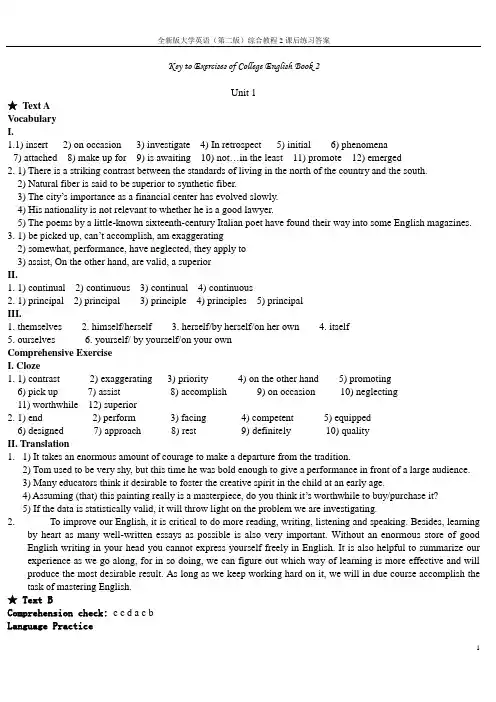
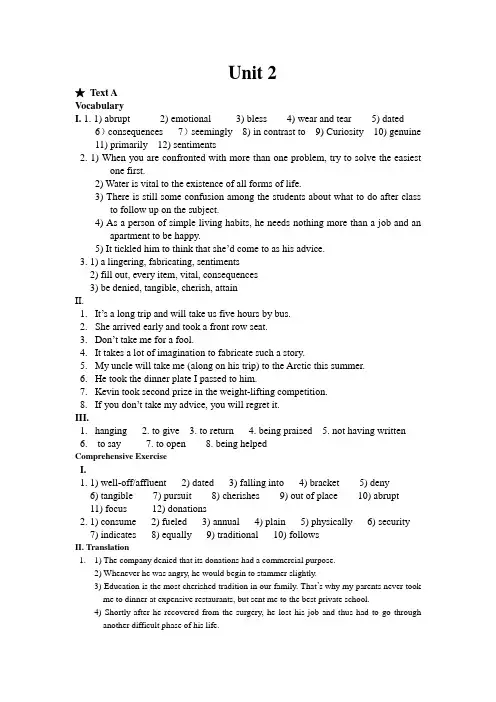
全新版大学英语第二版综合教程2最全的课后练习答案
- 格式:docx
- 大小:57.27 KB
- 文档页数:61
最全的全新版大学英语第二版综合教程 2 答案
课后练习答案
Unit1 Ways of Learning
Part II Reading Task
Comprehension
Content Question
Pair Work
1. They were studying arts education in Chinese kindergartens and
elementary schools in Nanjing.
2. Their 18-month-old son Benjamin was fond of trying
to place the key into the slot of the key box during their stay
at the Jinling Hotel.
3. They would come over to watch Benjamin and then try
to teach him how to do it properly.
4. Because he realized that this anecdote was directly
relevant to their assigned tasks in China: to investigate early
childhood education and to throw light on Chinese attitudes
toward creativity.
5. Most of them displayed the sameattitude as the staff
6. He emphasized that the most important thing is to
teach the child that on can solve a problem effectively by
oneself.
7. He means that this incident pointed to important
differences in educational and artistic practices between
China and the USA.
8. The manner in which the Chinese staff saw the need
to teach the child by guiding his hand in the characteristic
of a broader attitude to education, one that stands in contrast to the
Western preference for leaving the child to explore and learn unaided.
9. One example is of children at the age of 5 or 6
painting flowers, fish and animals skillfully and confidently;
in a second example, calligraphers 9 and 10 years old were
producing works; and in a third, young artists work on
perfecting their craft for several hours a day.
10. Americans think that unless creativity has been
acquired early, it may never emerge, and skills can be picked
up later. Chinese think that if skills are not acquired early,
they may never be acquired, and there is no hurry to promote
creativity.
11. This is mainly due to the difference in their way
of thinking.
12. The author makes the suggestion that we should strike
a better balance between the poles of creativity and basic
skills.
Text Organization
Working On Your Own
1.
1) The text begins with an anecdote.
2) His thoughts are mainly about different
approaches to learning in China and the West.
3) He winds up the text with a suggestion in the form
of a question.
2. Chinese
1) Show a child how to do something, or tech by holding
the hand
2) Give greater priority to developing skills at an
early age, believing that creativity can be promoted over time
Americans
1) Teach children that they should rely on
themselves for solutions to problems
2) Put more emphasis on fostering creativity in young
children, thinking skills can be picked up later Language
Sense Enhancement
(1) Summarizing
(2) value originality and independence
(3) contrast between
(4) in terms of
(5) harbor
(6) fearful
(7) comparable
(8) promote creativity
(9) emerge
(10) picked up
I
1.
1) insert
2) on occasion
3) investigate
4) In retrospect
5) initial
6) phenomena
7) attached
8) make up for
9) is awaiting
10) not; in the least
11) promote
12) emerged
2.
1) a striking contrast between the standards of living
in the north of the country and the south.
2) is said to be superior to synthetic fiber.
3) as a financial center has evolved slowly.
4) is not relevant to whether he is a good lawyer.
5) by a little-known sixteen-century Italian poet have
found their way into some English magazines.
3.
1) be picked up; can’t accomplish; am exaggerating
2) somewhat; the performance; have neglected; they
apply to
3) assist; On the other hand; are valid; a superior
II
1.
1) continual
2) continuous
3) continual
4) continuous