进口药用辅料注册资料列表-英文版-带详细说明
- 格式:pdf
- 大小:51.70 KB
- 文档页数:4
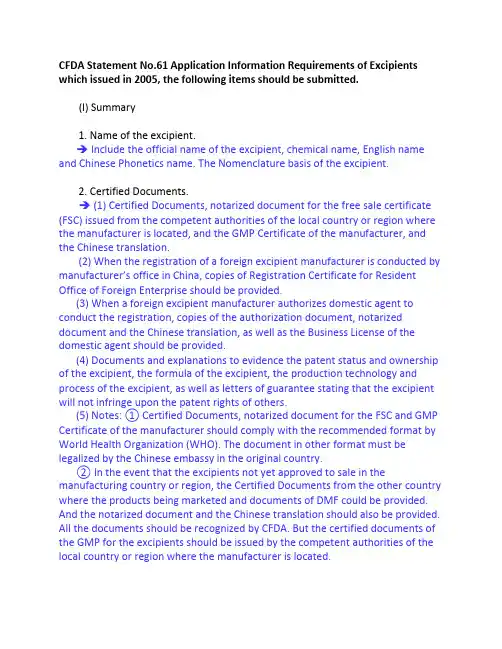
CFDA Statement No.61 Application Information Requirements of Excipients which issued in 2005, the following items should be submitted.(I) Summary1. Name of the excipient.Include the official name of the excipient, chemical name, English name and Chinese Phonetics name. The Nomenclature basis of the excipient.2. Certified Documents.(1) Certified Documents, notarized document for the free sale certificate (FSC) issued from the competent authorities of the local country or region where the manufacturer is located, and the GMP Certificate of the manufacturer, and the Chinese translation.(2) When the registration of a foreign excipient manufacturer is conducted by manufacturer’s office in China, copies of Registration Certificate for Resident Office of Foreign Enterprise should be provided.(3) When a foreign excipient manufacturer authorizes domestic agent to conduct the registration, copies of the authorization document, notarized document and the Chinese translation, as well as the Business License of the domestic agent should be provided.(4) Documents and explanations to evidence the patent status and ownership of the excipient, the formula of the excipient, the production technology and process of the excipient, as well as letters of guarantee stating that the excipient will not infringe upon the patent rights of others.(5) Notes: ① Certified Documents, notarized document for the FSC and GMP Certificate of the manufacturer should comply with the recommended format by World Health Organization (WHO). The document in other format must be legalized by the Chinese embassy in the original country.② In the event that the excipients not yet approved to sale in the manufacturing country or region, the Certified Documents from the other country where the products being marketed and documents of DMF could be provided. And the notarized document and the Chinese translation should also be provided. All the documents should be recognized by CFDA. But the certified documents of the GMP for the excipients should be issued by the competent authorities of the local country or region where the manufacturer is located.③ For application of imported pharmaceutical vacant capsules, gelatin for capsules, pharmaceutical grade gelatin which all are bovine original, the related documents and certificates of the source and category of the raw materials of preparing gelatin which is the main raw material for preparing capsules should be provided. The certificates which issued by the government for demonstrating the raw materials of preparing gelatin were not come from the BSE Country.3. Objectives and basis for R & D.Include R&D, market status, related literatures, manufacture, summary about the excipient application in formulations.4. Summary of main study work.Include summary for the main research results which had been done by the applicant, overall evaluation of the excipient on safety, effectiveness, quality controllability and etc.5. Draft of packaging insert, note to the draft, and latest literatureInclude instruction for usage of the excipient, includes name of the excipient, chemical structure or molecular formula, usage, cautions, package (strength, content), shelf life, the “Pharmaceutical Excipient” should be labeled.6. Design of packaging and labelingSamples of designed package and label(II) Pharmaceutical data7. Summary of Pharmaceutical StudyInclude the synthetic technics, formula selection, structure identification, quality study and establishing the quality standard, the summary of experiment and global literature of stability study.8. Research information and relevant literature of the production processInclude process flow and chemical equations, the starting material and organic solvent, reaction conditions (temperature, pressure, time, catalysts and etc.) and operating steps, refining methods, the main physicochemical constants and periodically accumulated results of the data, the amount of the raw materials, yields and the impurities or other intermediates which was produced orintroduced in the manufacture process, the specifications of the involved chemical materials, the source and the scientific name of the animal, botanical or mineral materials. The reasons for the modification of manufacture process if the manufacture process was different with the literatures.9. Study information and relevant literature for chemical structure or components identification of the excipientInclude documents for chemical structure or components identification of the excipient10. Study information and literature for quality specificationInclude physicochemical constants, purity analysis test, content analysis test and methods validation, periodically accumulated results of the data of the excipient11. Study information and literature for compatibility between API and excipients12. Draft of quality specification and notes to the draft, and provide reference substance or standard substanceThe format of the quality specification should comply with current ChP and using ChP terminology and measurement unit. The used categories of reagents, solutions, buffer solution and titrants should be listed in ChP and with the same concentration, it should be demonstrated detailed if there were different in concentration or categories. The documents for source, physicochemical constants, purity, content analysis test and its analysis method and results data of the reference substance or standard substance should be provided.13. Test reports of continuing 3 batches of the samples (the samples should be same as application usage)14. Stability study and relevant literaturesAlso include the stability test of the excipient which packed in the primary package.15. Selection basis and quality specification of immediate packing material and container(III) Pharmacology and toxicology study information16. Summary of pharmacology and toxicology study17. Study information and literature for whether excipients affect API’s pharmacological effect or not18. General Pharmacology study and literature19. Acute/single dose toxicity study and literature20. Repeated dose toxicity study and literature21. Special safety study and literature of hypersensitive (topical, systemic and photo-toxicity), hemolytic and topical irritative (blood vessel, skin, mucous membrane, and muscle) reaction related to topical and systemic use of the drugs22. Study and literature of mutagenicity test23. Study and literature of reproductive toxicity24. Study and literature of carcinogenicity test(IV) Clinical Study Information25. Summary of global clinical study information26. Clinical study protocol27. Investigator’s Brochure28. Draft of Informed Consent Form, approval of the Ethics Committee29. Clinical study report。