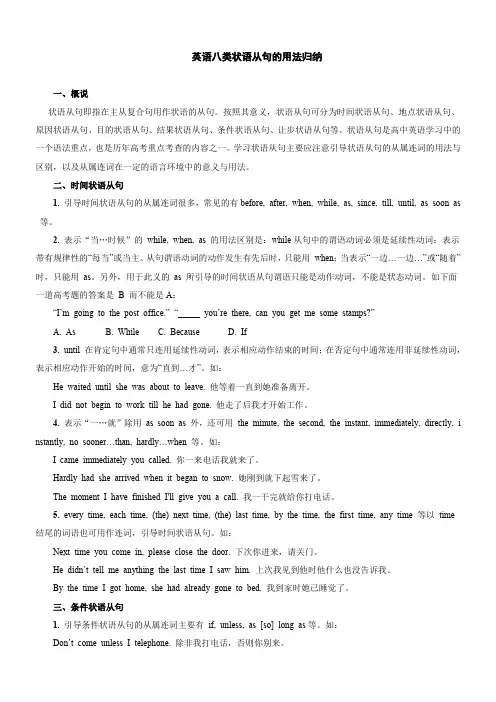
高考英语语法知识点归纳总结_状语从句
- 格式:doc
- 大小:124.00 KB
- 文档页数:7
WORD格式可编辑
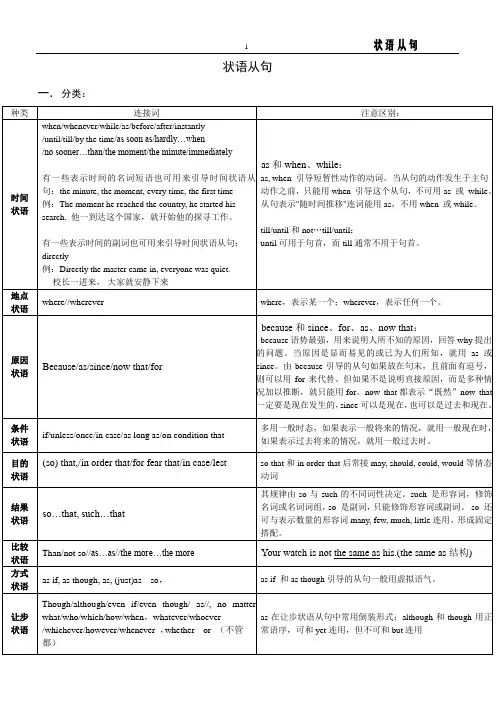
专业知识 整理分享 状语从句
种
类 从属连词 例 句 说 明
时
间
状
从 when When I came into the room, he was writing a letter.
We shall go there whenever we are free. when指的是“某一具体的时间”
whenever指的是“在任何时间”
I was walking along the street when suddenly
someone patted me on the shoulder from behind.
I was about to go swimming when our guide stopped
me. when意为“这时”或“在那个时候”,表示某件事正在发生或刚刚发生时,另一动作同时发生。这种用法的when分句一般位于句末。常用句型:be about to do… when…, be doing…
when…, had done… when…, be on one’s way… when…, be on
the point of doing… when…
He usually walks when he might ride.They had only
three tables when they needed five.
How can you hope for mercy yourself when you
show none? 尽管,虽然,既然,鉴于,如果
while While it was raining, they went out.
I stayed while he was away. while指“在某一段时间里”,“在…期间”,while引导的动作必须是持续性的
I like watching TV while he likes reading. while 做并列连词,表示相对关系“然而”
While I understand your point of view, I don’t share
it. While 引导让步状语从句,相当于although,但一般位于主句之前。
While there is life, there is hope.
While引导条件状语从句,相当于as/so long as,翻译成“只要”
as He hurried home, looking behind as he went.
as引导持续性动作,强调主句和从句的动作同时发生
As I get older, I get more optimistic. 两种正在发展或变化的情况,有“随着”的意思,表时间的推移。 WORD格式可编辑
专业知识 整理分享 He hurried home, looking behind as he went.
一边……一边……
As he was going out, it began to rain. 强调两个动作紧接着发生。
As a boy(When he was a boy), he was hopeless at
maths. as+名词,相当于时间状语从句
before A.Be a pupil before you become a teacher.
BWe waited a long time before he came out
.We hadn’t waited long before he came out.
C.He died before he wrote a will.
D.he sun had set before we knew it.
Leave me before I changed my mind.
I’d die before I apologized to them.
Get out before I call the police. 往往表示主句的动作先于从句的动作发生,“在……之前”,
A.“ ……才”(强调主句所表达的时间、举例很长或花费的力气很大。)
B.“……就”(强调主句所表达的时间、举例短或花费的力气很大。)
C.“还没有……”“免得”“不知不觉”“宁可、宁愿”“否则,要不然”
It will be five years before he returns to his
homeland.
It won’t be long before we meet again. It+(not)be+some time+before从句。肯定句中,“多长时间之后才”;否定句中,“用不了多长时间就”
after He arrived after the game started.
until/till We waited till (until)he came back . 如主句动词是持续性动作,常用肯定式,表示“直到…为止”
She didn’t stop working until eleven o’clock .
Until he had passed out of sight, she stood there.
如主句动词是瞬间动词,常用否定式,表示“直…才”“在…以前不”,从句放在句首表示强调,一般用until
since Great changes have taken place in China since 1978.
As soon as I arrive in Shanghai, I’ll write to you. 状语从句在主句之前时一般用逗号与主句分开,如从句在主句之后则不必用标点符号。
Mr. Li has been here since he came back.
I have written home but once since I came here. since后是非延续性动词的过去式,则时间的起点应从该动作发生时算起。 WORD格式可编辑
专业知识 整理分享 He has written to me frequently since he was ill. since后是延续性动词的过去式,则时间的起点应从该动作结束时算起。
It is (has been) a long time since I smoked.
It has been two years since I began to smoke. It + be+ some time+since 短语或从句,如果从句中谓语动词是非延续性动词,意为“做某事已有多长时间”;如果是延续性动词,意为“不做某事已有多长时间”。需要注意主句与从句时态的一致性。
一……就…… Hardly had we begun when we were told to stop.
I had hardly got home when it began to rain.
=Hardly had I got home when it began to rain.
No sooner had we got to the station than the train
left. hardly…when和no sooner…than的意义相当于as soon as,但只表示过去发生的事情,主句为过去完成时,从句为过去时,如hardly或no sooner位于句首时语气强,而且主句的谓语要用部分倒装。
一……就…… Every time I travelled by boat, I got seasick.The
moment I heard the song, I felt cheerful.
Next time you come ,you’ll see him. 有些名词或副词可以起连词的作用。如:the minute, the
moment, the day, the week, the year, the first time, any time,
next time, every time, the last time, each time, all the time, by
the time, immediately, instantly, directly, as soon as, once等。在时间状语从句中,不能用将来时或过去将来时,而要用现在时或过去时代替将来时。
On arriving at the station, the thief was arrested.一
On his arrival in Paris, he was recognised as a oble
and thrown into prison. on doing sth.或on one’s +名词
地
点
状
从 where
wherever Where there is a will, there is a way.
Where there is water there is life.
You are free to go wherever you like.
Wherever you go, you must obey the law. where与wherever意义基本相同,但后者语气较强,多用于书面语。where表示特定的地点,wherever表示非特定的地点。 WORD格式可编辑
专业知识 整理分享 原
因
状
从 because I came back late yesterday because I was on duty because用来回答why 的问题,语气最强
not because…but because 不是因为……而是因为……
partly because… 部分是因为……
because because of
since Since everyone is here, let’s begin our meeting since表示既然或全已知的理由,稍加分析即可表明的原因,多放句首
for He must be ill, for he is absent today. 不是说明直接原因,而是对某种情况加以推断,用于表示补充说明理由。