Unit 7 Poems 语法讲义 2020-2021学年牛津深圳版英语七年级下册
- 格式:docx
- 大小:378.33 KB
- 文档页数:10
1. Student can grasp exclamatory of this unit;
2. Student can grasp the imperative sentence well;
4.Student can can use the grammar easily.
1. What is the feeling of the girl when she smells the flowers?
(Try to act out the expression of her.)
2. What is the synonym of the sentence that the girl says?
参考答案:
1. She feels happy about the flowers.
2. How beautiful the flowers are!
unit7 Poems
重点语法 一、感叹句
感叹句是用来表达说话人对某人、某物或某件事表示赞美、惊讶、喜悦、气愤或悲哀等语气的句子,这类句子有强烈的感情,句尾用感叹号。感叹句通常由how或what引出。
⒈如果对句子中的名词或名词词组表示感叹,用what引出。
⒈ What+a/an+adj.+单数名词+主语+谓语(+其他成分)!其中主语和谓语可以省略。
What an interesting book (it is)!多有趣的一本书啊!
⒈ What+ adj.+名词复数/不可数名词+主语+谓语(+其他成分)!其中主语和谓语可以省略。
What beautiful flowers (they are)!多漂亮的花啊!
⒈如果对句子中的形容词、副词或动词表示感叹,用how引导。
⒈ How+adj./adv.+主语+谓语(+其他成分)!
How hard the people are working!这些人们工作多努力啊!
⒈ How+主语+谓语!
How time flies! 时间过得真快呀!
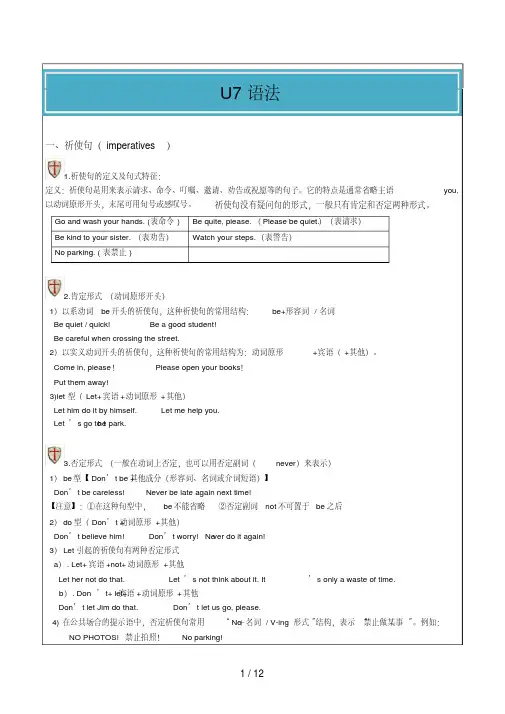
二.祈使句
祈使句通常用来表示命令、请求、禁止、建议、警告等语气。它的主语you(听话人)通常省略。其构成通常有以下几种形式。
1)Be型(即系动词原型be+表语+其他)
2)Do型(即实义动词原形+宾语+其他)
3)Let型(即Let+宾语+动词原形+其他)
4)No+ V-ing型(此种形式通常用于公共场合的提示语中,意为“禁止做某事“)
一.感叹句 Exclamatory
教材例句
1. What an interesting poem it is!
2. What beautiful flowers they are!
3. How bright the starts are!
以上三个句子含有丰富的感情色彩,表达自己的感受,句子末尾都用了感叹号,用 what 或 how 开头,这是感叹句。
基本表达概念
用来表达喜、怒、哀、乐等强烈感情色彩的句子,叫感叹句。感叹句用 what 或
how 引导,句末常用感叹号。
例:
What a clever boy he is!
How tall the man is!
感叹句的具体构成
感叹句是用来表达说话人对某人、某物或某件事表示赞美、惊讶、喜悦、气愤或悲哀等语气的句子,这类句子有强烈的感情,句尾用感叹号。感叹句通常由
how或what引出。
⒈如果对句子中的名词或名词词组表示感叹,用what引出。
⒈ What+a/an+adj.+单数名词+主语+谓语(+其他成分)!其中主语和谓语可以省略。
What an interesting book (it is)!多有趣的一本书啊!
⒈ What+ adj.+名词复数/不可数名词+主语+谓语(+其他成分)!其中主语和谓语可以省略。
What beautiful flowers (they are)!多漂亮的花啊!
2.如果对句子中的形容词、副词或动词表示感叹,用how引导。
⒈ How+adj./adv.+主语+谓语(+其他成分)!
How hard the people are working!这些人们工作多努力啊!
⒈ How+主语+谓语!
How time flies! 时间过得真快呀!
【即学即练】
(1) These flowers are very beautiful. (改为感叹句)
_______ _______ flowers they are! (2) The little boy is very clever. (改为感叹句)
_______ _______ the little boy is!
参考答案:(1) What beautiful; (2)How clever
二. 祈使句Imperative sentence
定义:
用于表达命令、请求、劝告、警告、禁止等的句子叫做祈使句,祈使句最常用于表达命令,因此在学校文法中也常称为命令句。
祈使句结构:
肯定句:Do + sth.
否定句:Don’t do + sth.
祈使句的主要句式 V 型 (Don’t)+V原+其他 如:Don’t speak in class !
L 型 (Don’t) let+宾语+V原+其他 如:Let’s go to to school !
Be型 (Don’t) Be + 表语 如:Be careful !
No型 No + n./V-ing 如:No smoking here!
难点:
1. 祈使句的反义疑问句。如果是Let’s, 用’Shall we?’其余用’Will you?’
如果是Let us, 用’Will you?’
Don’t smoke in the meeting room,will you?
2. 对于祈使句的回答,肯定用will 否定用won’t
Don’t go outside,please. It’s rainy heavily outside.
No, I won’t
Read it slowly.will you? Yes, I will.
3. 与非谓语动词做主语的句子的辨析
判断句中是否有谓语,如果有,则是非谓语动词,反之,则是祈使句。
Spending more time talking with your parents makes then well understand you.
Spend more time talking with your parents, and they can well understand you.
【即学即练】
1. -请安静,老师会生气的。
2. 让我们坐火车去吧!可以吗?
参考答案: 1. Be quiet, or the teacher will be angry.
2. Let’s go there by train. Shall we?
同步练习
一.单项选择
⒈ ____ delicious the dish is!
A. What B. How C. What a
⒈ ____ strange clothes he is wearing!
A. What a B. What C. How a
⒈ ____ interesting subject it is!
A. What B. How C. What an
⒈ ____ foggy it was yesterday!
A. What B. What a C. How
⒈ ____ careless a boy you are!
A. How B. What a C. What
6. --- ______ day it is!
---Let's go out and enjoy the sunshine!
A. What a lovely B. How windy C. What a rainy D. How wet
7. ______ delicious food my mother cooks every day!
A. What a B. What C. How
8. --- ______ good news it is! The panda are found alive after the earthquake.
---It’s so ______.
A. What a; excited B. What; exciting
C. How a; excited D. How; exciting
9. What a funny person ______! We all like walking with him.
A. is it B. is he C. it is D. he is
10. ______ information he offered us! We all thank him!
A. What useful B. What useless C. How useful D. How useless
11. ______ exciting news! We will have a ______ holiday after the exam.
A. What an; two months B. How an; two months
C. What; two-month D. How; two months’
12. ---We will build a subway in Fuzhou before 2014.
---Wow, ______! Will it pass our place?
A.what an excited news B. how excited the news is
C. what exciting news D. how exciting news
13 ______ terrible weather we had last Sunday!
A. What B. What a C. Such D. How
14. What a friendly person _______! We all like talking with him.
A. is it B. is he C. it is D. he is
15. _______ swimming in this river!
A. How great fun B. What great fun
C. How a great fun D. What a great fun