
There be句型
- 格式:ppt
- 大小:92.01 KB
- 文档页数:18
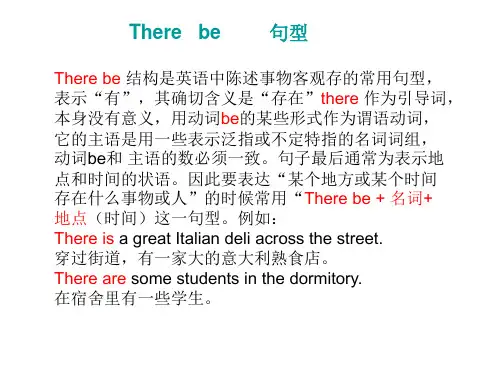

"There be" 句型是英语中最常见的句型之一,用来表示某物或某人的存在。以下是一些常见的 "There be" 句型:
肯定句:There is/are + 主语 + 地点 + 时间。
例如:There is a book on the table.(桌子上有一本书。)
否定句:There is/are not + 主语 + 地点 + 时间。
例如:There are not any apples on the tree.(树上没有苹果。)
一般疑问句:Is/Are there + 主语 + 地点 + 时间?
例如:Is there a book on the table?(桌子上有本书吗?)
特殊疑问句:What's/What are there + 主语 + 地点 + 时间?
例如:What's on the table?(桌子上有什么?)
表示存在的某物:There be + 主语 + 地点 + 时间。
例如:There is a book on the desk.(桌子上有一本书。)
表示存在的某人:There be + 主语 + 地点 + 时间。
例如:There are three people in the room.(房间里有三个人。)
表示某地有某物:There be + 主语(地点状语)+ 时间状语。
例如:There is a flower on the desk.(桌子上有一朵花。)
表示某人拥有某物:There be + 主语 + 所属关系+ 主语。
例如:There is a book in my bag.(我的包里有一本书。)
表示某地有某人:There be + 主语(地点状语)+ 人称代词宾格(作宾语)+ 时间状语。
例如:There is my friend in the classroom.(我的朋友在教室里。)
表示某地有某物和某人:There be + 主语(地点状语)+ 主语(人称代词宾格作宾语)+ 时间状语。

there be 句型表现形式
“There be” 句型是一种常用的英语语法结构,用于表示某处存在某物或某人。其基本形式为“There be + 主语 +
地点状语”,其中主语可以是一个名词、代词或动名词。
以下是一些常见的“There be”句型表现形式:
1. 肯定句:There is/are + 主语 +
地点状语。例如:There is a book on the table. 桌子上有一本书。
2. 否定句:There is/are not + 主语 +
地点状语。例如:There are not any apples in the bag.
袋子里没有苹果。
3. 疑问句:Is/Are there + 主语 +
地点状语?例如:Is there a restaurant near here?这附近有餐厅吗?
4. 特殊疑问句:疑问词 + is/are there + 主语 +
地点状语?例如:How many children are there in the
classroom?教室里有多少个孩子?
5. 反义疑问句:There is/are + 主语 +
地点状语,aren't/isn't there?例如:There are some flowers in
the garden,aren't there?花园里有一些花,不是吗?
需要注意的是,“There be”句型中的主语与地点状语并不是随意搭配的,而是要根据实际情况选择合适的名词、代词或动名词。同时,该句型通常用于描述当前存在的某个事物或情况,因此要注意时态的正确使用。
therebe句型用法总结
"there be"是一个常用的句型,在句子中用来表达某处存在某物或某人的意思。它的结构为:there + be动词+定冠词+名词。这个句型常用于句子的开头或中间。
例如:
1. There is a book on the desk.(桌子上有一本书。)
2. There are two dogs in the garden.(花园里有两只狗。)
此外,还可以使用"there be"句型来表达存在的时间或地点时,如:
1. There was a party last night.(昨晚有一次派对。)
2. There will be a meeting in the conference room.(会议室里将会有一次会议。)
"there be"的否定形式是"there be not",通常缩写为"there
isn't"或"there aren't"。 拓展:
在"there be"句型中,还可以使用"there have been"来表示在某个地方或时间曾经存在过某物或某人。常用于强调过去发生的事情。
例如:
1. There have been many earthquakes in this area.(这个地区曾经发生过很多次地震。)
2. There have been several famous actors in this theater.(这个剧院曾经有过几位著名演员。)
此外,还可以使用"there used to be"表达曾经在某个地方存在过某物或某人,但现在已经不存在了。
例如:
1. There used to be a school near my house, but it was
demolished.(我家附近曾经有一所学校,但已经被拆除了。)
2. There used to be a tall tree in the park, but it was

There_be_句型用法总结
句型:There + be + 名词短语/代词
用法总结:
1. “There be”句型用于描述处存在物或人,表示“有”或“存在”的意思。
例如:
- There is a cat in the room.(屋子里有只猫。)
- There are many people in the park.(公园里有很多人。)
2. 当There be句型为肯定句时,be的形式根据后面的名词短语/代词的单复数来决定。
例如:
- There is a book on the table.(桌子上有一本书。)
- There are three apples in the basket.(篮子里有三个苹果。)
3. 当There be句型为否定句时,使用“There be + no + 名词短语/代词”。
例如:
- There is no milk in the fridge.(冰箱里没有牛奶。)
- There are no cars on the street.(街上没有车。)
4. 当There be句型为疑问句时,将be提前到there之前。 例如:
- Is there a pen on your desk?(你的桌子上有一支笔吗?)
- Are there any books in the library?(图书馆里有书吗?)
5. “There be”句型也可以用于描述过去的情况,表示“曾经有”或“存在过”的意思。
例如:
- There used to be a bookstore on this street.(这条街上曾经有一家书店。)
- There were many trees in the old park.(旧公园里曾经有很多树。