
book2 unit4 warming up1
- 格式:ppt
- 大小:3.45 MB
- 文档页数:19
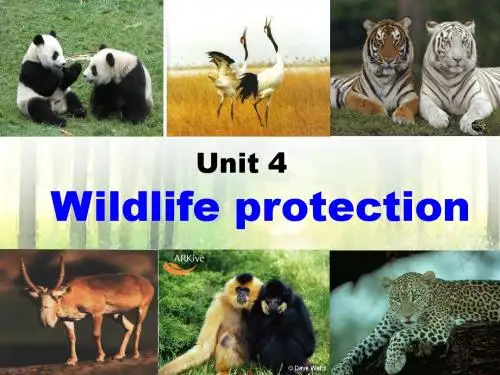


Teaching PlanTeaching material: new senior English for China, student’s book 2 published by People’s Education Press.Teaching contents: unit 4 wildlife protectionTopic: HOW DAISY LEARNED TO HELP WILDLIFEType: readingTeaching goals1 Knowledge and skill goals:(1) Students can master new words, useful expressions and grammar points.(2) Students can get some main information about the wildlife in danger and protection.(3) Students’ listening, speaking, reading and writing skills can be improved.2 Ability goals:(1) Students’ skills of using English can be improved(2) Students can be able to understand the main idea, scan for the needed information and grasp the details.3 Emotional goals:(1) Help students realize the importance of the wildlife protection and make them be more positive in wildlife protection.(2) Develop students’ awareness of cooperation.Objectives of knowledge and skill goals(1) Students can talk about the causes of endangered wildlife to improve their listening and speaking ability.(2) Students can find key words or topic sentences of each paragraph by skimming.(3) Students can get some detailed information of text by scanning.Teaching key points1. Help the students grasp the main idea of the reading text, and get some detailed information and understand the important language points .2. Help students understand the significance of wildlife protection and they may do something for wildlife after the class.Teaching difficult points1. The students express their own ideas by using their own words.2. The usage of present progressive passive voice.Teaching methods1. Communicative Language Teaching2. Task-based Language Teaching3. Computer Assisted Language TeachingLearning MethodsTask-based, self-dependent and cooperative learningTeaching ProcedureStep 1 Warming-upTask 1 Speech(randomly ask one student to give a speech on wildlife)When the speech is over, the teacher invites some students to give comments and then the teacher gives some suggestions.(The purpose of this task is to improve students’ spoken language. Meanwhile, it can be used as a way to check whether students have finished their reading after the class, the aim of which is to facilitate their interest in English reading)Task 2 Show them some beautiful pictures of wild animals, and then show a video about the situation of endangered animals.(The purpose of this task is to help students understand the importance of wildlife protection, and thus arouse students’ interest in reading text. )(After watching the video, students may understand if there are no animals, no plants, there will be no human beings. So they may realize the importance of helping wildlife and understand that we human beings should live in harmony with them.)Task 3 let students discuss in groups about the causes of endangered animals.( the purpose of this task is to train students’ cooperation and thinking ability. It makesstudents familiar with the reading text.)Step 2 Pre-taskTask 1 predicting tasksThe teacher asks students to look at the title and pictures in the text and make prediction about the main content of the reading passage.Here are some questions1)what do you know from the title?2)What are the pictures about?3)Where do you think the pictures are taken?4)Can you predict the main content of the text according to the title and the pictures?5)What questions do you believe will be answered in the text?( The purpose of this task is to enhance students’ predicting ability and reduce the difficulties of reading comprehension.)Task 2 the teacher invites some students to share what they know about wildlife (the students may show some news or living condition of endangered animals), and at last the teacher may givesome supplement to deepen students’understanding.)Teacher’s supplement: 1) what does WWF stand for?World Wide Fund for Nature2) Three aims of WWF:①to protect endangered species②to conserve endangered species③to try to find solutions to threats to the environment of the world for the benefit of people and nature(The purpose of this task is to broaden students’ knowledge and improve their interest in English reading. The students who do little reading after class will admire students who share their knowledge about wildlife because these students certainly do more reading after the class. Therefore, they will spontaneously improve their reading ability by reading more books. )Step 3 Task-cycleTask 1 Skimming to check their prediction and try to answer predicting questions, then summarize the main idea of each part.Main idea of each paragraph1. Why we need wildlife protection2. A good example of wildlife protection3-4. What we can get from wildlife protection( The purpose of this task is to train students’ ability of finding key words and topic sentences. Let students go through the text to know the framework of the reading material, which will make good preparation for the next reading task. )Task 2 Listing task. (let students find more detailed information in each paragraph, and then work in a group of six to fill in the following challenging table)In this step, the students will read the text carefully, finish the following tasks in groups, and then prepare a report for the whole class on how they did the task and what conclusion they got.Task 3 ReportAsk some representatives of each group to report the outcomes and findings of their discussion. During the report stage, the teacher induces students to show their work, the teacher can constantly give them some encouragement and some help when necessary.( the purpose of this task is to help students comprehend more detailed information. They will fully comprehend the reading text by listing these information, but they need integrate some information when filling some forms. After students accomplish this task, they may notice the passive voice of present continue tense)Task 4 teacher and other students’commentTask 5 language focus( the teacher asks students which language points they don’t understand, and then let students discuss in groups to give explanation. )For example. Guess the correct meaning of the underlined words in the text.Step 4 Post-taskTask 1 role-play (group of 6)In the text, there appears Daisy, a flying carpet, an antelope, an elephant, a monkey, so students can try to use their own words to show different roles’feelings. One of the members acts as an interpreter.Students can perform role-play according to the following stages: (1) assign groups and roles (2) polish and read the lines in their roles (3) rehearse (4) presentation and evaluation( the purpose of this task is making students completely enter in the reading context and really understand the situation of these animals and their feelings. All members of the group can take part in this activity, which can improve their cooperative and communicative ability) Task 2 DebateFor side: the life of wild animals will be better in the futureAgainst side: life of wild animals will be worse in the future)Step 5 EvaluationStudents’ self -evaluation.Peer evaluation among groups.Teacher’s evaluation as a whole.Step 6 Summary and HomeworkAsk students to make a poster to call for people to protect wildlife.Step 7 Teaching reflection1). The teacher taught this lesson according to the demand of new curriculum in senior high school. The teacher successfully acted as the organizer, helper and guider of students’ learning. During the process of teaching, the teacher lay stress on students’ positive learning and put students as the center of anything.2). When the teacher designed the reading tasks, she can fully take students’ actual reading ability into consideration, so almost all of the students can actively participate in these activities. Of course, they can successfully learn and consolidate language by finishing kinds of the tasks, which is good for accumulating learning experience and building up a sense of achievement.3). This lesson was designed by the principle of TBLT. The design of each task in this teaching plan was completely bound up in students’ learning. Train students’ cooperative spirit by group work. Every task had a clear purpose, which realized the application of English in authentic situation.。


Unit4 Warming up and reading精品教案Teaching AimsTo talk about endangered speciesTo read about wildlife protectionProceduresI. Warming up by learning about animalsLook at the photos below and listen to me telling you about the animals, the endangered animals.The Giant Panda is a mammal now usually classified inthe bear family, beside, that is native to central China.The Giant Panda lives in mountainous regions, likeSichuan and Tibet. The Giant Panda is the symbol of theWorld Wildlife Fund (WWF), a conservation organization. Toward the latter half of the 20th century, the panda also became somewhat of a national emblem for China, and is now used in Chinese gold coins. Giant Pandas are an endangered species, threatened by continued loss of habitat and by a very low birthrate, both in the wild and in captivity. About 1,600 are believed to survive in the wild.Milu deer is a Chinese deer. It has a long tail, wide hooves, and branched antlers.Another Chinese name for it is “four unlikes,.” because theanimals were seen as having the horns of a stag, the neck of acamel, the foot of a cow, and the tail of an ass.These animals were first made known to Western science in the 19th century, by Father Arm and David, a French missionary working in China. At the time, the only surviving herd was in a preserve belonging to the Chinese emperor. The last herd of Milu deers that remained in China were eaten by Western and Japanese troops that were present at the time of the Boxer Rebellion.These deer are now found in zoos around the world, and a herd of Milu deer was reintroduced to Dafeng Reserve, China in the late 1980s. They are classified as “critically endangered.” in the wild, but do not appear to have suffered from a geneticbottleneck because of small population size.A tiger is a large cat famous for its beautiful fur oforange striped with black. Tigers live in Asia and arebecoming very rare. This is due to people huntingthem for their fur and destroying the forests they live in.II. Pre-readingDefining wildlifeWhat does the world wildlife mean?The term wildlife refers to living organisms that are not in any way artificial or domesticated and which exist in natural habitats. Wildlife can refer to flora (plants) but more commonly refers to fauna (animals). Needless to say, wildlife is a very general term for life in various ecosystems. Deserts, rainforests, plains, and other areas—including the most built-up urban sites—all have distinct forms of wildlife. Humankind has historically tended to separate civilization from wildlife in a number of ways; besides the obvious difference in vocabulary, there are differing expectations in the legal, social, and moral sense. This has been reasonfor debate throughout recorded history. Religions have often declaredcertain animals to be sacred, and in modern times concern for theenvironment has provoked activists to protest the exploitation ofwildlife for human benefit or entertainment.Make a list of other endangered wildlife in China that is being protected.Pre-reading questions:Reading to the recordingNow turn to page 26, listening and reading to the recording of the text. Try to keep pace with the native reader, making your reading resemble that of the reader, in speed, in intonation and in pronunciation.III. Reading1.Reading and getting informationNow you are to read the text for information to fill in the form.2.Reading and underliningNext you are to read the text and underline all the collocations at the same time.IV. Closing up by matching animals to five risk categoriesDifferent endangered species appear on different endangered species lists. And people who are trying to protecting animal use the following five risk categories to group the unlucky animal.Now in groups of four try to group all the unlucky animals found in China.。