英语五个基本句式
- 格式:docx
- 大小:25.35 KB
- 文档页数:19
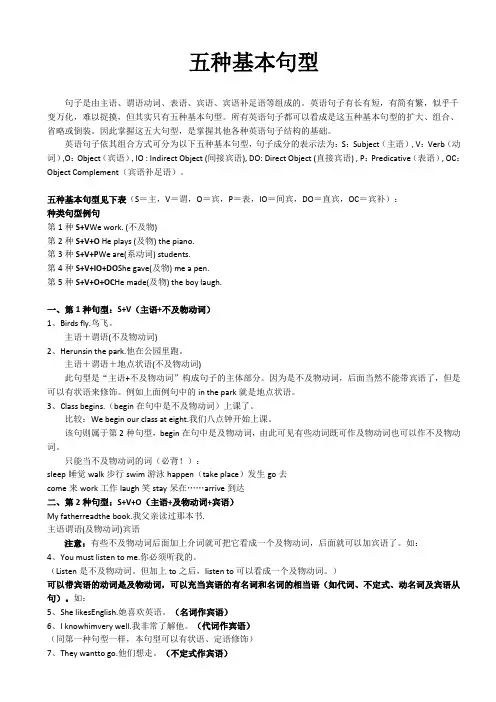
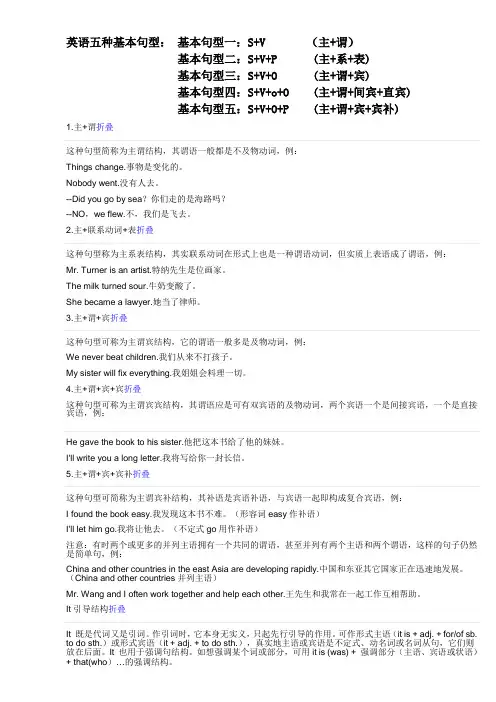
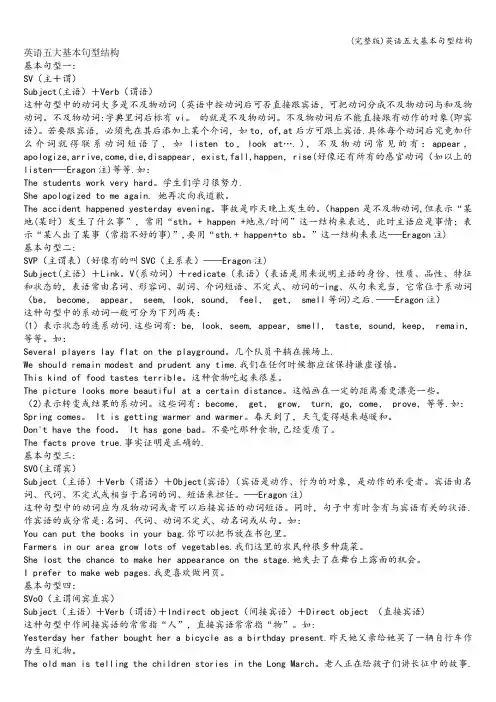
英语五个基本句式从英语的句子结构上说,除了修饰名词的定语和修饰动词的状语外,在千变万化的句子中可归纳为五个基本句式,一般地说,某些动词用在某一句式中,下面笔者把这些句型和常用的动词进行归类, 供你参考。
1.S(主)+ Vi (不及物动词)(谓)Time flies.1)S + V + adverbial(状语)Birds sing beautifully.2)S + Vi+ prep Phrase (介词短语)He went on holiday.3)S + Vi+ Infinitive (不定式)We stopped to have a rest.4)S + Vi+ Participle (分词)I'll go swimming.2. S (主)+ Vt (及物动词)(谓)+ O (宾)We like English.1)S + Vt + N/PronI like music.I like her.2)S + Vt + infinitive(不定式)I want to help him.常用于这句型的动词有:attempt, dare, decide, desire, expect, hope, intend, learn, offer, pretend,need, promise, propose, purpose, refuse, want, wish 等。
3)S + Vt + Wh-Word + InfinitiveI don't know what to do.常用于这句型的动词有: ask, consider, decide, discover, explain, find out, forget, guess,等。
4) S + Vt + Gerund I enjoy living here.常用于这句型的动词有: admit, advise, avoid, consider, defend, enjoy, excuse, finish, forbid, mind, miss, practise, risk, suggest, give up, can't help 等。
5) S + Vt + That-clause I don't think (that ) he is right.常用于这句型的动词有: admit, believe, command, confess, declare, demand, deny, doubt,We are Chinese.除了 be 系动词外,还有一些动词也可以用作系动词, 1) 表感官的动词, feel, smell, taste, sound, look, appear, seem 等。
2) 表转变变化的动词, become, get, grow, turn, go, 等。
3)表延续的动词 remain, keep, seem, hold, stay, rest 等。
4) 表瞬时的动词 come, fall, set, cut, occur 等 5) 其他动词 eat, lie, prove, ring, run, shine, sit, stand, continue, hang等。
1)S + Lv + N/Pron ( 名词 / 代词)He is a boy. This is mine. 2)S + Lv + Adj (形容词)She is beautiful. 3)S + Lv + Adv ( 副词)Class is over. 4)S + Lv + Prep Phraseinquire, know, learn, observe, remember, see, settle, tell,think, understand, wonder expect, explain, feel ( 觉得) , hear (听说) (当心) , notice, propose, request, report, think, understand, wish, wonder (觉得奇怪)。
3. S (主)+ V (谓)(lv )( 系动词)+ P (表), hope, imagine, intend, know, mean, mind say, see (看出), show, suggest, suppose,He is in good health.5) S + Lv + Participle ( 分词) He is excited. The film is interesting.4. S ( 主) + Vt (谓) + In O (间接 宾) + D O (直接 宾) I give you help. 1) S + Vt + N/Pron + N I sent him a book. I bought May a book.2) S + Vt + N/Pron + To/for-phrase He sent a book to me. He bought a coat for me.间接宾语前需要加 to 的常用动词有: allow, bring, deny, do ( 带来), leave, lend, offer, owe, pass, pay, permit, promise, read, refuse, render, restore, sell, send, show, teach, tell wish, write 等。
间接宾语前需要加 for 的常用动词有: bring, buy, cash, choose, fetch, order, paint, play ( 演奏), save, sing, spare 等。
5. S (主)+ Vt (谓)+ O (宾)+ O C (宾补) I make you clear. 1) S + Vt + N/Pron + N We named our baby Tom.常用于这句型的动词有: appoint, call, choose, elect, entitle, find, make, name, nominate ( 命名)。
2) S + Vt + N/Pron + Adj He painted the wall white.常用于这句型的动词有: beat, boil, cut, drive, find, get, hold, keep, leave, like, make, paint, see, set, turn, want, wash, wipe, wish 等。
give, grant, hand, get, leave, make,3) S + Vt + N/Pron + Prep PhraseShe always keeps everything in good order.4) S + Vt + N/Pron + InfinitiveI wish you to stay.I made him work常用于这句型的动词有:a)不定式带to 的词:advice, allow, ask, beg, cause, choose, comma nd, decide, encourage, expect, force, get, hate, invite, know, leave, like, love, order,permit, persuade, prefer, remain, request, teach, tell, want, warn, wish 等。
b) 不定式不带to 的词:feel, have, hear, know, let, listen to, look at, make, notice, see, watch 等。
5) S + Vt + N/Pron + Participle ( 分词)I heard my name called.I feel something moving.常用于这句型的动词有:catch, feel, find, get, have, hear, imagine, keep, leave, listen to, look at, notice, observe, perceive, see, set, smell, start, watch 等。
6) S + Vt + N/Pron + Wh-word + InfinitiveHe show me how to do it.常用于这句型的动词有:advise, ask, inform, show, teach, tell 等。
7) S + Vt + N/Pron + That-clauseHe told me that the film was great.常用于这句型的动词有:assure, inform, promise, remind, teach, tell, warm 等。
8) S + Vt + N/Pron + Wh-ClauseHe asked me what he should do.常用于这句型的动词有:advise, ask, inform, show, teach, tell.英语常用句型编辑整理初学英语的人常常感到在掌握一些英语单词和基本语法后,在英语说和写方面还是很难表达自己,笔者认为其中一个原因是没有掌握一些英语句型,只有掌握了一些句型才能比较正确、完整地表达自己。
下面是笔者收集的一些常用句型。
1. 否定句型1) 一般否定句I don't know this. No n ews is good n ews.There is no pers on (smoke)/not a pers on/not any pers on (smoke) in the house.2) 特指否定He went to his office, not to see him.I am sorry for not coming on time.I don't thin k/believe/suppose/feel/imag ine you are right.3) 部分否定All the an swers are not rightAll is not gold that glittersI don't know all of them.I can't see everybody/everythi ng.Both of them are not right.4) 全体否定None of my frie nds smoke.I can see nothing/no body.Neither of them is right.Noth ing can be so simple as this.5)延续否定You did n't see him, n either/nor did I.You don't know, I don't know either.He does n't know En glish, let alon e/to say nothing of/not to speak of (更不用说)Fre nch.6)半否定句We seldom/hardly/scarcely/barely hear such fine sin gi ng.I know little En glish. I saw few people.7)双重否定You can't make somethi ng out of nothing.What's done cannot be undone.There is no sweet without sweat.No gain without pains.I can't help /keep/ laugh ing whe never I hear it.No man is so old but (that) he can lear n.8)排除否定Every one is ready except you.He did nothing but play.But for your help, I could n't do it.9)加强否定I won't do it at all.I can't see it any more.He is no lon ger a boy.2. 判断句型1)一般判断句It is important for us to learn English.It is kind of you to help me sin cere means hon est.The boy is called/named Tom.We regarded/c on sider it as an honor.It is En glish that we should lear n.It is he who helped me a lot.3)弱式判断Your sentence does n't sou nd/look/appear/feel right.You look/seem as if/as thought you had bee n there before.Maybe/Perhaps/ she is ill.He is probably ill.He is likely ill.It is possible that he is late4)注释判断He can remember so many English words, that is (to say) he is a living dictionary.(字典)5)正反判断That sou nds all right, but in fact it is not.6)比较判断It is more a picture tha n a poem.7)互斥判断He or you are wrong.Either he is right or I am.3. 祝愿祁使句式1)一般句式Study hard and keep fit.Be brave! Don't be shy!Get out of here.Do tell me.Never tell a lie.3)委婉祈使句Please tell me the true.Would/Will/Wo n't do me a favor?Would/Do you mind my smok ing?What/How/ about going on foot?4)建议祈使句Let us go. Let us know the time.Don't let the fire out.Let's not waste the time.You'd better start early.Shall we liste n to some music?Why don't you get somethi ng to drink? Suppose/suppos ing you pick me up at about six?I suggest we (should) take the train.5)祝愿句Success to you!Wish you a good jour ney.May you have a happy marriage.Here's to your success!Allow me to propose a toast to our frie ndship! 4. 感叹句型How well he speaks!How kind she is!What a nice weather it is!Here he comes!Such is life!Won derful!Help!5. 疑问句型1)一般疑问句Is he a doctor?Do you the way to the stati on?2)反意疑问句He is a teacher, is n't he?It is quite cheap, don't you think?3)特殊疑问句What is the dista nce/width/size/populatio n/temperature/fare? Who is he?What is he?(干什么的)What is he like?How is he?How do you like him?What do you think of him?What ever do you mean by say ing this?4)选择疑问句He is a doctor or a n urse?5)间接疑问句Do you know how old he is?Tell me if (whether) you like it.What do you thin k/say/suppose I should do?6. 数词句型1)表数目It is exactly ten o'clock.It is five miles away from here.He is more than/over/ at least not less than 20.He is un der/at most/ no more tha n 20.2)表年月日He was born on April 22 1994/in 1994 on the morning of Oct.1. 3)表年龄He is 20 years old/years of age.He is at the age of 10.4)表倍数It is four times that of last years.This is four times as big (aga in) as that one.This is four times bigger tha n that one.The in come is double what it was.The output of coal was 200% greater than in 1998.5)表计量It is 10 meters Ion g/wide/high.It costs me 100 yua n.I spe nt 10 hours to finish it.It took me 10 days to finish it.It is worth 100 yua n.7. 关联指代句型1)两项关连I have two books, one is Chin ese; the other En glish.I have five books, one is Chin ese; the others En glish.To say is one thi ng, but/a nd/ to do is ano ther.One the one hand, I am your teacher, and on the other hand, I am also you friend.Some like to play football, others are fond of basketball.2)先后顺序First/firstly, I wish good health, sec on d/sec on dly success in your study, third/thirdly good luck in everythi ng.First stop, the n look, fin ally cross.At first/in the beginning/ he word hard. Later/Afterwards he is not so diligent.3)修饰限制This is the same book as I lost yesterday.This is the same book that I lost yesterday.(同一本书)Don't trust such a man as over praise you.He/On e/Those/They who should come failed to appear.A man/A pers on /The one/Anyon e/People who saw her liked her very much.The day/time/mome nt will come whe n Chi na is str on gest in the world.4)两项连接He can speak not only En glish but also Fren ch.The book is both in terest ing and in structive.It is neither cold nor hot.Please either come in or go out.The old worker has experie nee and kno wledge as well.5)加和关系Besides literature, we have grammar and writing.Apart from oxyge n, there are some other gases in the air.In additi on to "if", there is many other conjun cti ons that can in troduce con diti onal clauses.I must go now, in cide ntally, if you want that book.You seem to like tea, so do I.8. 比较句型1)等比句He is as tall as I.He is the same height as I.She is no less dilige nt tha n he.The lab is no better than a cottage.2)差比句I speak En glish worse tha n he does.He is not so/as tall as I am.Our kno wledge is much in ferior to their.3)极比句He is the tallest of all in the class.Non e/No on e/ is so bli nd as those that won't see.Noth ing is so easy as this.4)比例句The more a man kno ws, the more he feels his ignorance(无知)5)择比句He is taller tha n any other boy in the classIt is better late than never.They would die tha n live as slavesHe prefers doing to talki ngHe prefers to do rather tha n to talk.He prefers mathematics to En glish.I'd rather stay here.6)对比句You thi nk me idle, but on the con trary, I am busy.They are working hard while you are wasting your time.9. 比喻句型We must work like him.He behaves as his father does.He speaks En glish as if/though he was a foreig ner.10. 条件假设句1)一般事实If we succeed, what will the people say?Suppose it rains, what shall we do?Persevere(坚持)and you'll succeed.2)虚拟条件句If I were you, I would go.If you had see n it, you would have bee n moved.3)反条件句Unl ess you try, you'll n ever succeed.Don't move, or/else/otherwise I'll shot.4)唯一条件句If only I have another chanee, I shall do better.Only in this way can we lear n En glish well.So/As long as we don't lose heart, we'll succeed.5)推论条件句Since that is so, there is no more to say.Now that you are grow n up, you must stop this behavior.11. 时间句型1)一般时When I see him, I'll tell him.2)表同时You'll grow wiser as you grow older.Work while you work, play while you play.He worked, at the same/i n the mean time he liste ned to the music. 3)限制时Every/each time whe n I went to his house, he was out.By the time that we got there, he was out.4)交替时Sometimes he sin gs, sometimes he dan ces.At one time the baby cries, at another it talks.5)先时I stopped hem before he bega n to talk with me.6)后时I'll tell you after I finish it.7)紧接时As soon as I see him, I'll tell him.Once you beg in, you must con ti nue.The (very) mome nt/in sta nt (that) I saw him, I recog ni zed him. On hear ing the n ews, she bust into tears.Hardly had I see n the light, whe n I heard a loud thu nderi ng.8)延续时I have n't see n him since I came here.A friend is never know till/until a man have need.12. 地点句型1)一般地点Where have you bee n?Where there is a will, there is a way.2)方位Hebei lies in the east of China.Japa n is lies to the east of China.The house faces (to) the south.He is sitting at the front of the classroomHe is sta nding in front of/before me.He is sitt ing at the back of/beh ind me.He is sitting in the back of/at the rear of the classroom. He is sitt ing n ext to/besides me.He is sitti ng close to/near me.At the top of/On top of the shelf, there are some books. He is sitting on the left/right.The mountain you see to the right is the Purple Mountain.13. 原因句型He did n't go to school because he was ill.Since we are all here, let's begi n our meet ing.It might rain yesterday, for the grou nd was wet.Now (that) we have finished the work, we can go home.I am glad to meet you.I am sorry that I hear that.Thank you for your help.That is why he failed to come.He did n't come because of/on accou nt of the weather. He went out of curiosity.I succeeded tha nks to his help.This failure is due to the fact they lack experie nee. Owing to our joint efforts, the task was fulfilled.What are study ing En glish for?For what reas on did you choose this?What's the point of ask ing his to do that?How come you n ever told me about it?What with the wind and what with the rain, our walk was spoiled.14. 目的句型He stopped aside so that she could go in.He sits in the front in order that he can see words clearly.He gets up early so as to/i n order to have time to do exercises. He repeated it for fear that there should be any mistake.15. 结果句型It was very cold, so that the river froze.They cost a lot of mon ey, so/therefore we use them carefully. He is such a good man that every one likes him.He ran so fast that no one could catch him.He hurried to the house only to find that it was empty.I was caught in the rain. As a result, I had a bad cold.16. 程度句型How often do you write to your parents?How long do you stay at home?It is so beautiful that we all love it.It is too big for you.He is too excited to speak.He is not old en ough to know this.The letter must be sent as soon as possibleYou must work as hard as you can.As far as I kno w, I can speak only En glish.17. 让步句型Though/Although he is rich, (yet/still) he does n't show off.Yang as he is, he know a lot of thin gs.Eve n if/though he succeeded, he was not proud.No matter what you say, I'll still try to do it.Keep calm, whatever happe ns.In spite of this, we must go ahead with our pla ns. Regardless of all the difficulties, we'll fight it out to the end.18. 转折句型I searched everywhere but could not find him.You may go, only return quickly.He is seriously ill, still there is hope of his recovery.It looked like rain, however it was clear in the after noon. He is still you ng, yet he is high up in the positi on.He did n't tell me the truth, I know it, though.19. 省略句I thin k/say/suppose/expect/believe/hope so.Why not come earlier n ext time?英语五个基本句式英语常用句型。