
新概念英语1公开课-Unit1-Excuse-me!
- 格式:ppt
- 大小:645.00 KB
- 文档页数:24

=====WORD完整版----可编辑----专业资料分享=====
----完整版学习资料分享---- Lesson 1 Excuse me ! 对不起!
New words and expressions 生词和短语
excuse [ik'skju:z] vt.原谅
me [mi:] pron.我(宾格)
yes [jes] adv.是, 是的
is [iz;] v.be动词的现在时第三人称单数
this [ðis] pron.这, 这个
your [juə] pron.&adj. 你的, 你们的
handbag ['hændbæg] n.(女用)手提包
pardon ['pɑ:dn] int. 原谅,请再说一遍
it [it] pron.它
thank you ['θæŋk-ju:] 感谢你(们)
very much ['veri-mʌtʃ] 非常地
※在英语中有5个特殊的字母
A E I O U 他们叫做元音字母
在你发音的过程中,气流没有受到阻碍叫做元音
是构成单词最小最基本的单位
excuse [ik'skju:z] vt.原谅
excuse me 对不起,打扰一下
sorry 是指做错了事情
而其他的场合,为了引起话题,想询问,或者让路,用excuse me =====WORD完整版----可编辑----专业资料分享=====
----完整版学习资料分享----
excuse n.借口, 理由, 饶恕, 致歉
Eg:
It is the excuse for him to eat the apple.
这就是他吃苹果的借口
Please excuse me for opening the door .请原谅我把门打开了。
介词后面要+doing(for about)
me [mi:] pron.我(宾格)
e的前面没有其他元音字母的时候,e发本身音
放在动词和介词的后面做宾语
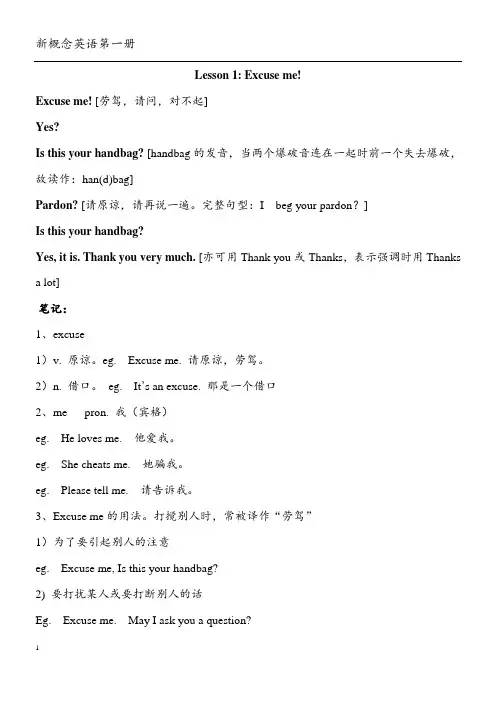
新概念英语第一册
1
Lesson 1: Excuse me!
Excuse me! [劳驾,请问,对不起]
Yes?
Is this your handbag? [handbag的发音,当两个爆破音连在一起时前一个失去爆破,故读作:han(d)bag]
Pardon? [请原谅,请再说一遍。完整句型:I beg your pardon?]
Is this your handbag?
Yes, it is. Thank you very much. [亦可用Thank you或Thanks,表示强调时用Thanks
a lot]
笔记:
1、excuse
1)v. 原谅。eg. Excuse me. 请原谅,劳驾。
2)n. 借口。 eg. It’s an excuse. 那是一个借口
2、me pron. 我(宾格)
eg. He loves me. 他爱我。
eg. She cheats me. 她骗我。
eg. Please tell me. 请告诉我。
3、Excuse me的用法。打搅别人时,常被译作“劳驾”
1)为了要引起别人的注意
eg. Excuse me, Is this your handbag?
2) 要打扰某人或要打断别人的话
Eg. Excuse me. May I ask you a question? 新概念英语第一册
2
3) 向陌生人问路
Eg. Excuse me. Could you please tell me the way to the railway station? 劳驾,请问去火车站的路怎么走呢?
4) 向某人借东西
Eg. Excuse me. Can I borrow your pen? 打扰下,可不可以接你的钢笔用下啊?
5)需要从别人身边挤过或让别人给自己让路
Eg. Excuse me. Could you please make some room for me? 劳驾,借过下一下。

精品文档-可编辑
学生姓名 原就读学校 年级授课时间 教师姓名
教学内容 新概念英语第一册Lesson 1 Excuse me!
教学目标 情境对话
教学重、难点 辨析:Excuse me.和I’m sorry.的用法区别
一、写出句子的中文意思
Sue: Excuse me. __________________
John: Yes? __________________
Sue: What's your name? __________________
John: Pardon? __________________
Sue: What's your name? __________________
John: My name is John. __________________
Sue: What's your name? __________________
You: My name is...... __________________
1、Excuse me.和I’m sorry.的用法区别:
Excuse me. 打扰,劳驾。常用于事前:引起某人注意、打断、挤过、想进门或离开等。
I’m sorry. 对不起,很抱歉。常用于事后:做错某事、伤害到别人、请求原谅。
【Action】公交车上的场景:挤下车、不小心踩到某人。带疑问的语气与上升的语调,说Sorry?或Excuse me?
excuse me:虽然可以译为“对不起”,但它实际上是一种礼貌的语言形式,主要表达讲话者对受话者的敬重。下列场合较为常见:
(1)向陌生人问路,请求别人帮忙时。如:
Excuse me, can you tell me where the post office is?
(2)需要打断别人的谈话,或要对别人刚讲的内容提出反对意见时,为了不显得粗鲁无礼,常用excuse me。如:

新概念第一册
Lesson 1 Excuse me
一、单词精讲
excuse [iks’kju:z]v.原谅【用法】 excuse me 意为:“对不起”
1.想与陌生人交谈,引起对方的注意(如问路、见前方围一群人好奇 的打听情况等)。
例如:Excuse me, where is the post office?
2.在某个聚会中突然中途要离开一会(如需要接电话)。
例如:Excuse me, may I answer the phone?
3. 从别人面前经过,并可能给对方造成不便(如春运期间在火车上人 群中穿梭)。
例如:Excuse me, could you leave me some room?4.对有失礼仪的行为表示抱歉(如打嗝、打喷嚏等)
me[mi:]pron.我(宾格)
【用法】宾格用在动词、介词之后。He asked me to go to school with him.他邀请我和他一起去学校。
【拓展】
I 表示主格,译为我,放在句首。
例如:I am a student.
my我的,形容词性物主代词,不能单独使用,后面必须跟名词。
例如:This is my pen.
mine 我的,名词性物主代词,相当于形物代+名词例。
如:This pen is mine. = This is my pen.
yes [jes]adv.好,对
[词性]它主要用作副词,表示“是,好,对”等肯定的回答。例如:“Are you a student?” “Yes, I am.”(“你是一名学生吗?”“是的,我是。”)
[词义扩展]在口语中,“yes”还可以用来表示同意、赞成或回应召唤等。例如,当有人说“Let's go to the park.”(咱们去公园吧。)你可以回答“Yes.”表示同意这个提议。
[常见用法搭配]“yes”常常单独使用,作为对一般疑问句的简短回答。
例如:“Do you like apples?” “Yes.”(“你喜欢苹果吗?”“是的。”)