信号与系统奥本海姆习题答案
- 格式:doc
- 大小:1.62 MB
- 文档页数:24
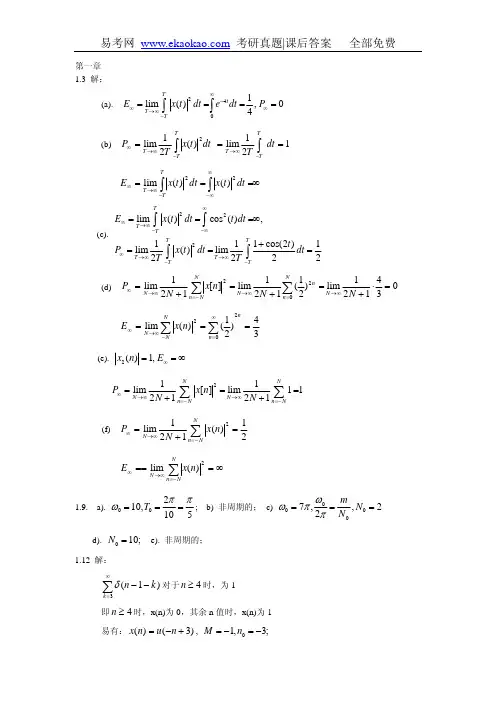
Chapter 1 Answers
1.6 (a).No
Because when t<0, )(1tx=0.
(b).No
Because only if n=0, ][2nxhas valuable.
(c).Yes
Because kkmnkmnmnx]}414[]44[{]4[
kmknmkn)]}(41[)](4[{
kknkn]}41[]4[{
N=4.
1.9 (a). T=/5
Because 0w=10, T=2/10=/5.
(b). Not periodic.
Because jtteetx)(2, while teis not periodic, )(2tx is not periodic.
(c). N=2
Because 0w=7, N=(2/0w)*m, and m=7.
(d). N=10
Because njjeenx)5/3(10/343)(, that is 0w=3/5, N=(2/0w)*m, and m=3.
(e). Not periodic.
Because 0w=3/5, N=(2/0w)*m=10m/3 , it’s not a rational number.
1.14
A1=3, t1=0, A2=-3, t2=1 or -1
dttdx)( is Solution: x(t) is
Because kkttg)2()(, dttdx)(=3g(t)-3g(t-1) or dttdx)(=3g(t)-3g(t+1)
1.15. (a). y[n]=2x[n-2]+5x[n-3]+2x[n-4] Solution:
]3[21]2[][222nxnxny
]3[21]2[11nyny
]}4[4]3[2{21]}3[4]2[2{1111nxnxnxnx
]4[2]3[5]2[2111nxnxnx
Then, ]4[2]3[5]2[2][nxnxnxny
(b).No. For it’s linearity.
the relationship between ][1ny and ][2nx is the same in-out relationship with (a).
you can have a try.
1.16. (a). No.
For example, when n=0, y[0]=x[0]x[-2]. So the system is memory.
(b). y[n]=0.
When the input is ][nA,
then, ]2[][][2nnAny, so y[n]=0.
(c). No.
For example, when x[n]=0, y[n]=0; when x[n]=][nA, y[n]=0.
So the system is not invertible.
1.17. (a). No.
For example, )0()(xy. So it’s not causal.
(b). Yes.
Because : ))(sin()(11txty , ))(sin()(22txty
))(sin())(sin()()(2121tbxtaxtbytay
1.21. Solution:
We have known:
(a).
(b).
(c).
(d).
1.22. Solution:
We have known:
(a).
(b).
(e).
(g)
1.23. Solution:
For )]()([21)}({txtxtxEv
)]()([21)}({txtxtxOd
then,
(a).
(b).
(c).
1.24. Solution:
For: ])[][(21]}[{nxnxnxEv
])[][(21]}[{nxnxnxOd
then,
(a).
(b).
(c).
1.25. (a). Periodic. T=/2.
Solution: T=2/4=/2.
(b). Periodic. T=2.
Solution: T=2/=2.
(d). Periodic. T=0.5.
Solution: )}()4{cos()(tutEtxv
)}())(4cos()()4{cos(21tuttut
)}()(){4cos(21tutut
)4cos(21t
So, T=2/4=0.5
1.26. (a). Periodic. N=7
Solution: N=m*7/62=7, m=3.
(b). Aperriodic.
Solution: N=mm16*8/12, it’s not rational number.
(e). Periodic. N=16
Solution as follow: )62cos(2)8sin()4cos(2][nnnnx
in this equation,
)4cos(2n, it’s period is N=2*m/(/4)=8, m=1.
)8sin(n, it’s period is N=2*m/(/8)=16, m=1.
)62cos(2n, it’s period is N=2*m/(/2)=4, m=1.
So, the fundamental period of][nx is N=(8,16,4)=16.
1.31. Solution
Because )()1()(),2()()(113112txtxtxtxtxtx.
According to LTI property ,
)()1()(),2()()(113112tytytytytyty
Extra problems:
Sketch tdttxty)()(. 1. Suppose
Solution:
2. Suppose Sketch:
(1). )]1(2)1()3()[(ttttg
(2). kkttg)2()( Solution: (1).
(2).
Chapter 2
2.1 Solution:
Because x[n]=(1 2 0 –1)0, h[n]=(2 0 2)1, then
(a).
So, ]4[2]2[2]1[2][4]1[2][1nnnnnny
(b). according to the property of convolutioin:
]2[][12nyny
(c). ]2[][13nyny