
条件式
- 格式:ppt
- 大小:64.50 KB
- 文档页数:13
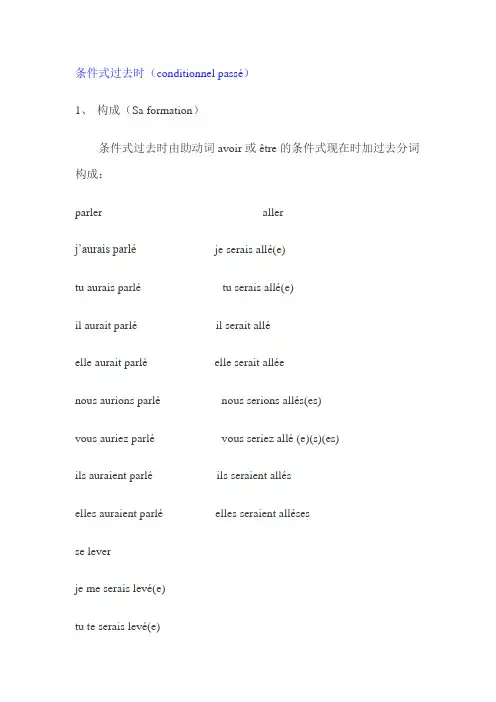
条件式过去时(conditionnel passé)1、构成(Sa formation)条件式过去时由助动词avoir或être的条件式现在时加过去分词构成:parler allerj’aurais parléje serais allé(e)tu aurais parlétu serais allé(e)il aurait parléil serait alléelle aurait parléelle serait alléenous aurions parlénous serions allés(es)vous auriez parlévous seriez allé (e)(s)(es)ils auraient parléils seraient alléselles auraient parléelles seraient allésesse leverje me serais levé(e)tu te serais levé(e)il se serait levéelle se serait levéenous nous serions levés(es)vous vous seriez levé(e)(s)(es)ils se seraient levéselles se seraient levées注意:使用动词être做助动词时,应特别注意主语与过去分词间的性,数配合。
2、用法(ses emplois):1)用于独立句:①推荐某件事已经发生,但未能肯定时用此语式,该用法常见于新闻报道。
On aurait envoyé un homme sur la lune.可能往月球上送人。
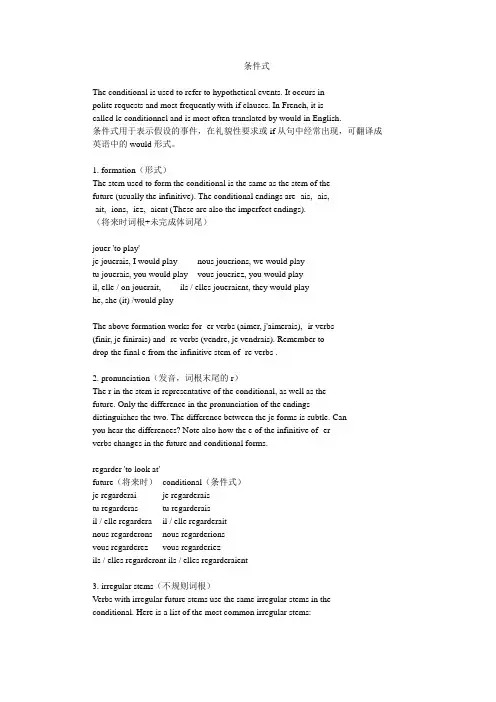
条件式The conditional is used to refer to hypothetical events. It occurs inpolite requests and most frequently with if clauses. In French, it iscalled le conditionnel and is most often translated by would in English.条件式用于表示假设的事件,在礼貌性要求或if从句中经常出现,可翻译成英语中的would形式。
1. formation(形式)The stem used to form the conditional is the same as the stem of thefuture (usually the infinitive). The conditional endings are -ais, -ais,-ait, -ions, -iez, -aient (These are also the imperfect endings).(将来时词根+未完成体词尾)jouer 'to play'je jouerais, I would play nous jouerions, we would playtu jouerais, you would play vous joueriez, you would playil, elle / on jouerait, ils / elles joueraient, they would playhe, she (it) /would playThe above formation works for -er verbs (aimer, j'aimerais), -ir verbs(finir, je finirais) and -re verbs (vendre, je vendrais). Remember todrop the final e from the infinitive stem of -re verbs .2. pronunciation(发音,词根末尾的r)The r in the stem is representative of the conditional, as well as thefuture. Only the difference in the pronunciation of the endingsdistinguishes the two. The difference between the je forms is subtle. Canyou hear the differences? Note also how the e of the infinitive of -erverbs changes in the future and conditional forms.regarder 'to look at'future(将来时)conditional(条件式)je regarderai je regarderaistu regarderas tu regarderaisil / elle regardera il / elle regarderaitnous regarderons nous regarderionsvous regarderez vous regarderiezils / elles regarderont ils / elles regarderaient3. irregular stems(不规则词根)Verbs with irregular future stems use the same irregular stems in the conditional. Here is a list of the most common irregular stems:infinitive stem conditional translationaller ir- j'irais I would goavoir aur- j'aurais I would runcourir courr- je courrais I would rundevoir devr- je devrais I would be obliged to envoyer enverr- j'enverrais I would sendêtre ser- je serais I would befaire fer- je ferais I would dofalloir faudr- il faudrait it would be necessarymourir mourr- je mourrais I would dieobtenir obtiendr- j'obtiendrais I would obtainpleuvoir pleuvr- il pleuvrait it would rainpouvoir pourr- je pourrais I would be ablerecevoir recevr- je recevrais I would receivesavoir saur- je saurais I would knowtenir tiendr- je tiendrais I would holdvenir viendr- je viendrais I would comevoir verr- je verrais I would seevouloir voudr- je voudrais I would want4. verbs with spelling changes(拼写变化的动词)Some verbs with spelling changes in the present form their future/conditional stem regularly. These include verbs like préférer, espérer, manger, and commencer.infinitive stem conditional translationpréférer préférer- j e préférerais I would preferespérer espérer- j'espérerais I would hopemanger manger- je mangerais I would eatcommencer commencer- je commencerais I would startVerbs with spelling changes like appeler, employer and acheter add -r to the present of the je form to create their future stem.present tense stem conditional translationj'appelle appeller- j'appellerais I would callj'emploie emploier- j'emploierais I would usej'achète achèter- j'achèterais I would buy5. uses(用法)1) wishes or requests(希望或要求)The conditional expresses potentiality. It is used to express a wish ora suggestion, to make a request, or to accept or extend invitations. Itis less direct and more polite than the imperative. The verbs 'pouvoir','vouloir', and 'devoir' are often found in the conditional to diminishthe strength of a command. In most cases, the conditional is translatedas meaning would in English. However, je pourrais means 'I could', je devrais means 'I should' and je voudrais means 'I would like'. Also donot confuse 'would' in English meaning 'used to' which should be translated as an imparfait in French, and NOT as the conditional: A Paris, Joe-Bob allait au MacDo tous les jours. (In Paris, Joe-Bob would/used togo to McDonald's everyday).Joe-Bob et Tammy se trouvent au restaurant où Edouard travaille comme serveur.Joe-Bob and Tammy are at the restaurant where Edouard works as a waiter.Edouard: Bonsoir Madame, Monsieur. Aimeriez-vous commander un apéritif pour commencer?Edouard: Good evening, would you like to order drinks to start?Tammy: Oh oui! Pourrions-nous avoir un Ricard et un Perrier? Ensuite, je voudrais une salade verte, s'il vous pla?t.Tammy: Oh yes, could we have one Ricard and one Perrier? Then I would like a green salad, please.Joe-Bob: Je veux un hamburger.Joe-Bob: I want a hamburger.Edouard: Monsieur, vous devriez être plus poli dans ce restaurant, sinon,je pourrais oublier votre commande!Edouard: Sir, you should be more polite in this resaurant, or else Icould forget your order!2) hypothetical action(前提动作)The conditional is used when making statements which are contrary to present facts. It expresses a hypothethical result which depends on (stated or implied) circumstances which do not exist. In order for theaction expressed by the conditional to occur, something else must take place first. Note that the condition in the si or if clause, is alwaysstated in the imparfait. (See 'si' clauses for further examples.)Tex et Joe-Bob regardent la télé. 'Le gros lot se monte à 30 millionsde dollars. Que feriez-vous si vous gagniez?'Tex and Joe-Bob are watching television. 'The Lottery is at 30 million dollars. What would you do if you won?'Tex: Moi, j'écrirais sans cesse des livres de philosophie.Tex: I would write philosophy books non-stop.Joe-Bob: Moi j'achèterais mon dipl?me d'université.Joe-Bob: I would buy my university diploma.3) possibility or uncertainty(可能性或不确定性)The conditional is also used to give information whose accuracy cannot be guaranteed. Journalists often use it to report events which are not knownto be true.Tammy et Bette regardent la télé. Soudain, leur programme préféré est interrompu et un commentateur annonce:Tammy and Bette are watching television. Suddenly, their favorite programis interrupted and a commentator announces:'Une tornade vient de s'abattre sur Hubbard, Texas. Il y aurait plusieurs victimes. Un tatou et un écureuil seraient gravement blessés. Restez avecnous, nous devrions avoir plus de détails d'ici quelques secondes . . .''A tornado just struck in Hubbard, Texas. Allegedly, there are several casualties. An armadillo and a squirrel seem to be seriously wounded.Stay with us, we should have more details in a few seconds . . .'Presque immédiatement, le téléphone sonne. Tammy répond: A . . ., All??'Almost immediately, the phone rings. Tammy answers: 'He . . ., Hello?'A l'autre bout, Tex dit: 'Tammy, c'est moi, Tex. Ne t'inquiète pas, onva très bien. Je rentrerai bient?t.'At the other end, Tex says: 'Tammy, it's me Tex. Don't worry we're fine.I'll be home soon.'4) reported speech (indirect discourse)(间接引语,过去将来时)In addition, the conditional is used to represent the future in relationto a narration in the past when reported speech is used to tell whatsomeone said.Tex a dit qu'il rentrerait bient?t.Tex said he would be home soon.练习Give the conditional of the verb indicated in parentheses.1. Edouard: Vous ______ aimable de fermer la porte. (être)2. Bette: Si ?a ne te fais rien, je ______ aller au concert. (préférer)3. Tammy: Tex, c'est l'anniversaire de Fiona. Tu ______ lui offir un cadeau. (devoir)4. Tammy: Il ______ vraiment que Tex travaille. (falloir)5. Tex: Edouard et moi, nous ______ bien envie d'une petite liqueur. (avoir)6. Bette: On ______ beaucoup rencontrer Tex. (aimer)7. Tammy et Bette ______ vivre en France. (aimer)8. Tex: Vous ______ intérêt à faire attention. (avoir)9. Joe-Bob: ______- vous me prêter de l'argent? (pouvoir)10. Tex: Je ______ un café, s'il vous pla?t. (vouloir)。

西语条件式
条件式是西班牙语中的一种语法形式,是表达虚拟情况的一种方式。
它分为两种类型:条件式一和条件式二。
条件式一用于表达现实中可能发生的事情,其构成形式为:如果+现在时,将来时。
例如:“如果明天下雨,我将会呆在家里。
”
条件式一常用于表达句子里所带的情态,如愿望和建议。
例如:“如果能去旅行就太好了。
”
条件式二则用于表达假设情况下的不可能性或虚拟情况,并带有情态动词“能够”或“愿意”的否定形式。
其构成形式为:如果+过去式,将会用过去完成时。
例如:“如果你能够魔法变出一部新手机,那真好。
”
条件式二常用于表达与现实相反的情境,构成反意问句时,则会表达强烈的愿望。
例如:“如果我有更多时间,我会去学习希腊语,你呢?”
总的来说,条件式可以帮助我们表达虚拟情况,因此在学习西班牙语的过程中,掌握条件式是非常必要的。

西语条件式用法条件式是西班牙语中非常常用的一种句型结构,用于表达可能会发生的情况、假设、猜测或建议等。
条件式根据假设或条件的不同可以分为三种形式:条件式一、条件式二和条件式三。
下面将分别介绍这三种条件式的用法和构造。
1. 条件式一 (El condicional simple)条件式一用于表示可能发生的事情或情况,这种情况通常是与现实相符的。
构造条件式一的句子时,需要用到动词的词干+相应的词尾,具体规则如下:- AR动词的词尾是-ía- ER和IR动词的词尾是-ía例如:- Hablaría contigo si tuviera tiempo.(如果我有时间,我会和你说话。
)- Comeríamos helado si hiciera calor.(如果天气炎热,我们会吃冰淇淋。
)此外,条件式一也可以用于表示礼貌的请求或建议。
例如:- ¿Podrías ayudarme con esto, por favor?(你可以帮我一下吗?)- Sería mejor que estudiaras más.(最好多学一些。
)2. 条件式二 (El condicional compuesto)条件式二用于表示与现实情况不符的假设、猜测或愿望。
构造条件式二的句子时,需要用到动词 haber 的条件式一形式加上动词的过去分词形式。
例如:- Si tuviera dinero, compraría una casa en la playa.(如果我有钱,我会在海滩上买房子。
)- Si pudiera volar, visitaría todos los países del mundo.(如果我能飞,我会去游览世界上的每个国家。
)条件式二也可以用于表示谦虚的请求或建议。
例如:- ¿Podrías ayudarme con esto, por favor?(你可以帮我一下吗?)- Sería mejor que estudiaras más.(最好多学一些。