大学英语四级真题(word打印版)2010年12月
- 格式:doc
- 大小:117.50 KB
- 文档页数:20
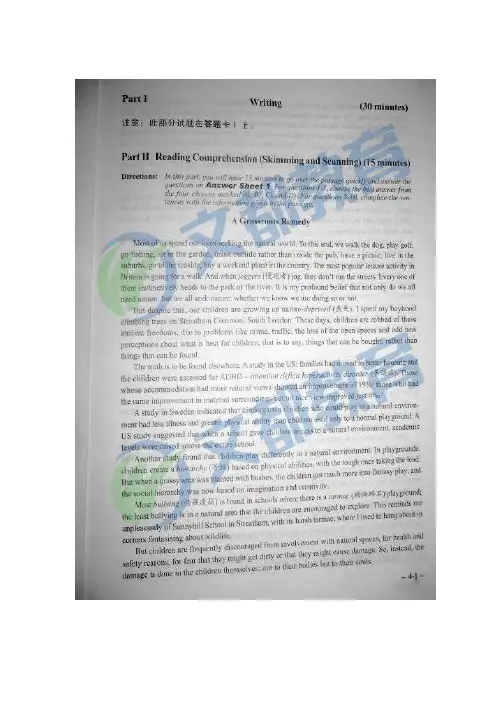
2010年12月18日大学英语新四级(CET-4)考试Part Ⅰ WritingDirections:For this, part, you are allowed 30 minutes to write a short essay on the topic of How Should Parents Help Children to Be Independent? You should write at least 120 words following theoutline given below."1. 目前不少父母为孩子包办一切2. 为了孩子独立,父母应该……PartⅡ Reading Comprehension (SKimming and Scanning)Directions:In this part, you will have 15 minutes to go over the passage quickly and answer the questions on Answer Sheet 1. For questions 1-7 choose the best answer from the four choices marked A), B), C) and D). For questions 8-10, complete the sentences with the information given in the passage.A Grassroots RemedyMost of us spend our lives seeking the natural world. To this end, we walk the dog, play golf, go fishing, sit in the garden, drink outside rather than inside the pub, have a picnic, live in the suburbs, go to the seaside, buy a weekend place in the country. The most popular leisure activity in Britain is going for a walk. And when joggers(慢跑者) jog, they don't run the streets. Every one of them instinctively heads to the park or the river. It is my profound belief that not only do we all need nature, but we all seek nature, whether we know we are doing so or not.But despite this, our children are growing up nature-deprived (丧失) . I spent my boyhood climbing trees on Streatham Common, South London. These days, children are robbed of these ancient freedoms,due to problems like crime, traffic, the loss of the open spaces and odd new perceptions about what is best for children, that is to say, things that can be bought, rather than things that can be found.The truth is to be found elsewhere. A study in the US: families had moved to better housing and the children were assessed for ADHD—attention deficit hyperactivity disorder(多动症). Those whose accommodation had more natural views showed an improvement of 19%; those who had the same improvement in material surroundings but no nice view-improved just 4%.A study in Sweden indicated that kindergarden children who could play in a natural environment had less illness and greater physical ability than children used only to a normal playground. A US study suggested that when a school gave children access to a natural environment, academic levels were raised across the entire school.Another study found that children play differently in a natural environment. In playgrounds, children create a hierarchy(等级) based on physical abilities, with the tough ones taking the lead. But when a grassy area was planted with bushes, the children got much moreinto fantasy play, and the social hierarchy was now based on imaginations and creativity.Most bullying(恃强凌弱) is found in schools where there is a tarmac(柏油碎石) playground; the least bullying is in a natural area that the children are encouraged to explore. This reminds me unpleasantly of Sunnyhill School in Streamham, with its harsh tarmac, where I used to hang about in comers fantasising about wildlife.But children are frequently discouraged from involvement with natural spaces, for health and safety reasons, for fear that they might get dirty or that they might cause damage. So, instead, the damage is done to the children themselves: not to their bodies but to their souls.One of the great problems of modem childhood is ADHD, now increasingly and expensively treated with drugs. Yet one study after another indicates that contact with nature gives huge benefits to ADHD children. However, we spend money on drugs rather than on green places.The life of old people is measurably better when they have access to nature. The increasing emphasis for the growing population of old people is in quality rather than quantity of years. And study after study finds that a garden is the single most important thing in finding that quality.In wider and more difficult areas of life, there is evidence to indicate that natural surroundings improve all kinds of things. Even problems with crime and aggressive behaviour are reduced when thereis contact with the natural world.Dr William Bird, researcher from the Royal Society for the Protection of Birds, states in his study. "A natural environment can reduce violent behaviour because its restorative process helps reduce anger and impulsive behaviour." Wild places need encouraging for this reason, no matter how small their contribution.We tend to look on nature conservation as some kind of favourthat human beings are granting to the natural world. The error here is far too deep: not only do humans need nature for themselves, but the very idea that humanity and the natural world are separable things is profoundly damaging.Human beings are a species of mammals(哺乳动物). For sevenmillion years they lived on the planet as part of nature. Our ancestral selves miss the natural world and long for contact withnon-human life. Anyone who has patted a dog, stroked a cat, sat undera tree with a pint of beer, given or received a bunch of flowers or chosen to walk through the park on nice day, understands that.We need the wild world. It is essential to our well-being, our health, our happiness. Without the wild world we are not more but less civilized. Without other living things around us we are less than human.Five ways to find harmony with the natural worldWalk: Break the rhythm of permanently being under a roof. Get off a stop earlier, make a circuit of the park at lunchtime, walk the child to and from school, get a dog, feel yourself moving in moving air, look, listen, absorb.Sit: Take a moment, every now and then, to be still in an open space. In the garden, anywhere that's not in the office, anywhere out of the house, away from the routine. Sit under a tree, look at water, feel refreshed, ever so slightly renewed.Drink: The best way to enjoy the natural world is by yourself; the second best way is in company. Take a drink outside with a good person, a good gathering: talk with the sun and the wind with birdsong for background.Learn: Expand your boundaries. Learn five species of birds, five butterflies, five trees, five bird songs. That way, you see and hear more: and your mind responds, gradually to the greater amount of wildness in your life.Travel: The places you always wanted to visit: by the seaside, in the country, in the hills. Take a weekend break, a day-trip, get out there and do it; for the scenery, for the way through the woods, for the birds, for the bees. Go somewhere special and bring specialness home. It lasts forever, after all.1. What is the author's profound belief?A) People instinctively seek nature in different ways.B) People should spend most of their lives in the wild.C) People have quite different perceptions of nature.D) People must make more efforts to study nature.2. What does the author say people prefer for their children nowadays?A) People freedom.B) Things that are natural.C) Urban surroundings.D) Things that are purchased.3. What does a study in Sweden show?A) The natural environment can help children learn better.B) More access to the nature makes children less likely to fall ill.C) A good playground helps kids develop their physical abilities.D) Natural views can prevent children from developing ADHD.4. Children who have chances to explore natural areas______.A) tend to develop a strong love for science.B) are more likely to fantasise about wildlife.C) tend to be physically tougher in adulthood.D) are less likely to be involved in bullying.5. What does the author suggest we do to help children with ADHD?A) Find more effective drugs for them.B) Provide more green spaces for them.C) Place them under more personal care.D) Engage them in more meaningful activities.6. In what way do elderly people benefit from their contact with nature?A) They look on life optimistically.B) They enjoy a life of better quality.C) They are able to live longer.D) They become good-humored.7. Dr william Bird suggests in his study that______.A) humanity and nature are complementary to each other.B) wild places may induce impulsive behaviour in people.C) access to nature contributes to the reduction of violence.D) it takes a long time to restore nature once damaged.8. It is extremely harmful to think that humanity and the natural world can be______.9. The author believes that we would not be so civilisedwithout______.10. The five suggestions the author gives at the end of the passage are meant to encourage people to seek ______ with the natural world.PartⅢ Listening ComprehensionSection ADirections:In this section you will hear 8 short conversationas and 2 long eonversationa. At the end of each conversation one or more queastions will be asked about what was said Both the conversation and the questions will be spoken only once. After each question there will be a pause. During the pause, you must read the four ehoices marked A), B), C) and D), and decide which the best answer Thee mark the corresponding letter on Answer Sheet 2 with a single line throgh the centre.11. A) The man should visit the museums.B) She can't stand the hot weather.C) The beach resort is a good choice.D) She enjoys staying in Washington.12. A) Her new responsibilities in the company.B) What her job prospects are.C) What the customers' feedback is.D) The director's opinion of her work.13. A) Combine her training with dieting.B) Repeat the training every three days.C) Avoid excessive physical training.D) Include weightlifting in the program.14. A) When she will return home.B) Whether she can go by herself.C) Whether she can travel by air.D) When she will completely recover.15. A) The woman knows how- to deal with the police.B) The woman had been fined many times before.C) The woman had violated traffic regulations.D) The woman is good at finding excused.16. A) Switch offthe refrigerator for a while.B) Have someone repair the refrigerator.C) Ask the man to fix the refrigerator.D) Buy a refrigerator of better quality.17. A) He owns a piece of land in the downtown area.B) He has got enough money to buy a house.C) He can finally do what he has dreamed of.D) He is moving into a bigger apartment.18. A) She is black and blue all over.B) She has to go to see a doctor.C) She stayed away from work for a few days.D) She got hurt in an accident yesterday.Questions 19 to 21 are based on the conversation you have just heard.19. A) She was a bank manager.B) She was a victim of the robbery.C) She was a defence lawyer.D) She was a witness to the crime.20. A) A tall man with dark hair and a moustache.B) A youth with a distinguishing mark on his face.C) A thirty-year-old guy wearing a light seater.D) A medium-sized young man carring a gun.21. A) Identify the suspect from pictures.B) Go upstairs to sign some document.C) Have her photo taken for her files.D) Verify the record of what she had said.Questions 22 to 25 are based on hte conversation you have just heard.22. A) By reading a newspaper ad.B) By seeing a commercial on TV.C) By listening to the morning news.D) By calling an employment service.23. A) She could improve her foreign languages.B) She could work close to her family. C) She could travel overseas frequently.D) She could use her previous experiences.24. A) Taking management courses.B) Teaching English at a university.C) Working as a secretary.D) Studying for a degree in French.25. A) Prepare for an interview in a couple of days.B) Read the advertisement again for more details.C) Send in a written application as soon as possible.D) Get to know the candidates on the short list.Section BDirections:In this section you will hear 3 short passages. At the end of each passage, you will hear some questions. Both the passage and the questions will be spoken only once. After you hear a question, you must choose the best answer from the four choices markedA), B), C) and D). Then mark the corresonding letter on Answer Sheet 2 with a single line through the centrePassage OneQuestions 26 to 29 are based on the conversation you have just heard.26. A) They cannot see the firefighters because of the smoke.B) The do not realize the danger they are in.C) They cannot hear the firefighters for the noise.D) They mistake the firefighters for monsters.27. A) He travels all over America to help put out fires.B) He often teaches children what to do during a fire.C) He teaches Spanish in a Sat Francisco community.D) He provides oxygen masks to children free of charge.28. A) He saved the life of his brother choking on food.B) He rescued a student from a big fire.C) He is very good at public speaking.D) He gives informative talks to young children.29. A) Firefighters play an important role in America.B) Kids should learn not to be afraid of monsters.C) Carelessness can result in tragedies.D) Informative speeches can save lives.Passage TwoQuestions 30 to 32 are based on the passage you have just heard.30. A) To satisfy the needs of their family.B) To fully realize their potential.C) To make money for early retirement.D) To gain a sense of their personal worth.31. A) They may have to continue to work in old age.B) They may regret the time they wasted.C) The may have nobody to depend on in the future.D) They may have fewer job opportunities.32. A) Making wise use of your time.B) Enjoying yourself while you can.C) Saving as much as you can.D) Working hard and playing hard.Passage ThreeQuestions 33 to 35 based on the passage you have just heard.33. A) Hardworking students being accused of cheating.B) Boy students being often treated as law-breaking.C) Innocent people being suspected groundlessly.D) Junior employees being made to work overtime.34. A) Forbidding students to take food out of the restaurant.B) Requesting customers to pay before taking the food.C) Asking customers to leave their bags on the counters.D) Allowing only two students to enter at a time.35. A) He was taken to the manager.B) He was closely watched.C) He was asked to leave.D) He was overcharged.Section CDirections:In this' section, you will hear a passage three times. When the passage is read for the first time, you should listen carefully for its general idea. When the passage is read for the second time, you are required to fill in the blanks numbered from 36to 43 with the exact words you have just heard For blanks' numbered from 44 to 46 you are required to fill in the missing information.For these blanks; you can either use the exact words you have just heard or write down the main points in your own words Finall when the passage is read for the third time, you should check what you have written.Writing keeps us in touch with other people. We write to communicate with relatives and friends. We write to (36) our family histories so our children and grandchildren can learn and (37) their heritrage (传统). With computers and Internet connections in so many (38) , colleges, and businesses, people are e-mailing friends and relatives all the time--or talking to them in writing in on line (39) rooms. It is cheaper than calling long distance, and a lot more (40)than waiting until Sunday for the telephone (41) to drop. Studentsare e-mailing their professors to (42) and discuss their classroom assignments andto (43) them. They are e-mailing classmates to discuss and collaborate (合作) on homework. (44)Despite the growing importance of computer, however, there will always be a place and need for the personal letter. (45) . No matter what the content of the message, its real point is, "I want you to know that I care about you." (46) . but only in the success of human relationships.PartⅣ Reading Comprehension (Reading in Depth)Section ADirections: In this section, there is a passage with ten blanks. You are required to select one word for each blank from a list of choices given in a word bank following the passage. Read the passage through carefully before making your choices. Each chowe in the bankis identified by a letten Please mark the corresponding letter for each item on Answer Sheet 2 with a single line through the centre,You may not use any of the words in the bank more than once Questions 47 to 56 are based on the following passage.What determines the kind of person you are? What factors make you more or less bold, intelligent, or able to read a map? All of these are influenced by the interaction of your genes and the environmentin which you were (47) . The study of how genes and environment interact to influence (48) activity is known as behavioral genetics. Behavioral genetics has made important (49) to the biological revolution, providing information about the extent to which biology influences mind, brain and behavior.Any research that suggests that (50) to perform certain behaviors are based in biology is controversial. Who wants to be told thatthere are limitations to what you can (51) based on something that is beyond your control, such as your genes? Its is easy to accept that genes control physical characteristics such as sex, race and eye color. But can genes also determine whether people will get divorced, how (52) they are, or what career they are likely to choose? Aconcern of psychological scientists is the (53) to which all of these characteristics are influenced by nature and nurture (养育) , by genetic makeup and the environment. Increasingly, science (54) that genes lay the groundwork for many human traits. From this perspective, people are born (55) like undeveloped photographs: The image is already captured, but the way it (56) appears can vary based on the development process. However, the basic picture is there from theDirections: There are 2 passages. in this section. Each passageis followed by some questions or unfinished statements. For each of them there are four choices' markedA), B), C) and D). You should decide on the best choice and mark the corresponding letter on Answer Sheet 2 with a single line through the centre.Passage OneQuestions 57 to 61 are based on the following passage.It is pretty much a one-way street.While it may be common for university researchers to try their luck in the commercial world, there is very little traffic in the opposite direction. Pay hasalways been the biggest deterrent, as people with families often feel they cannot afford the drop in salary when moving to a university job. For some industrial scientists, however, the attractions ofacademia(学术界) outweigh any financial considerations.Helen Lee took a 70% cut in salary when she moved from a senior post in Abbott Laboratories to a medical department at the University of Cambridge. Her main reason for returning to academia mid-careerwas to take advantage of the greater freedom to choose research questions. Some areas of inquiry have few prospects of a commercial return, and Lee'ss one of them.The impact of a salary cut is probably less severe for ascientist in the early stages of a career. Guy Grant, now a research associate at the Unilever Centre for Molecular informatics at the University of Cambridge, spent two years working for apharmaceutical(制的) company before returning to university as apost-doctoral researcher. He took a 30% salary cut but felt it worthwhile for the greater intellectual opportunities.Higher up the ladder, where a pay cut is usually more significant, the demand for scientists with a wealth of experience in industry is forcing universities to make the transition (转换) to academia more attractive, according to Lee. Industrial scientists tend to receive training that academics do not, such as how to build amultidisciplinary team, manage budgets and negotiate contracts. They are also well placed to bring something extra to the teaching side of an academic role that will help students get a job when they graduate, says Lee, perhaps experience in nanufacturing practice or productdevelopment. "Only a small number of undergraduates will continue in an academic career. So someone leaving university who already has the skills needed to work in an industrial lab has far more potential in the job market than someone who has spent all their time on a narrow research project."57. By "a one-way street"(Line 1, Para 1), the author means______.A) university researchers know little about the commercial worldB) there is little exchange between industry and academiaC) few industrial scientists would quit to work in a universityD) few university professors are willing to do industrialresearch58. The word "deterrent"(Line 3,Paral) most probably refers to something that______.A) keeps someone from taking actionB) helps to move the trafficC) attracts people's attentionD) brings someone a financial burden59. What was Helen Lee's major consideration when she changed her job in the middle of her career?A) Flexible work hours.B) Her research interests.C) Her preference for the lifestyle on campus.D) Prospects of academic accomplishments.60. Guy Grant chose to work as a researcher at Cambridge in order to______.A) do financially more rewarding work.B) raise his status in the academic world.C) enrich his experience in medical research.D) exploit better intellectual opportunities.61. What contribution can industrial scientists make when they come to teach in a university?A) Increase its graduates' competitiveness in the job market.B) Develop its students' potential in research.C) Help it to obtain financial support from industry.D) Gear its research towards practical applications.Passage TwoQuestions 62 to 66 are based on the following passage.Being sociable looks like a good way to add years to your life. Relationships with family, friends, neighbours, even pets, will alldo the trick, but the biggest longevity(长寿) boost seems to comefrom marriage or an equivalent relationship. The effect was first noted in 1858 by William Farr, who wrote that widows and widowers(鳏夫) were at a much higher risk of dying than their married peers. Studies since then suggest that marriage could add as much as sevenyears to a man's life and two to a woman's. The effect holds for all causes of death, whether illness, accident or self-harm.Even if the odds are stacked against you, marriage can more than compensate. Linda Waite of the University of Chicago has found that a married older man with heart disease can expect to live nearly four years longer than an unmarried man with a healthy heart. Likewise, a married man who smokes more than a pack a day is likely to live as long as a divorced man who doesn't smoke. There's a flip side, however, as partners are more likely to become ill or die in the couple of years following their spouse's death, and caring for a spouse with mental disorder can leave you with some of the same severe problems. Even so, the odds favour marriage. In a 30-year study of more than 10,000 people, Nicholas Christakis of Harvard Medical School describes how all kinds of social networks havesimilar effects.So how does it work? The effects are complex, affected by socio-economic factors, heath-service provision, emotional support and other more physiological(生理的) mechanisms. For example, social contact can boost development of the brain and immune system, leading to better health and less chance of depression later in life. People in supportive relationship may handle stress better. Then there are the psychological benefits of a supportive partner.A life partner, children and good friends are all recommended if you aim to live to 100. The ultimate social network is still being mapped out, but as Christakis say: "People are interconnected, so lheir health is interconnected."62. Willian Farr's study and other studies show that ______.A) social life provides an effective cure for illnessB) being sociable helps improve one's quality of lifeC) women benefit more than men from marriageD) marriage contributes a great deal to longevity63. Linda Waite's studies support the idea that ______.A) older men should quit smoking to stay healthyB) marriage can help make for ill healthC) the married are happier than the unmarriedD) unmarried people are likely to suffer in later life64. It can be inferred from the context that the "flip side"(Line 5, Para. 2) refers to ______.A) the disadvantages of being marriedB) the emotional problems arising from marriageC) the responsibility of taking care of one's familyD) the consequence of a broken marriage65. What does the author say about social networks?A) They have effects similar to those of a marriage.B) They help develop people's community spirit.C) They provide timely support for those in need.D) They help relieve people of their life's burdens.66. What can be inferred from the last paragraph?A) It's important that we develop a social network when young.B) To stay healthy, one should have a proper social network.C) Getting a divorce means risking a reduced life span.D) We should share our social networks with each other.PartⅤ ClozeDirections: There are 20 blanks in the following passage. For each blank there are four choices marked A), B), C) and D) on the right side of the paper. You should choose the ONE that best fitsinto the passage Then mark the corresponding letter on Answer Sheet 2 with a single line through the centre.Over half the world's people now live in cities. The latest "Global Report on Human Settlements" says a significant change took place last year. The report (67) this week from U.N. Habitat, a United Nations agency.A century ago, (68) than five percent of all people lived in cities. (69) the middle of this century it could be seventy percent, or (70) six and a half billion people.Already three-fourths of people in (70) countries live in cities. Now most urban population (72) is in the developing world.Urbanization can (73) to social and economic progress, but also put (74) on cities to provide housing and (75) . The new report says almost two hundred thousand people move (76) cities and towns each day. It says worsening inequalities, (77) by social divisions and differences in (78) , could result in violence and crime (79) cities plan better.Another issue is urban sprawl(无序展的城区) . This is wherecities (80) quickly into rural areas, sometimes (81) a much faster rate than urban population growth.Sprawl is (82) in the United States. Americans move a lot. In a recent study, Art Hall at the University of Kansas found that people are moving away from the (83) cities to smaller ones. He sees a (84) toward "deurbanization" across the nation.(85) urban economies still provide many (86) that rural areas do not.67. A) came on B) came off C) came over D) came out68. A) more B) other C) less D) rather69. A) By B) Through C) Along D) To70. A) really B) barely C) ever D) almost71. A) flourishingB) developed C) thriving D) fertile。