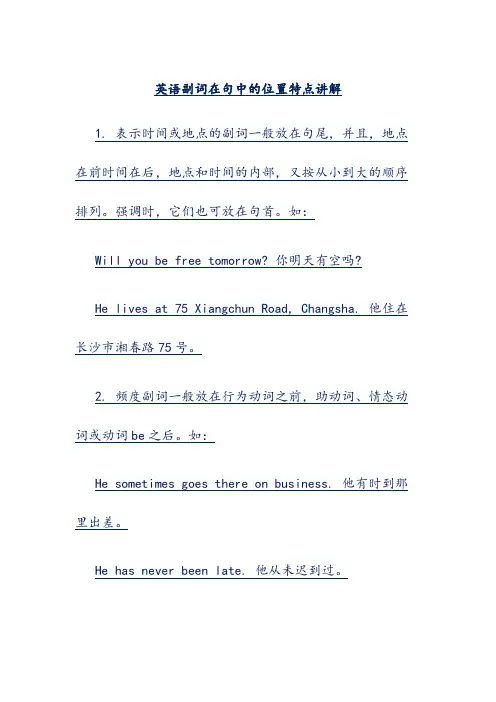
[英语中副词的位置]副词在句中的位置
- 格式:doc
- 大小:25.00 KB
- 文档页数:7
[英语中副词的位置]副词在句中的位置篇一 : 副词在句中的位置副词在句中的位置一、句首。
2、强调事情发生的频率的副词常放在句首。
如:usually,sometimes, occasionally等。
Usually, farmers use ploughs to prepare their fields for planting crops.3、表示确定时间的副词也可置于句首。
Today that same family may well feel poor, because the backbone of American life.4、起连接作用的副词、表示顺序等的副词也可置于句首,后面一般用“,”隔开。
Consequently, the weather in this regions remains fairly constant.5、only、hardly等特殊副词也可以位于句首。
Hardly had we left the station when it began to rain。
二、句中。
1、作定语时的位置:一般要放在所修饰的名词之后。
There is no way around the uncertainty.2、修饰形容词时的位置:一般放在被修饰的词之前。
I’m really glad our club decided to raise money for the Children’s Hospital.3、频度副词通常放在行为动词前面,或者be动词、情态动词或助动词后面。
They purposefully make you feel like less of a person so you’ll buy their stuff and they’ll make money.Who knows, they might even come to enjoy not having to takecalls.三、句尾。
1、often可与very或quite等一起放于句尾。
Punishing people for using hand-held gadgets while driving isdifficult enough.2、表示地点的副词常放在句未。
Is there truly a threat here?3、表示方式的副词常放在句未,也可放在其它位置,但通常不放在动词与宾语之间。
And those are countries that provide health care and child care , which eases the economic pinch considerably. 。
1、疑问副词一般都位于句首。
Why won’t scientists complain about the government’s policy concerning scientific research?2、强调事情发生的频率的副词常放在句首。
如:usually,sometimes, occasionally等。
Usually, farmers use ploughs to prepare their fields for planting crops.3、表示确定时间的副词也可置于句首。
Today that same family may well feel poor, because the backbone of American life.4、起连接作用的副词、表示顺序等的副词也可置于句首,后面一般用“,”隔开。
Consequently, the weather in this regions remains fairly constant.5、only、hardly等特殊副词也可以位于句首。
Hardly had we left the station when it began to rain。
二、句中。
1、作定语时的位置:一般要放在所修饰的名词之后。
There is no way around the uncertainty.2、修饰形容词时的位置:一般放在被修饰的词之前。
I’m really glad our club decided to raise money for the Children’s Hospital.3、频度副词通常放在行为动词前面,或者be动词、情态动词或助动词后面。
They purposefully make you feel like less of a person so you’ll buy their stuff and they’ll make money.Who knows, they might even come to enjoy not having to takecalls.三、句尾。
1、often可与very或quite等一起放于句尾。
Punishing people for using hand-held gadgets while driving is difficult enough.2、表示地点的副词常放在句未。
Is there truly a threat here?3、表示方式的副词常放在句未,也可放在其它位置,但通常不放在动词与宾语之间。
And those are countries that provide health care and child care , which eases the economic pinch considerably. 在动词之前。
2) 在be动词、助动词之后。
3) 多个助动词时,副词一般放在第1个助动词后。
注意: a. 大多数方式副词位于句尾,但宾语过长,副词可以提前,以使句子平衡。
We could see very clearly a strange light ahead of us. b. 方式副词well,badly糟、坏,hard等只放在句尾。
He speaks English well. 二、副词的排列顺序: 1)时间,地点副词,小单位的在前,大单位在后。
2) 方式副词,短的在前,长的在后,并用and或but等连词连接。
Please write slowly and carefully. 3) 多个不同副词排列:程度+地点+方式+时间副词。
注意:副词very 可以修饰形容词,但不能修饰动词。
改错: I very like English. I like English very much. 注意:副词enough要放在形容词的后面,形容词enough放在名词前后都可。
I don”t know him well enough. There is enough food for everyone to eat. There is food enough for everyone to eat.希望以上回答对你有帮助以后有什么问题,请到的论坛来,这里专门为你免费解答各课学习问题篇四 : 法语副词位置Où faut-il placer l’adverbe dans une phrase ?在一个句子里,副词应该放在哪里 ,L’adverbe est un mot qui sert, le plus souvent, à modifier les verbes. Enfran?ais, l’adverbe se forme souvent en rajoutant ? ment ? à un adjectif.副词一般用来修饰一个动词。
,,法语的副词一般很简单,只要在一个形容词后面加“ment”就行了 :- Je marche de fa?on rapide ? je marche rapidement 我走得很快。
- Il mange de fa?on sale ? il mange salement 他吃得很脏。
Il y a toutefois pas mal d’adverbes qui ne se terminent pas par ? ment ?.哈哈,法语老是有例外,所以没有“ment”的副词也不少,例如:très , assez , toujours ,souvent , vite …- Il marche de fa?on rapide ? il marche rapidement, il marche vite. 他走得很快。
L’adverbe, c’est pratique pour simplifier les phrases. Pas la peine dedire ? il mange de fa?on sale ?, il suffit de dire ? il mange salement ?.Mais il y a a ussi des adjectifs qui n’ont pas d’adverbe.副词很方便因为用副词就可以写很简单的句子. 例如,不用说:ilmange de fa?on sale:,只要说:il mange salement:就行了(不过,讨厌~一些法语形容词没有副词, 例如 fluide :- Elle danse de fa?on fluide ? on ne peut pas dire ? elle danse fluidement ?, ?a n’existe pasOùplacer l’adverbe ? Ce n’est pas très compliqué.副词应该放在哪里 ? 并不复杂 :Quand l’adverbe modifie un adjectif, il est placé en général avant.修饰形容词的时候,副词一般放在形容词前面:- Vous êtes très aimable. 你很和气。
- Il est devenu rapidement obèse. 他很快就变得非常胖。
- C’est vachemen t moche. 这个东西很丑。
Mais pour les adverbes de plusieurs syllabes, on peut les placeraprès l’adjectif, pour insister sur le sens apporté par l’adverbe.例外,例外~两三个syllabes的副词可以放在形容词后面,用来强调这个副词的意思:- Il est devenu obèse rapidement. 他非常快就变得很胖。