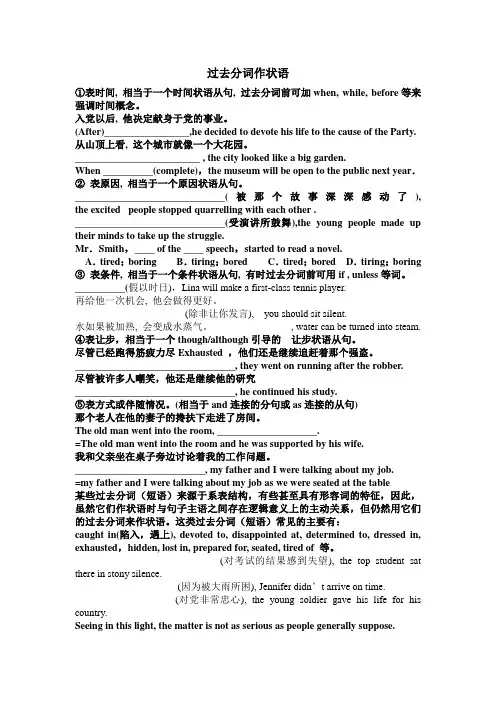
过去分词作状语
- 格式:doc
- 大小:42.50 KB
- 文档页数:5
过去分词作状语
过去分词作状语可表示时间、原因、条件、让步、方式或伴随情况等。掌握其用法应该注意以下几点
一、过去分词作状语与状语从句之间的转换
1)表示时间,相当于一个时间状语从句,为了明确其意义有时可在分词前加上when,while等连词。如:
⑴Asked why she didn’t do it ,she began to cry.
=When she was asked why she didn’t do it,she began to cry.
当问到她为什么没有做此事时,她开始哭了起来。
⑵Seen from the top of the hill, the city looked like a big garden.
=When we see it from the top of the hill, the city looked like a big
garden.
从山顶上看,这个城市就像一个大花园。
2)表示原因,相当于as, since, because引导的原因状语从句。如:
⑴She soon fell asleep, tired by the journey.
=Since she was tired by the journey she soon fell asleep.
由于旅途劳累,她很快就睡着了。
⑵Born and brought up in the village.
=Because he was born and brought up in the village.
由于生长在那个村庄,所以他认识那里许多人。
3)表示条件,相当于一个条件状语从句,有时过去分词前可用if, unless等词。如:
⑴Given half an hour, I can also work out this problem.
=If I am given half an hour, I can also work out this problem.
如果再给我半小时,我也能解出这道题。
⑵She won’t go to the party , unless (she is) invited.
除非得到邀请,否则她不去参加晚会。
4)表示让步,相当于一个though, although引导的让步状语从句。如:
⑴Laughed at by many people, he continued his study.
=Although he was laughed at by many people, he continued his study. 尽管被许多人嘲笑,他还是继续他的研究。
⑵Although (he was )told of the danger, he still risked his life to save the
boy.
虽然被告之有危险,他仍然冒生命危险去救那个孩子。
5)表示方式或伴随情况时,过去分词可用并列结构或从句代替。如:
⑴The scientist entered the lab, followed by a group of young fellows.
=The scientist entered the lab, he was followed by a group of young
fellows.
这位科学家进了实验室,后面跟着一群年青人。
⑵She begins to cry loudly as if (she was )bitten by a snake.
她大声叫了起来,好象是被蛇咬了。
二、过去分词作状语在句中的位置
1)表示时间时常位于句首。
Discussed many times,the problems were settled at last.在讨论了多次之后,问题终于解决了
2)表示原因时常可位于句首、句中或句末 。
Caught in a heavy rain, he was all wet. 因为淋了一场大雨,所以他全身湿透了
The children,exhausted, fell asleep at once.由于劳累,孩子很快就睡着了。
3)表示条件时常位于句首。
Taken in time, the medicine will be quite effective. 如果吃得及时,这药是很有效的。
4)表示方式或伴随情况时,常位于句末。
She sat by the window, lost in thought. 她坐在窗前,陷于沉思.
三、过去分词的独立主格结构
1) 分词作状语时,要特别注意其逻辑主语必须和谓语动词的主语一致。否则,分词必须有自己的主语,这种带主语的分词被称为分词的独立主格结构。如 ⑴Everything considered, his plan seems better. 从各方面考虑,他的计划似乎好一些。
⑵Weather permitting, we will go out for a picnic. 假如天气许可的话,我们将去野餐。
2) 独立结构有时也可以用“with/ without + 名词(或代词的宾语)+ 分词”的结构,表示伴随状况。如:
⑴With the problem settled, they were happy and relaxed.
问题解决了,他们又高兴又轻松。
⑵They sat there silently, (with) their eyes fixed on the lake.
他们静静地坐在那里,眼睛看着湖面。
四、过去分词作状语时与句子主语的关系
1)过去分词作状语时,与句子主语(即过去分词的逻辑主语)存在被动的关系,有时还表示动作已经完成。如:
⑴Moved by her words, I accepted her present.被她的话所感动,我接受了他的礼物。
⑵When we got home, the sun had set. 我们到家时太阳已落山。
2)有些过去分词因来源于系表结构,作状语时与句子主语之间存在逻辑意义上的主动关系,但仍然用它们的过去分词来作状语。这类过去分词及短语常见的有lost,seated,hidden,disappointed,absorbed in,dressed in,tired of 等。如:
⑴Absorbed in deep thought, he didn't hear the sound.
因为沉溺于思考之中,所以他没听到那个声音。
⑵Disappointed at the examination results, the student sat there in stony
silence.
对考试结果很失望,那位学生一言不发地坐在那儿。
过去分词语法专练
从A、B、C、D四个选项中,选出可以填入空白处的最佳选项。
1.He tells us that he will not come unless __________invited.
A.invited B.invitingC.isn’t invited D.he will be invited 2.When_______,the museum of science will be open to the public next
month.
pleting B.being completed pleted D.to be completed
3.The murderer was brought in, with his hands _______behind his
back.
A.being tied B.having C.to be tied D.tied
4._______such heavy pollution already,it may now be too late to clean
up the river.
A.Having suffered B.Suffering C.To suffer D.Suffered
5._______in thought,the woman didn’t notice her bag _______.
A.Losing;stolen B.Losing;stealing
C.Lost;stealing D.Lost;stolen
6. Most of the artists______ to the party were from South Africa.
A. invited B.to invite C.being invited D.had been invited
7.The research is so designed that once _____ nothing can be done to
change it.
A. begins B. having begun
C. beginning D. begun
8.Those who suffer from cancer,when _______,seek solitude.
A.hurted B.hurt C.hurting D.having hurt
9 ____ more attention,the trees could have grown better.
A.Giving B.To give C.Given D.Having given
10.When she entered the kitchen, she found the gas ____ and the window
____ .
.A.burning;shutting B.burning;shut
C.burnt;shutting D.burnt;shut
11______by the loud noise,he stood still.
A.Frighten B.Frightening
C.Frightened D.To be frightening
12._____a rainy day,we decided not to go out for a walk as usual.
A.Being B.It being
C.It was D.To be
13. ______ by the hero’s speech,the students are determined to study
even harder.
A.Deeply moved B.Having deeply moved