(精讲精练)直接引语变间接引语(讲练结合版)
- 格式:doc
- 大小:102.00 KB
- 文档页数:7
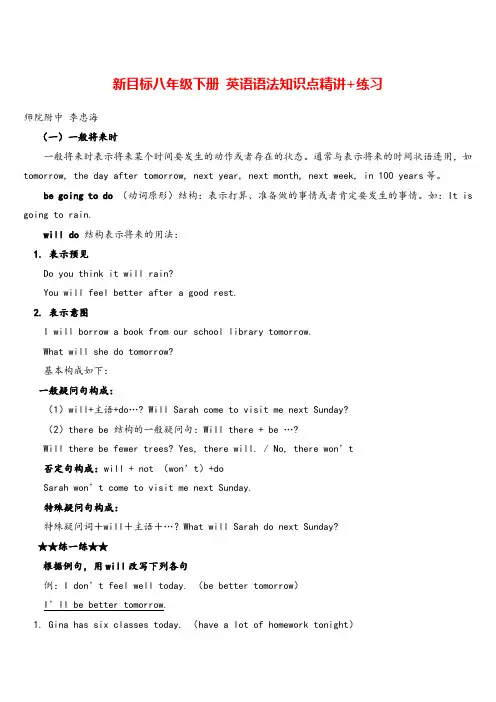
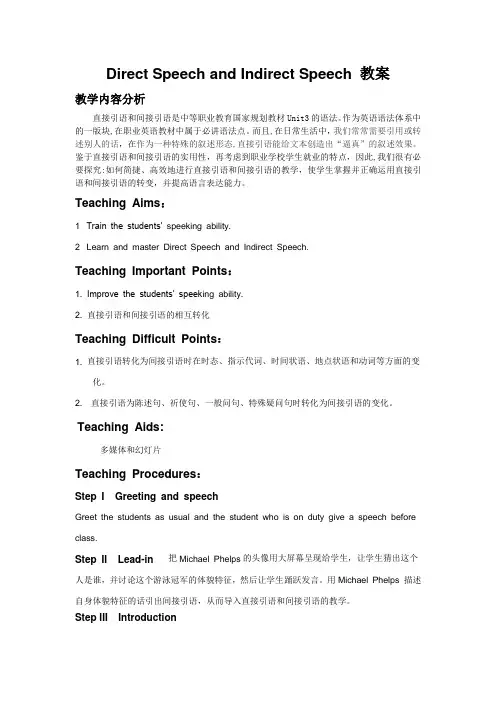
(精讲精练)直接引语变间接引语(讲练结合版)一、概述引用或转述别人说的话时有两种方法:直接引述别人的原话,这叫做直接引语(direct speech)。
用自己的话转述别人的话,叫间接引语(indirect speech)。
一般地讲,直接引语前后要加引号,间接引语不用引号,而用宾语从句来表达。
Mr. Black said, “I'm busy.”布菜克先生说:“我很忙”。
(直接引语)Mr. Black said that he was busy.布菜克先生说他很忙。
(宾语从句是间接引语)二、直接引语变间接引语应注意的问题1.连接词的选择:1)直接引语如果是陈述句变为间接引语时,用连词that引导(that在口语中常省去),that从句之前用say、tell等动词。
He said , “I like it very much.”→He said (that )he liked it very much.2)直接引语是一般问句变为间接引语时,须用连接词whether或if连接,使其成为间接引语的宾语从句。
如果主句中的谓语动词为said,则将其改为asked。
如果谓语动词后没有间接宾语,可以加上一个间接宾语me, him, her, them, u s等。
She said, “Is your father an engineer?”→She asked me if (whether)my father was an engineer.3)直接引语是特殊问句如果直接引语为特殊疑问句, 改为间接引语时,仍用特殊疑问句中的疑问词what, where, when, who, how many作为连接词将其引出,构成间接引语中的宾语从句,如果主句中的谓语动词为said,则将其改为asked。
“When did you get up this morning?”asked my father.→My father asked me when I had got up that morning.4)直接引语是祈使句当直接引语是祈使句,变为间接引语要用”tell sb. (not) to do sth.”结构。
The teacher said to her mother ,”Please give me the book.”→The teacher told her mother to give her the book.巧记:去掉引号要加去掉引号要加去掉引号要加去掉引号要加to;ask,order须记住,直引若是否定式,not加在to前部。
转述祈使句时,要使祈使句的动词原形变为带to的不定式,并在不定式的前面根据句子的意思加上tell、ask、orde r等动词,如果祈使句为否定式,在不定式的前面加not。
如果祈使句中有please一词,改为间接引语时,就将please去掉。
成为:told (asked, ordered, warned)someone (not) to do something结构。
①He said,“Sit down, please.”→He asked me to sit down.②The teacher said, “Don’t talk in class! ”→The teacher told us not to talk in class!③The captain said to his men,“Fire!”→The captain ordered his men to fire.④The policeman said to the children,“Don't play football in the middle of the street.”→The policeman warned the children not to play football in the middle of the street.2、人称的变化直接引语改为间接引语人称要相应的变化。
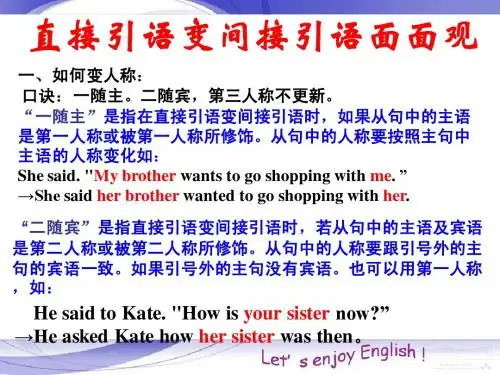
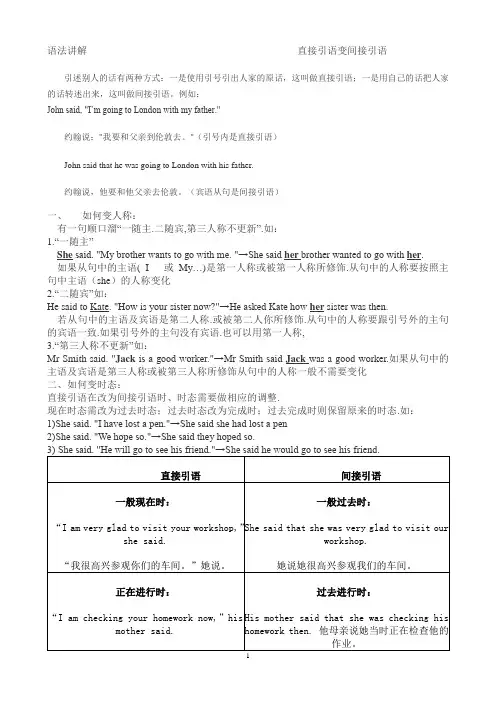
口诀如下:一随主,二随宾,第三人称不更新。
“一随主”即把直接引语中的第一人称(如:I,me,my,mine,we,us,our,ours)变为与主句的主语相一致的人称。
“二随宾”即把直接引语中的第二人称(you,your,yours)变为和主句的间接宾语(即听话人,如无听话人,可根据上下文的体会人为确定一个人称)相一致的人称。
“第三人称不更新”即直接引语中的第三人称(he,him,his,she,her,hers, it,its, they, their,theirs,them)变为间接引语时,人称不变。
一随主:They said ,”our parents often go shopping with us.”→They said their parents often go shopping with them.二随宾: ①He said, “Y ou told me this story.”→He said that I had told him that story.②She said to Mary ,”How is your brother now?”→She asked Mary how her brother was then.第三人称不更新:①He said to me, “She’s left her book in your room”.He told me that she had left her book in my room.②Mr White said,”Hand is a good worker.”→Mr White said Hand was a good worker.3.时态的变化直接引语变为间接引语时,从句的时态要作出相应的变化,当主句为一般现在时,从句可以是任何时态;当主句为一般过去时,从句必须为过去时的某个时态。
即“主过从过,主现从任”。
情态动词也要变成相应的过去式:Can—could;may —might;must — must/had to①He said, “I usually watch TV on Sunday.”→He said that he usually watched TV on Sunday.②He said, “I'm using the knife.”→He said that he was using the knife.③She said, “I have not heard from him since May.”→She said that she had not heard from him since May.④He said, “I had finished my homework before supper.”→He said that he had finished his homework before supper.⑤Zhou Lan said, “I'll do it after class.”→Zhou Lan said that she would do it after class.⑥He said,“I shall be doing my homework then.”→He said that he should be doing his homework then.⑦He said, “We shall have finished the work by that time.”→He said that they should have finished the work by that time.注意:直接引语如果是客观真理直接引语如果是客观真理直接引语如果是客观真理直接引语如果是客观真理、名人名言、与一个具体的过去时间连用说明客观事实时,变为间接引语时,时态不变。
①The teacher said, “The earth is round. ”→The teacher said that the earth is round.②He said, “I was born in Shangdong in 1965.”→He said that he was born in Shangdong in 1965.③He said, “Columbus discovered America in 1492.”→He said Columbus discovered America in 1492.他说哥伦布在1492年发现了美洲。
4.语序的变化直接引语如为疑问句,改为间接引语时,须将疑问句的语序改为陈述句的语序。
①The teacher said to Li Ming, “Have you finished your homework?”→The teacher asked Li Ming whether he had finished his homework.②“What do you do every Sunday morning?”my friend said to me.→My friend asked me what I did every Sunday morning.③注意:直接引语里是:What's wrong with……?/What's the matter? /What's the trouble?/What has happened?/等特殊疑问句时,间接引语的语序不变。
He said to her“What’s the matter with you?”→He asked her what was the matter with her. 他问她怎么了。
5.其它变化指示代、时间状语和地点状语的相应变化见下表:①He said, “I met Mr. Smith this morning.”He said that he had met Mr. Smith that morning.②He said, “We went to the cinema yesterday.”→He said they had gone to the cinema the day before.③Lily said, “I will come back next month.”→Lily said that she would go back the next month.④He said, “It is nine o'clock now.”→He said that it was nine o'clock then.⑤He said, “I haven't seen her today.”→He said that he hadn't seen her that day .⑥She said, “I went there yesterday.”→She said that she had gone there the day before.⑦She said, “I'll go there tomorrow.”→She said that she would go there the next day.⑧He said, “My sister was here three days ago.”→He said that his sister had been there three days before.(here→there; ago→before)⑨She said, “I will come here this evening.”→She said that she would go there that evening.(come→go;here→there;this→that)以上这些变化,要根据说话的具体时间和具体地点的情况而定,不可机械照搬。