
雅思阅读TFNG 题型
- 格式:pptx
- 大小:639.79 KB
- 文档页数:20

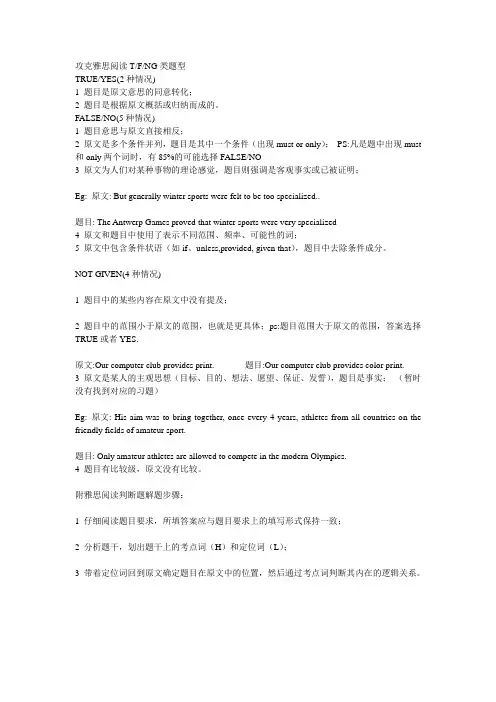
攻克雅思阅读T/F/NG类题型TRUE/YES(2种情况)1 题目是原文意思的同意转化;2 题目是根据原文概括或归纳而成的。
FALSE/NO(5种情况)1 题目意思与原文直接相反;2 原文是多个条件并列,题目是其中一个条件(出现must or only);PS:凡是题中出现must 和only两个词时,有85%的可能选择FALSE/NO3 原文为人们对某种事物的理论感觉,题目则强调是客观事实或已被证明;Eg: 原文: But generally winter sports were felt to be too specialized..题目: The Antwerp Games proved that winter sports were very specialized4 原文和题目中使用了表示不同范围、频率、可能性的词;5 原文中包含条件状语(如if、unless,provided, given that),题目中去除条件成分。
NOT GIVEN(4种情况)1 题目中的某些内容在原文中没有提及;2 题目中的范围小于原文的范围,也就是更具体;ps:题目范围大于原文的范围,答案选择TRUE或者YES.原文:Our computer club provides print. 题目:Our computer club provides color print.3 原文是某人的主观思想(目标、目的、想法、愿望、保证、发誓),题目是事实;(暂时没有找到对应的习题)Eg: 原文: His aim was to bring together, once every 4 years, athletes from all countries on the friendly fields of amateur sport.题目: Only amateur athletes are allowed to compete in the modern Olympics.4 题目有比较级,原文没有比较。
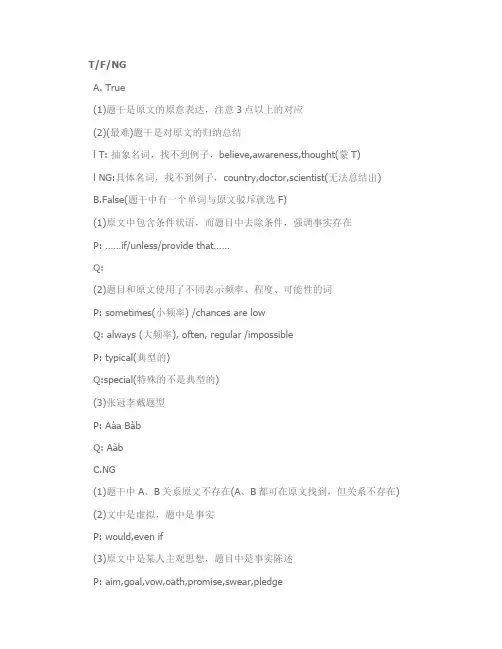
T/F/NGA. True(1)题干是原文的原意表达,注意3点以上的对应(2)(最难)题干是对原文的归纳总结l T: 抽象名词,找不到例子,believe,awareness,thought(蒙T)l NG:具体名词,找不到例子,country,doctor,scientist(无法总结出)B.False(题干中有一个单词与原文驳斥就选F)(1)原文中包含条件状语,而题目中去除条件,强调事实存在P: ……if/unless/provide that……Q:(2)题目和原文使用了不同表示频率、程度、可能性的词P: sometimes(小频率) /chances are lowQ: always (大频率), often, regular /impossibleP: typical(典型的)Q:special(特殊的不是典型的)(3)张冠李戴题型P: Aàa BàbQ: AàbC.NG(1)题干中A、B关系原文不存在(A、B都可在原文找到,但关系不存在)(2)文中是虚拟,题中是事实P: would,even if(3)原文中是某人主观思想,题目中是事实陈述P: aim,goal,vow,oath,promise,swear,pledge(4)题目中的范围小于原文的范围,即更具体了P: toad 产tadpole(5)原文是直接或间接引语,题目中去掉引用,成为事实。
P: “ ”sb. suggested/asserted that…… (一家之言不是真理)但如果说objective research finding…则有可能是对的。
作者根据某种观点推出自己的结论时,(6)文中是数据或具体事实,题目中抽象化、规律化。
ONLY P: A好 P: A、B and C好Q: only A好 Q: only A好NG FalseOnly 的反义词: and, various, differentD.NB(1)不涉及逻辑而考语言理解P: A好 B好Q: A+B好 NG(2)不涉及修辞手法(3)不涉及文化差异(4)不涉及复杂的语法转换(但涉及复杂的时态转换和情态动词比较)(5)如题目中有时间、百分比、金钱、温度等数字,只考精确程度,不涉及范围大小判断(数字出现多选F)(6)范围词:all,only,most(majority)P: 53%Q: majority(即50%以上---半数以上) T(7)90%按文章先后顺序出题,如无顺序,则有特殊定位词(8)不能加入个人知识去判断(athletes),但有时可用常识(Darwin)P:UK P: EuropeQ: Europe Q: UKT NG(9)考点唯一:KodakE.做题步骤(1)看清题目要求,注意T/F/NG还是Y/N/NG(2)准确理解题意,把握考点词(比较级、最高级、比较形式the same as、是非对错好坏的判断、数字、三个范围词)(3)画出定位词(keywords),回原文出处,做题目与原文的对比理解。


雅思阅读T/F/NG模拟试题含答案(1)True/False/Not Given ExercisesWhen was the last time you saw a frog? Chances are, if you live in a city, you have not seen one for some time. Even in wet areas once teeming with frogs and toads, it is BEComing less and less easy to find those slimy, hopping and sometimes poisonous members of the animal kingdom. All over the world, and even in remote parts of Australia, frogs are losing the ecological battle for survival, and biologists are at a loss to explain their demise. Are amphibians simply oversensitive to changes in the ecosystem? Could it be that their rapid decline in numbers is signaling some coming environmental disaster for us all? This frightening scenario is in part the consequence of a dramatic increase over the last quarter century in the development of once natural areas of wet marshland; home not only to frogs but to all manner of wildlife. However, as yet, there are no obvious reasons why certain frog species are disappearing from rainforests in Australia that have barely been touched by human hand. The mystery is unsettling to say the least, for it is known that amphibian species are extremely sensitive to environmental variations in temperature and moisture levels. The danger is that planet Earth might not only lose a vital link in the ecological food chain (frogs keep populations of otherwise pestilent insects at manageable levels), but we might be increasing our output of air pollutants to levels that may have already become irreversible. Frogs could be inadvertently warning us of a catastrophe.An example of a species of frog that, at far as is known, has become extinct, is the platypus frog. Like the well-known Australian mammal it was named after, it exhibited some very strange behaviour; instead of giving birth to tadpoles in the water, it raised its young within its stomach. The baby frogs were actually born from out of their mother's mouth. Discovered in 1981, less than ten years later the frog had completely vanished from the crystal clear waters of Booloumba Creek near Queensland's SunshineCoast. Unfortunately, this freak of nature is not the only frog species to have been lost in Australia. Since the 1970s, no less than eight others have suffered the same fate.One theory that seems to fit the facts concerns the depletion of the ozone layer, a well documented phenomenon which has led to a sharp increase in ultraviolet radiation levels.The ozone layer is meant to shield the Earth from UV rays, but increased radiation may be having a GREater effect upon frog populations than previously believed. Another theory is that worldwide temperature increases are upsetting the breeding cycles of frogs.TRUE/FALSE/NOT GIVEN1.Frogs are disappearing only from city areas.2.Frogs and toads are usually poisonous.3.Biologists are unable to explain why frogs are dying.4.The frogs' natural habitat is becoming more and more developed.5.Attempts are being madebecause they control pests.7.The platypus frog became extinct by 1991.8.Frogs usually give birth to their young in an underwater nest.9.Eight frog species have become extinct so far in Australia.10.There is convincing evidence that the ozone layer is being depleted.11.It is a fact that frogs' breeding cycles are upset by worldwide in creases in temperature.Answer Keys1.F 2.F 3.T 4.T 5.NG 6.T 7.T 8.NG 9.F 10.T 11.F雅思阅读T/F/NG模拟试题含答案(2)Practice 2Almost everyone with or without a computer is aware of the latest technological revolution destined to change forever the way in which humans communicate, namely, the Information Superhighway, best exemplified by the ubiquitous Internet. Already, millions of people around the world are linked by computer simply by having a modem and an address on the `Net', in much the same way that owning a telephone links us to almost anyone who pays a phone bill. In fact, since the computer connections are made via the phone line, the Internet can be envisaged as a network of visual telephone links. It remains to seen in which direction the Information Superhighway is headed, but many believeit is the educational hope of the future.The World Wide Web, an enormous collection of Internet addresses or sites, all of which can be accessed for information, has been mainly responsible for the increase in interest in the Internet in the 1990s. Before the World Wide Web, the `Net' was comparable to an integrated collection of computerized typewriters, but the introduction of the `Web' in 1990 allowed not only text links to be made but also graphs, images and even video.A Web site consists of a `home page', the first screen of a particular site on the computer to which you are connected, from where access can be had to other subject related `pages'(or screens) at the site and on thousands of other computers all over the world. This is achieved by a process called `hypertext'. By clicking with a mouse device on various parts of the screen, a person connected to the `Net' can go traveling, or surfing' through a of the screen, a person connected to the `Net' can go traveling, or `surfing' through a web of pages to locate whatever information is required.Anyone can set up a site; promoting your club, your institution, your company's products or simply yourself, is what the Web and the Internet is all about. And what is more, information on the Internet is not owned or controlled by any one organization. It is, perhaps, true to say that no one and therefore everyone owns the `Net'. BECause of the relative freedom of access to information, the Internet has often been criticised by the media as a potentially hazardous tool in the hands of young computer users. This perception has proved to be largely false however,for the dual purposes for which it was intended - discovery and delight.TRUE/FALSE/NOT GIVEN1.Everyone is aware of the Information Superhighway.ing the Internet costs the owner of a telephone extra money.3.Internet computer connections are made by using telephone lines.4.The World Wide Web is a network of computerised typewriters.5.According to the author, the Information Superhighway may be the future hope of education.6.The process called`hypertext'requires the use of a mouse device.7.The Internet was created in the 1990s.8.The `home page'is the first screen of a `Web'site on the `Net'.9.The media has often criticised the Internet because it is dangerous.10. The latest technological revolution will change the way humans communicate.Answer Keys1.F2.NG3.T4.F5.T6.T7.F8.T9.F 10.T。