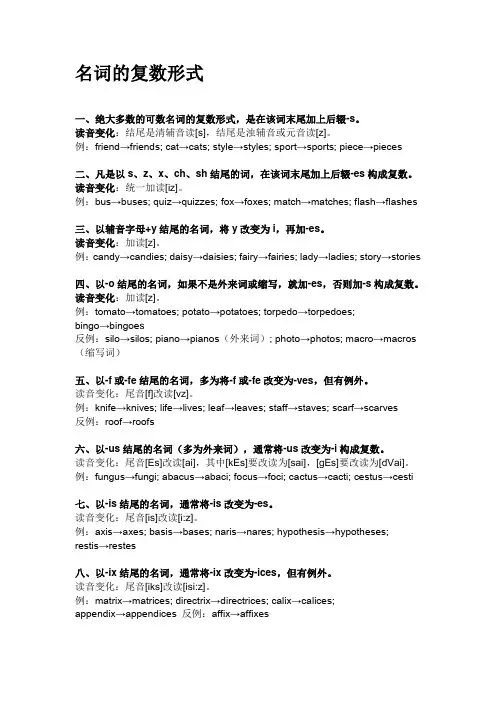
名词的复数形式
- 格式:pdf
- 大小:346.72 KB
- 文档页数:6
名词的复数形式
构成方法 读音 例词
在词尾加-s 1.在清辅音后读作 [s ]
2. 在浊辅音后读作 [ z ] 1. desk—desks [ s ]
2. map—maps [ s ] 3. field –filelds[ dz]
dog—dogs [ z ]
sea—seas [ z ]
1. 以s、x、sh、ch结尾
的名词后加-es
2. 如词尾是e,只加-s -(e)s读作[ iz ] 1. classclasses [ iz ]
box — boxes [ iz ]
dish—dishes[ iz ] watch—watches[ iz ]
2. horse—horses[ iz ]
如词尾为 –f或 –fe ,则一般变为 –ves -ves读作[ vz ] 1. leaf—leaves[vz ] 2. knife—knives[ vz ]
以辅音+y结尾的名词,变
y为 i再加-es -ies读作[ iz ] family—families[ iz ]
以元音+y结尾的名词,加
-s -s读作[ z ] boy—boys[ z ]
以辅音+o结尾的名词,加-es -es读作[ z ] hero—heroes[ z ] potato—potatoes[ z ]
tomato—tomatoes[ z ]
以元音+o结尾的名词,加-s -s读作[ z ] radio—radios[ z ] zoo—zoos[ z ]
以-th结尾的名词,加-s 1. 在长元音后,-ths读作
[ z ] 2. 在短元音或辅音后,
-ths读作[ s ] 1. bath—baths[ z ]
2. month—months[ s ]
英语里有一些名词的复数形式不是以词尾-s或-es构成,
构成方法 例词
变内部元音 foot[ u ]—feet[i: ] man[ ]—men[ e ] mouse[ au ]—mice[ ai ]
woman[ ]—women[ e ]
词尾加-en ox—oxen(公牛)
child[ ai ]—children[ i ]
形式不变(通形名词----单、复数同形) deer—deer fish—fish
sheep—sheep
集合名词 (只有复数,没有单数。) trousers people (人,人民) glasses (眼镜)
名词做定语
1. 只在后面名词加复数 2. man, woman随之后面的名词
而变化,后单其单,后复其复。
3. sport作定语永远用作复数。 1. apple tree—apple trees
2. man doctor—men doctors 3. sports shop sports shoes
表示国籍的名词
(中日不变,英法变,其余词后加s) Chinese—Chinese
Japanese—Japanese
Englishman—Englishmen Frenchman—Frenchmen
American—Americans
其它名词复数的规则变化 1) 以y结尾的专有名词,或元音字母+y 结尾的名词变复数时,直接加s变复数:
如: two Marys the Henrys
monkey---monkeys holiday---holidays
比较:层楼:storey ---storeys story---stories
2) 以o 结尾的名词,变复数时:
a. 加s,如: photo---photos piano---pianos radio---radios zoo---zoos;
b. 加es,如:potato--potatoes tomato--tomatoes
c. 均可,如:zero---zeros / zeroes 3) 以f或fe结尾的名词变复数时:
a. 加s,如: belief---beliefs roof---roofs
safe---safes gulf---gulfs; b. 去f,fe加ves,如:half---halves
knife---knives leaf---leaves wolf---wolves wife---wives life---lives thief---thieves;
c. 均可,如: handkerchief: handkerchiefs / handkerchieves 名词复数的不规则变化
1)child---children foot---feet tooth---teeth mouse---mice man---men woman---women
注意:与 man 和 woman构成的合成词,其复数形式也是 -men 和-women。
如: an Englishman,two Englishmen. 但German不是合成词,故复数形式为Germans;Bowman是姓,其复数是the Bowmans。
2)单复同形如:
deer,sheep,fish,Chinese,Japanese li,jin,yuan,two li,three mu,four jin
但除人民币元、角、分外,美元、英镑、法郎等都有复数形式。如:
a dollar, two dollars; a meter, two meters 3)集体名词,以单数形式出现,但实为复数。
如 people police cattle 等本身就是复数,不能说 a people,a police,a cattle,但
可以说 a person,a policeman,a head of cattle,the English,the British,the French,the
Chinese,the Japanese,the Swiss 等名词,表示国民总称时,作复数用。
如: The Chinese are industries and brave. 中国人民是勤劳勇敢的。 4)以s结尾,仍为单数的名词,如:
a. maths,politics,physics等学科名词,为不可数名词,是单数。
b. news 是不可数名词。 c. the United States,the United Nations 应视为单数。
The United Nations was organized in 1945. 联合国是1945年组建起来的。
d. 以复数形式出现的书名,剧名,报纸,杂志名,也可视为单数。 "The Arabian Nights" is a very interesting story-book.
<>是一本非常有趣的故事书。
5) 表示由两部分构成的东西,如:glasses (眼镜) trousers, clothes
若表达具体数目,要借助数量词 pair(对,双); suit(套); a pair of glasses; two pairs of
trousers
6)另外还有一些名词,其复数形式有时可表示特别意思,如:goods货物,waters
水域,fishes(各种)鱼
动词变名词
1.在词尾加er,r ,双写加er或or: A. play _ player, sing _ singer, wait _ waiter , find _ finder,
thrill _ thriller
B. write _ writer, drive _ driver, come _ comer, explore _ explorer dance _ dancer
C. run _ runner, win _ winner, rob _ robber, traval _ travaller
D. visit _ visitor, invent _ inventor 2. 在词尾加ing:
build _ building, draw _ drawing, end _ ending, begin _ beginning,
swim _ swimming, skate _ skating, feel _ feeling, say _ saying, mean _ meaning, cross _ crossing, surf _ surfing, paint _ painting
3.在词尾加ion 或去e加ion:
A. decide _ decision, describe _ description, produce _ production, celebrate _ celebration,pronounce _ pronunciation, decorate _ decoration
graduate _ graduation,frustrate - frustration,pollute _ pollution
contribute _ contribution, congratulate _ congratulation, educate _ education,organize _ orgnization,donate _ donation,
appreciate _ appreciation,operate _ operation, invite _ invitation
B. discuss _ discussion, invent _ invention, attract _ attraction impress _ impression,inject _ injection,instruct _ instruction
4.其它:
know _ knowledge, please _ pleasure, enjoy _ enjoyment, practise _ practice, die _ death, succeed _ success, weigh _ weight,
sit _ seat, change _ chance,enter _ entrance,fly _ flight,
rob _ robbery, discover _ discovery,fail _ failure,appear _ appearance, breathe _ breath
动词第三人称单数变化规则
1) 一般情况下,动词后面直接加 -s. 例如: works gets says reads