
新目标七年级下 Unit 3 课件
- 格式:ppt
- 大小:8.28 MB
- 文档页数:66

龙源期刊网
新目标英语七年级(下)Unit 3知识要点归纳
作者:
来源:《中学生英语·阅读与写作》2017年第03期
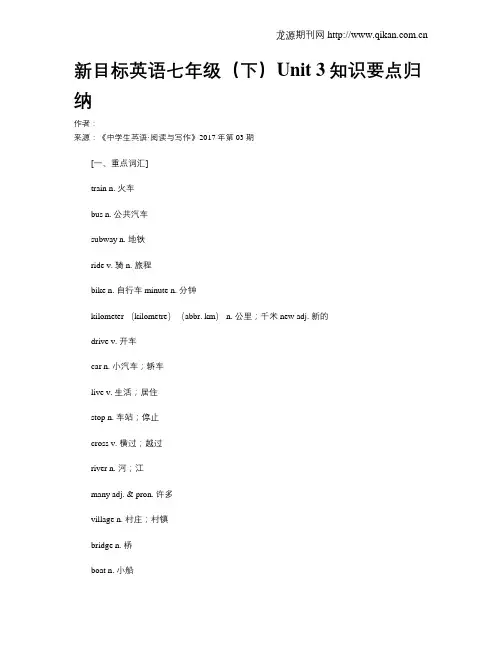
[一、重点词汇]
train n. 火车
bus n. 公共汽车
subway n. 地铁
ride v. 骑 n. 旅程
bike n. 自行车 minute n. 分钟
kilometer (kilometre)(abbr. km) n. 公里;千米 new adj. 新的
drive v. 开车
car n. 小汽车;轿车
live v. 生活;居住
stop n. 车站;停止
cross v. 横过;越过
river n. 河;江
many adj. & pron. 许多
village n. 村庄;村镇
bridge n. 桥
boat n. 小船
year n. 年;岁 龙源期刊网
afraid adj. 害怕;畏惧
villager n. 村民
leave v. 离开
dream n. 梦想;睡梦
true adj. 真的;符合事实的
[二、重点词组]
how far 多远
bus ride 乘汽车之行
school bus 校车
take a bus 乘坐公共汽车
get to school 到校
by boat 乘坐小船
walk to school 步行去上学
by train 乘坐火车
1 新目标7年下册Units 1-3练习题
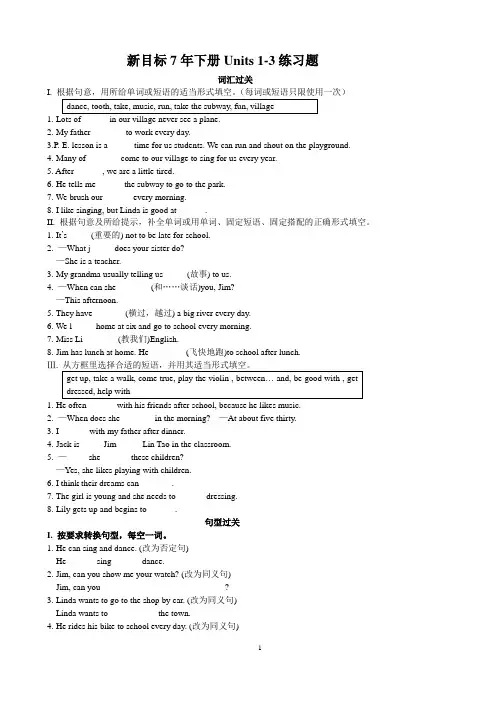
词汇过关
I.
根据句意,用所给单词或短语的适当形式填空。(每词或短语只限使用一次)
dance, tooth, take, music, run, take the subway, fun, village
1. Lots of ______in our village never see a plane.
2. My father _______ to work every day.
3.P. E. lesson is a _____ time for us students. We can run and shout on the playground.
4. Many of _______ come to our village to sing for us every year.
5. After ______, we are a little tired.
6. He tells me ______the subway to go to the park.
7. We brush our ______ every morning.
8. I like singing, but Linda is good at ______.
II. 根据句意及所给提示,补全单词或用单词、固定短语、固定搭配的正确形式填空。
1. It’s _____(重要的) not to be late for school.
2. —What j_____ does your sister do?
—She is a teacher.
3. My grandma usually telling us _____(故事) to us.
4. —When can she _______ (和……谈话)you, Jim?
—This afternoon.
5. They have _______(横过,越过) a big river every day.

戴氏教育蜀汉路校区
www,
The shortest way to do many things is to do only one thing at a time.想要多做事,最简单的办法是一次只做一件事。 戴氏教育集团 1 DSE五星级同步系列 Unit3 Is this your pencil?第4讲
swww,
一. 导入 教堂里,一个小男孩在祈祷:“上帝呀!我只有一个小小的心愿,请把首都
移到纽约吧 !”
一个牧师在旁边听到后,问小男孩:“小朋友,你为什么祈祷要把首都移到纽约?”
小男孩答道:“有一个考试题问的是首都在哪,我答的是纽约。”
二、知识点回顾: 背诵
This is my friend. That’s my grandfather.
These are my brothers. Those are my parents.
Who’s she? She’s my brother.
Who’re they? They’re my parents.
三、专题讲解
知识点讲解:1.Excuse me, Sonia. Is this your pencil? 对不起,索尼娅,这是你的铅笔吗?
七年级下册 Unit 3单元总结
- 1 - Unit.3 单元总结
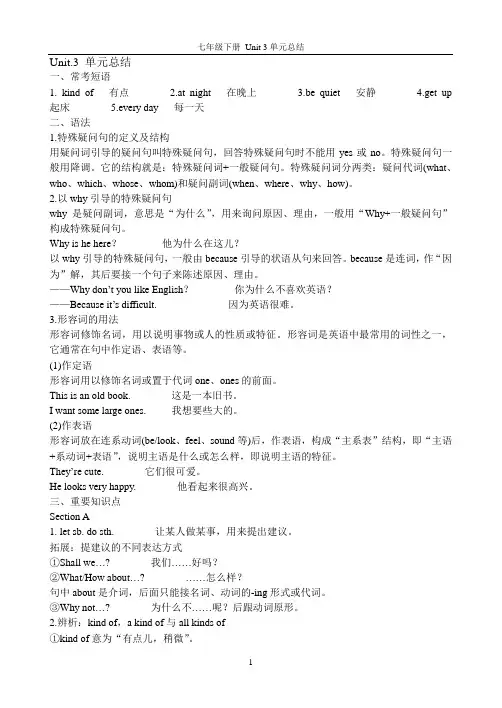
一、常考短语
1. kind of 有点 2.at night 在晚上 3.be quiet 安静 4.get up
起床 5.every day 每一天
二、语法
1.特殊疑问句的定义及结构
用疑问词引导的疑问句叫特殊疑问句,回答特殊疑问句时不能用yes或no。特殊疑问句一般用降调。它的结构就是:特殊疑问词+一般疑问句。特殊疑问词分两类:疑问代词(what、who、which、whose、whom)和疑问副词(when、where、why、how)。
2.以why引导的特殊疑问句
why是疑问副词,意思是“为什么”,用来询问原因、理由,一般用“Why+一般疑问句”构成特殊疑问句。
Why is he here? 他为什么在这儿?
以why引导的特殊疑问句,一般由because引导的状语从句来回答。because是连词,作“因为”解,其后要接一个句子来陈述原因、理由。
——Why don’t you like English? 你为什么不喜欢英语?
——Because it’s difficult. 因为英语很难。
3.形容词的用法
形容词修饰名词,用以说明事物或人的性质或特征。形容词是英语中最常用的词性之一,它通常在句中作定语、表语等。
(1)作定语
形容词用以修饰名词或置于代词one、ones的前面。
This is an old book. 这是一本旧书。
I want some large ones. 我想要些大的。
(2)作表语
形容词放在连系动词(be/look、feel、sound等)后,作表语,构成“主系表”结构,即“主语+系动词+表语”,说明主语是什么或怎么样,即说明主语的特征。