
七年级英语上册可数名词变复数规则
- 格式:pptx
- 大小:2.32 MB
- 文档页数:9

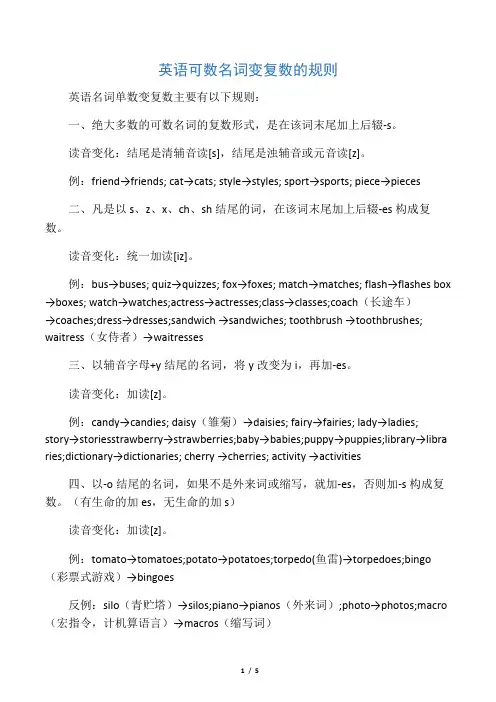
英语可数名词变复数的规则英语名词单数变复数主要有以下规则:一、绝大多数的可数名词的复数形式,是在该词末尾加上后辍-s。
读音变化:结尾是清辅音读[s],结尾是浊辅音或元音读[z]。
例:friend→friends; cat→cats; style→styles; sport→sports; piece→pieces二、凡是以s、z、x、ch、sh结尾的词,在该词末尾加上后辍-es构成复数。
读音变化:统一加读[iz]。
例:bus→buses; quiz→quizzes; fox→foxes; match→matches; flash→flashes box →boxes; watch→watches;actress→actresses;class→classes;coach(长途车)→coaches;dress→dresses;sandwich →sandwiches; toothbrush →toothbrush es; waitress(女侍者)→waitresses三、以辅音字母+y结尾的名词,将y改变为i,再加-es。
读音变化:加读[z]。
例:candy→candies; daisy(雏菊)→daisies; fairy→fairies; lady→ladies;story→storiesstrawberry→strawberries;baby→babies;puppy→puppies;library→libra ries;dictionary→dictionaries; cherry →cherries; activity →activities四、以-o结尾的名词,如果不是外来词或缩写,就加-es,否则加-s构成复数。
(有生命的加es,无生命的加s)读音变化:加读[z]。
例:tomato→tomatoes;potato→potatoes;torpedo(鱼雷)→torpedoes;bingo (彩票式游戏)→bingoes反例:silo(青贮塔)→silos;piano→pianos(外来词);photo→photos;macro (宏指令,计机算语言)→macros(缩写词)五、以-f或-fe结尾的名词,多为将-f或-fe改变为-ves,但有例外。

英语名词单数变复数的规则:一、绝大多数的可数名词的复数形式,是在该词末尾加上后辍-s.读音变化:结尾是清辅音读[s],结尾是浊辅音或元音读[z].例:friend→friends; cat→cats; style→styles; sport→sports; piece→pieces二、凡是以s、z、x、ch、sh结尾的词,在该词末尾加上后辍-es构成复数.读音变化:统一加读[iz].例:bus→buses; quiz→quizzes; fox→foxes; match→matches; flash→flashes三、以辅音字母+y结尾的名词,将y改变为i,再加-es.读音变化:加读[z].例:candy→candies; daisy→daisies; fairy→fairies; lady→ladies; story→stories四、以-o结尾的名词,如果不是外来词或缩写,就加-es,否则加-s构成复数.读音变化:加读[z].例:tomato→tomatoes; potato→potatoes; torpedo→torpedoes; bingo→bingoes反例:silo→silos; piano→pianos(外来词); photo→photos; macro→macros(缩写词)五、以-f或-fe结尾的名词,多为将-f或-fe改变为-ves,但有例外.读音变化:尾音[f]改读[vz].例:knife→knives; life→lives; leaf→leaves; staff→staves; scarf→scarves反例:roof→roofs六、以-us结尾的名词(多为外来词),通常将-us改变为-i构成复数.读音变化:尾音[Es]改读[ai],其中[kEs]要改读为[sai],[gEs]要改读为[dVai].例:fungus→fungi; abacus→abaci; focus→foci; cactus→cacti; cestus→cesti七、以-is结尾的名词,通常将-is改变为-es.读音变化:尾音[is]改读[i:z].例:axis→axes; basis→bases; naris→nares; hypothesis→hypotheses; restis→restes八、以-ix结尾的名词,通常将-ix改变为-ices,但有例外.读音变化:尾音[iks]改读[isi:z].例:matrix→matrices; directrix→directrices; calix→calices; appendix→appendices 反例:affix→affixes 九、以-um结尾的名词,将-um改变为-a.读音变化:去掉鼻尾音[m].例:forum→fora; stadium→stadia; aquarium→aquaria; datum→data; vacuum→vacua十、以-a结尾的名词,在该词末尾加上后辍-e.读音变化:尾音[E]改读[i:].例:larva→larvae; formula→formulae; ala→alae; media→mediae; hydra→hydrae十一、部分单词的复数形式不变.读音变化:保持原音.例:fish→fish; sheep→sheep; cattle→cattle; deer→deer; salmon→salmon十二、极少数单词,其复数形式没有任何规律.读音变化:没有规律.例:man→men; woman→women; child→children; person→people; ox→oxen十三、一些单数词得加en才能变成复数词:例:ox→oxen; child→children; brother→brethren十四、一些单数词得改头换面一番,才能变成复数词例:analysis→analyses分析; basis→bases基础; datum→data数据; foot→feet;formula→formulae/formulas公式; goose→geese; louse→lice虱子; man→menmouse→mice; medium→media/mediums媒介; memorandum→memoranda/memorandums备忘录; parenthesis→parentheses 圆括号; phenomenon→phenomena现象; radius→radii 半径tooth→teeth; woman→women十五、有些名词是单数、复数不分的例:deer; fish; cannon; sheep; salmon 鲑鱼; trout 鳟鱼十六、一些名词虽分单数、复数,但出现次数多的总是单数词例:abscence; clothing; film; help; furniture家具; machinery机械; news; scenery风景; sugar; traffic交通十七、另一些名词则以复数词出现的机会较多例:bellows风箱; clothes; police; shorts短裤; scissors剪刀; spectacles眼镜; shears大剪刀trousers长裤; wages工资十八、compound nouns,这类复数词是以主要的名词来表示例:daughter-in-law→daughters-in-law 媳妇; father-in-law→fathers-in-law岳父man-of-war→men-of-war兵舰; maid-servant→maid-servantsstep-son→step-sons晚子; son-in-law→sons-in-law十九、若表达具体数目,要借助数量词例:pair(对,双); suit(套); a pair of glasses; two pairs of trousers二十、另外还有一些名词,其复数形式有时可表示特别意思,例:goods货物,waters水域,fishes(各种)鱼二十一、除人民币元、角、分外,美元、英镑、法郎等都有复数形式.。