
期中复习二
- 格式:doc
- 大小:24.50 KB
- 文档页数:3
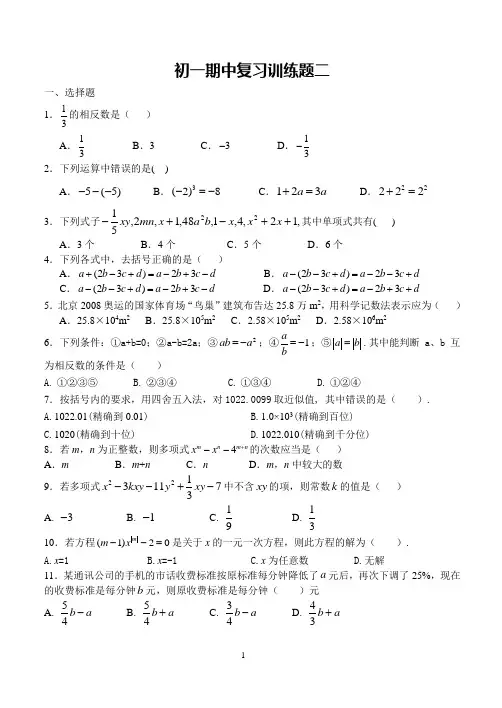
初一期中复习训练题二一、选择题1.13的相反数是( )A .13B .3C .3-D .13-2.下列运算中错误的是( )A .5(5)---B .3(2)8-=- C .123a a += D .22222+= 3.下列式子,12,4,1,48,1,2,5122++-+-x x x b a x mn xy 其中单项式共有( ) A .3个 B .4个 C .5个 D .6个 4.下列各式中,去括号正确的是( )A .(23)23a b c d a b c d +-+=-+-B .(23)23a b c d a b c d --+=--+C .(23)23a b c d a b c d --+=-+-D .(23)23a b c d a b c d --+=-++5.北京2008奥运的国家体育场“鸟巢”建筑布告达25.8万m 2,用科学记数法表示应为( ) A .25.8×104m 2 B .25.8×105m 2 C .2.58×105m 2 D .2.58×106m 2 6.下列条件:①a+b=0;②a-b=2a ;③2ab a =-;④1ab=-;⑤a b =.其中能判断a 、b 互为相反数的条件是( )A . ①②③⑤B . ②③④C . ①③④D . ①②④7.按括号内的要求,用四舍五入法,对1022.0099取近似值, 其中错误的是( ). A.1022.01(精确到0.01) B.1.0×103(精确到百位) C.1020(精确到十位)D.1022.010(精确到千分位)8.若m ,n 为正整数,则多项式4m n m n x x +--的次数应当是( ) A .m B .m +n C .n D .m ,n 中较大的数 9.若多项式22131173x kxy y xy --+-中不含xy 的项,则常数k 的值是( ) A. 3-B. 1-C. 19D. 1310.若方程(1)20mm x --=是关于x 的一元一次方程,则此方程的解为( ).A.x =1B.x =-1C.x 为任意数D.无解11.某通讯公司的手机的市话收费标准按原标准每分钟降低了a 元后,再次下调了25%,现在的收费标准是每分钟b 元,则原收费标准是每分钟( )元 A.54b a - B.54b a + C.34b a - D.43b a +12.下列说法:①若1a b =-,则a ,b 互为相反数 ;②若0a b +<,0ba>,则4343a b a b +=+; ③一个数的立方是它本身,则这个数为0或1;④若21x x +=,那么13x =或x = 1.其中正确说法的个数是( )A .0B .1C .2D .3 二、填空题13.请写出一个关于x 的一元一次方程,使它的解为x =-3: . 14.如果234m xy --与272n x y -的和是单项式,则m = ,n = 。


期中复习记叙文阅读练习(二)-2024-2025学年六年级语文上册(统编版)班级姓名成绩【例题解析】读下面的文章,完成下列小题。
牵手①女儿很小的时候,带她出门,总是伸一根食指让她紧紧牵住。
那时的女儿多小啊,脑袋刚刚齐到我的大腿,走路深一脚浅一脚趔趔趄趄,小小的胖手攥住我的食指,不要命地抓着,那真是甩也甩不脱,割也割不掉。
不知道那只小手哪来那么大的劲道,我的一根食指对她来说还是庞然大物呢。
②稍大的时候领她上街,牵手已经不够了,牵手之后还要用她的胳膊勾住我的小臂,结结实实的,一步不落,仿佛生怕稍不留意我就会从她的身旁逃之天天。
我觉得小臂被她勾拉得像要脱臼,甩动不灵也妨碍走路。
我会冷不防地用劲,从她胳膊里怀抱里抽出自己的手。
她“嗷”地一声扑上来,仍然是不屈不挠地抓住,而且比刚才更加用劲。
后来我就怕带她上街,或者喝令她去牵爸爸的手。
她牵爸爸的手也是一样全心全意,她爸爸让她牵着也会一脸陶醉和幸福。
③女儿现在已经十三四岁了。
十三四岁的女儿人高马大,我们俩并排走路,我不穿高跟鞋比她矮一个头尖。
人高马大的女儿出门依旧牵着我的手,但不是攥住我一根食指了,是把我的食指中指无名小指捏成一排,而后囊括进她的掌心。
我说不行,你太大了,你看街上有没有这么大的女孩子还牵妈妈手的?她“嗯”一声说,我想牵。
我试图甩脱她,一次两次,三次四次,但她固执地不让我的手滑开。
她的手劲多大啊!我的指骨在她掌心里酥麻酥麻,只要她再加一把劲我就会叫唤出声。
可我内心也喜欢这种指骨酥麻的感觉。
④我真不知道女儿牵我的手要牵到什么时候,今生今世我们的手还会不会分开。
我嘴里说着:不要,不要。
我心里默念着:牵吧,牵吧。
我的孩子!妈妈牵女儿的手天经地义;女儿牵妈妈的手地久天长。
女儿把她的手交到我手里,她就把她的一切都交给我了:在她满十八岁之前,她无忧无虑,因为忧虑有妈妈担着,荆棘由妈妈去砍,给她一把毒药她会不眨眼地当糖吞下,领她走上悬崖她会一步不落紧紧跟着。

期中复习卷(二)二、单项填空(共15小题;每小题1分,满分15分)16. —How do you make the birthday card for your mom, Millie?—Well, I decorate it ________ a small paper rose.A. onB. inC. withD. by17. Sally is ________ and often shares things with her friends.A. patientB. generousC. humorousD. handsome18. —Andrew, what are you doing over there?—Oh, I’m ________ a small light in my toy lantern.A. putting upB. putting outC. putting inD. putting away19. The trip to Suzhou was a great, ________ we did not enjoy it at the beginning.A. andB. butC. orD. so20. Which of the following groups may be a good vocabulary tree?A. B. C. D.21. —How will you go to the Nanjing Museum, Jim?—By underground. It’s much ________ than taking a bus.A. fastB. fasterC. fastestD. the fastest22. We can add “im-” to ________ to give it the opposite meaning.A. certainB. necessaryC. comfortableD. possible23. Simon was in trouble when he pulled himself up the rocks alone. ________, some climbershelped him out in the end.A. SuddenlyB. LuckilyC. SadlyD. Usually24. —Nancy, ________ is it from your home to the Greenland Park?—About half an hour by underground.A. how manyB. how muchC. how farD. how long25. David, just ________ the windows open. It’s a little hot inside today.A. leaveB. leavesC. forgetD. forgets26. The suffix “-less” in the word “useless” means ________.A. full ofB. look likeC. withoutD. with27. —Excuse me, where is the Nanjing Olympic Centre, please?—OK. Take the Metro Line 2 and ________ at the Olympic Centre station.A. take onB. take offC. get onD. get off28. Tina didn’t listen so ________ as Amy. She came second in the race.A. carefulB. carefullyC. more carefulD. more carefully29. —I think I can get an “A” on my writing about DIY.—________. I found 8 spelling mistakes in it just now.A. I agreeB. You’re ri ghtC. Of courseD. In your dreams30. —Peter, can you help me put up the clock on the classroom wall?—________. I’m coming.A. No problemB. I hope soC. That’s all rightD. That’s a good idea三、完形填空(共10小题;每小题1分,满分10分)DIY is a usual thing in China now. Wan Gang works for a computer company in Shenzhen. He enjoys his work, 31 it is hard for him to relax(放松) after work.One day when he saw many toy dogs in a toy shop, he had a(n) 32 . “Why not do some kinds of things and relax myself?” Then he began to make model planes, model ships and something else. The things that he had made by himself didn’t look as great as 33 he paid much money for in the shops, but he liked doing it. “It is not as much fun to play with 34 things from the shops,” he said. Now his 35 are full of many kinds of things he has made. They are very beautiful, and his family like them very much.More and more young people are like Yang, making or creating things by 36 . They like to do them on their own. Though making things with our own hands may take 37 time, some people, now known as DIYers—do-it-yourselfers, enjoy doing them very much. They can make all kinds of things they like. DIY is becoming more and more 38 in China. It may be new to the young, yet many people remember when it was a way of life.During the 1960s and 1970s, when there were not enough things for people to 39 , they had to use their own hands to do many things. Whitewashing the wall or making clothes was a part of life. If you wanted something done, you had to do it yourself; and if you needed something, you 40 it yourself.31. A. and B. or C. but D. so32. A. meeting B. idea C. secret D. exam33. A. this B. that C. these D. those34. A. free B. quiet C. expensive D. cheap35. A. pockets B. bookshelves C. computers D. shops36. A. myself B. yourself C. ourselves D. themselves37. A. much B. little C. no D. all38. A. different B. difficult C. popular D. successful39. A. put on B. live on C. knock on D. get on40. A. made B. bought C. borrowed D. lent四、阅读理解(共10小题;每小题1分,满分10分)阅读下列材料,从每题所给的四个选项(A、B、C、D)中,选出最佳选项。