
Literary_Terms
- 格式:ppt
- 大小:180.50 KB
- 文档页数:9
1.Ballad:In more exact literary terminology, a ballad is a narrative poem consisting of quatrains of iambic tetrameter altering with iambic trimeter. Common traits of the ballad are that: the beginning is often abrupt; the story is told through dialogue and action; the language is simple or "folksy"; the theme is often tragic; the ballad contraints a refrain repeated several times. The ballad became popular in England in the late 14th century and was adopted by many writers. rhyme: abcb2.Romance(传奇文学): was the most prevailing kind of literature of the upper class in feudal England in the Medieval Ages. It is a long composition in verse or in prose which describes the life and chivalric adventures of a noble hero. The central character of romances is the knight, a man of noble birth skilled in the use of weapons. Some romances also deal with legendary, supernatural, or amorous subjects and characters.3.Humanism:Humansim suggests a devotion to those studies supposed to promote human culture most effectively---in particular, those dealing with the life, thought, language, and literature of ancient Greece and Rome;It proclaimed that man is the most important noble creature in the world; the goal of life is to enjoy oneself in this present world instead afterlife;According to humanists, both man and world are hindered only by externalchecks from infinite improvement;Man could mould the world according to his desires, and attain happiness by removing all external checks by the exercise of reason;4.Renaissance: The word means rebirth or revival;It is commonly applied to the movement or period in western civilization, which marks the transition from the medieval to the modern world;It first sprang up in Italy in the 14th century and gradually spread all over Europe;The Renaissance indicates a revival of classical arts and sciences after the dark ages of medieval obscurantism;They held their cheif interest no in ecclesiastical knowledge, but in man, his environment and doings and his brave fight for the emancipation of man from the tyranny of the church and religious dogmas;Because in the ancient Greek and Roman mythology were found the ideas of universal love, respect to human beings and approval of man's power, ability and knowledge;In short, man became the center of the world instead of God as upheld in the Middle Ages;The movement is a great revolution carried out in the 14th to the middle 17th century Europe.It broke the chain and bondage of feudal and theological ties and brought human wisdom and capacity into full play.5.Enlightenment:also called the neoclassic movement, thephilosophical and artistic movement growing out of the Renaissance and continuing until the 19th century. The Enlightenment was an optimistic belief that humanity could improve itself by applying logic and reason to all things.It rejected untested beliefs, superstition, and the "barbarism" of the earlier medieval period, and embraced the literary, architectural, and artistic forms of the Greek-Roman world.Enlightenment thinkers were enhanced by the perfection of geometry and mathematics, and by all things harmonious and balanced. Typically, these Enlightenment writers would use satire to ridicule what they felt were illogical errors in government, social custom, and religious belief.6.Romanticism:The term refers to the literary and artistic movement of the late 18th and early 19th century. Romanticism rejected the earlier philosophy of the Enlightenment, which stressed that logic and reason were the best response humans had in the face of cruelty, stupidity, superstition and barbarism. Instead, the Romantics asserted that reliance upon emotion and natural passions provided a valid and powerful means of knowing and a reliable guide to ethics and living. The Romantic movement typically asserts the unique nature of the individual, the privileged status of imagination and fancy, the value ofspontaneity over "artifice" and "convention," the human need for emotional outlets, the rejection of civilized corruption, and a desire to return to natural primitivism and escape the spiritual destruction of urban life. Their writings are often set in rural, or Gothic settings and they show an obsessive concern with "innocent" characters---children, young lovers and animals.7.Sonnet: a poem consisting of 14 lines, with rhymes arranged according to one or other of certain definite schemes, of which the Petrarchan and the Elizabethan are the principal, namely: ①abba abba, followed by two, or three, other rhymes in the remaining six lines, with a pause in the thought after the octave;②abab cdcd efef gg. The sonnets of Shakespeare are in the latter form;The sonnet was introduced to England by Wyatt and developed by Surry and was thereafter widely used. Most of them are amatory in nature, and contain a certain narrative development.。
PoetryPoetry is one of the three major types or genres of literature, the others being prose and drama. Poems are often divided into lines and stanzas. Many poems employ regular rhythmical patterns or metres. However, some are written in free verse. Most poems make use of highly concise, musical and emotionally charged language. Many also use imagery, figurative language and devices of sound like rhyme. Types of poetry include narrative poetry such as ballads, epics, metrical romances; dramatic poetry like dramatic monologues and dramatic dialogues; lyrics such as sonnets, odes, elegies and love poems.Sonnet 十四行诗A sonnet is a fourteen-line lyric poem with a single theme, usually written in iambic pentameter.2 kinds of sonnet:The Petrarchan or Italian sonnet:an 8-line octave and 6-line sestet with the octave rhyming abba abba , the sestet cde cde. The octave raises a question, states a problem and the sestet answers the question, solves the problem.The Shakespearean or English sonnet : 3 4-line quatrains anda 2-line couplet rhyming abab cdcd efef gg. Each of the three quatrains usually explores a different variation of the main theme. The couplet presents a summarizing or concluding statement.Ode 颂词A lyric poem of some length that honors an individual, a thing or a trait dealing with a lofty theme in a dignified manner. The English odes are of three types.Ode to the West Wind is of the horatian type: with stanza of uniform length and arrangement. It consists of five 14-lined stanzas of iambic pentameter, each of the stanza containing four tercets and a closing couplet. The rhyme scheme is aba, bcb, cdc, ded, ee.史诗EpicA.An extended narrative poem with a heroic or superhumanprotagonist engaged in an action of great significance in a vast setting (often including the underworld and engaging the gods).B.Examples: Edmund Spenser's The Faerie Queene, JohnMilton's Paradise Lost, William Wordsworth's The Prelude,and T. S. Eliot's The Waste Land.Elements of poetryPoetry stresses on rhythm, imagery, emotion and imagination.1. Meter 韵律A fixed arrangement of accented and unaccented syllables in a foot。
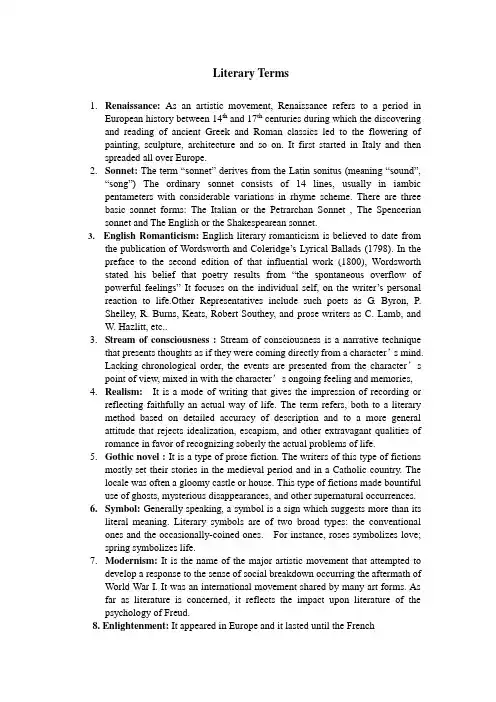
Literary Terms1.Renaissance: As an artistic movement, Renaissance refers to a period inEuropean history between 14th and 17th centuries during which the discovering and reading of ancient Greek and Roman classics led to the flowering of painting, sculpture, architecture and so on. It first started in Italy and then spreaded all over Europe.2.Sonnet:The term “sonnet” derives from the Latin sonitus (meaning “sound”,“song”) The ordinary sonnet consists of 14 lines, usually in iambic pentameters with considerable variations in rhyme scheme. There are three basic sonnet forms: The Italian or the Petrarchan Sonnet , The Spencerian sonnet and The English or the Shakespearean sonnet.3. English Romanticism: English literary romanticism is believed to date fromthe publication of Wordsworth and Coleridge’s Lyrical Ballads (1798). In the preface to the second edition of that influential work (1800), Wordsworth stated his belief that poetry results from “the spontaneous overflow of powerful feelings”It focuses on the individual self, on the writer’s personal reaction to life.Other Representatives include such poets as G. Byron, P.Shelley, R. Burns, Keats, Robert Southey, and prose writers as C. Lamb, and W. Hazlitt, etc..3.Stream of consciousness :Stream of consciousness is a narrative techniquethat presents thoughts as if they were coming directly from a character’s mind.Lacking chronological order, the events are presented from the character’s point of view, mixed in with the character’s ongoing feeling and memories, 4.Realism: It is a mode of writing that gives the impression of recording orreflecting faithfully an actual way of life. The term refers, both to a literary method based on detailed accuracy of description and to a more general attitude that rejects idealization, escapism, and other extravagant qualities of romance in favor of recognizing soberly the actual problems of life.5.Gothic novel : It is a type of prose fiction. The writers of this type of fictionsmostly set their stories in the medieval period and in a Catholic country. The locale was often a gloomy castle or house. This type of fictions made bountiful use of ghosts, mysterious disappearances, and other supernatural occurrences.6.Symbol: Generally speaking, a symbol is a sign which suggests more than itsliteral meaning. Literary symbols are of two broad types: the conventional ones and the occasionally-coined ones. For instance, roses symbolizes love;spring symbolizes life.7.Modernism: It is the name of the major artistic movement that attempted todevelop a response to the sense of social breakdown occurring the aftermath of World War I. It was an international movement shared by many art forms. As far as literature is concerned, it reflects the impact upon literature of the psychology of Freud.8. Enlightenment: It appeared in Europe and it lasted until the FrenchRevolution in 1789. It was closely associated with some new ideas such as liberty, democracy and rights of individuals which embodied the ideology of the rising middle class in Europe at that time.9. Puritanism:Puritans were the name given in the 16th century to the moreextreme Protestants within the Church of England who thought the English Reformation had not gone far enough in reforming the doctrines and structure of the church; they wanted to purify their national church by eliminating every shred of Catholic influence. They believed in the seven deadly sins: greed (avarice), envy, loath, gluttony, wrath, luxury and pride. Human beings are permanent sinners. Once it entered your life, there was no way to avoid it.It’s difficult to live a good life. But after sin, we can go to a paradise. They believed in after-world life. Strict puritans even regarded drinking, gambling and participation in theatrical performances as punishable offences.。