
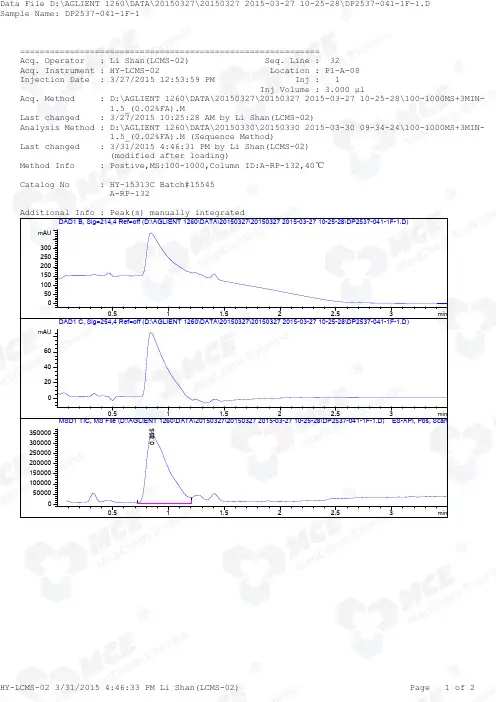
CBB1007_trihydrochloride_LCMS_15545_MedChemExpress
- 格式:pdf
- 大小:194.62 KB
- 文档页数:2

信越羟乙基纤维素的参数1.引言1.1 概述概述:信越羟乙基纤维素是一种常见的天然高分子化合物,具有广泛的应用领域。
它是由纤维素经过化学修饰得到的一种改性纤维素,具有良好的溶解性、胶体稳定性和药物控释性能,因此在医药、食品、化妆品等领域得到了广泛的应用。
本文将对信越羟乙基纤维素的相关参数进行详细介绍和分析。
首先,我们将给出纤维素的定义和特性,了解其原始结构和基本性质。
随后,我们将专注于信越羟乙基纤维素的参数,其中包括其化学结构、分子量、表面活性、溶解性、热稳定性等方面的内容。
通过对这些参数的研究,我们可以更好地了解该化合物的性质和特点。
在本文的结论部分,我们将总结信越羟乙基纤维素参数的重要性,并展望其在未来的应用前景。
信越羟乙基纤维素的参数研究不仅有助于我们深入了解和认识这一化合物,还对其在医药、食品、化妆品等行业的应用提供了理论指导和技术支持。
在未来,信越羟乙基纤维素的参数研究将继续深入,为相关领域的发展和进步做出更大的贡献。
文章结构本文分为引言、正文和结论三个部分。
1. 引言1.1 概述在这一部分,将介绍信越羟乙基纤维素(Hydroxyethyl Cellulose,简称HEC)的背景和相关概念,并给出文章的研究背景。
1.2 文章结构此部分将详细介绍本文的整体结构和各个章节的内容,帮助读者理清文章的逻辑脉络。
1.3 目的阐明本文的研究目的,即对信越羟乙基纤维素的参数进行深入研究,以期对其特性和应用提供更加细致全面的了解。
2. 正文2.1 纤维素的定义和特性在这一部分,将介绍纤维素的概念和基本特性,包括其化学结构、来源、功能等,为后续讨论信越羟乙基纤维素的参数奠定基础。
2.2 信越羟乙基纤维素的参数一此部分将重点讨论信越羟乙基纤维素的其中一个参数,包括该参数的定义、测量方法、影响因素以及其在实际应用中的意义和作用。
2.3 信越羟乙基纤维素的参数二这一章节将进一步探讨信越羟乙基纤维素的另一个参数,包括其定义、测量方法、与其他参数的关联性等,以便全面了解该参数的影响因素和应用范围。

【 1. 性状】 1.1 重酒石酸去甲肾上腺素为白色或类白色结晶性粉末, 无臭, 味苦。
遇光或遇 空气易变质。
(本品分子结构中具有邻苯二酚结构,露置空气中或遇光、热易氧 化,色泽变深,故因注意贮藏条件。
)1.2 溶解度 易溶于水,微溶于乙醇,难溶于乙醚、氯仿。
( 去甲肾上腺素含有 酚羟基 , 氨基等亲水基团 , 极性偏大 ; 其在酸性条件下较稳定 , 故一般与重酒石酸 形成的形式 ;) 1.3 熔点 熔点为100~106℃,熔融时同时分解,并显浑浊。
(可以用熔点 , 熔程鉴别化合物 , 但本品熔融时同时分解,故用热分析法分析鉴别较适宜) 1.4 比旋度 取本品精密称定,加水溶解并定量稀释制成每 1ml 中约含 50mg 的 溶液,比旋度为 -10.0 °至 -12.0 ° (左旋去肾上腺素的活性是右旋去甲肾上腺素的 27 倍 , 药用常用左旋体 , 根据比选度的测量也可作为其鉴别的方法之一 )【 2. 鉴别】重酒石酸去甲肾上腺素属于儿茶酚胺类药物,根据其根结构和性质, 可采取如下方法进行鉴别试验。
2.1 与三氯化铁反应2.1.1原理重酒石酸去甲肾上腺素分子结构中具有邻苯二酚,其酚羟基极易被 Fe 3+氧化 重酒石酸去甲肾上腺素的杂质检验研究方法 C 8H 11NO 3.C 4H 6O 6 本品为 (R )-4-(2- 氨基 -1- 羟基乙基 )-1 , 2-苯二酚重酒石酸盐一水合物。
按无水物计算,含 C 8H 11NO 3.C 4H 6O 6不得少于 99.0%。
而现色; 碱性条件氧化加剧,加入碳酸氢钠试液后产物颜色加深。
2.1.2方法取本品约10mg,加水1ml 溶解后,加三氯化铁试液 1 滴,振摇,即显翠绿色:再缓缓加碳酸氢钠试液,即显蓝色,最后变成红色。
2.1.3方法学考察专属性:应不受可能共存的物质干扰,其他结构相似的物质均应呈负反应(本法专属性差)耐用性:将样品试液放置一段时间后(样品稳定性),用本法测量结果变化不大2.2氧化反应2.2.1原理本品结构中具有酚羟基,易被碘氧化而呈色。

Technical BulletinACCUSPIN™ System – Histopaque ® 1077Catalog Numbers A6929, A7054, and A0561Product DescriptionACCUSPIN System-Histopaque -1077products are intended for use in the isolation of lymphocytes and other mononuclear cells. The separation medium, Histopaque-1077, is a sterile-filtered, endotoxin tested solution of polysucrose and sodium diatrizoate, adjusted to a density of 1.077 g/mL. The ACCUSPIN tube is specially designed with two chambers separated by a porous high density polyethylene barrier (frit).Separation of lymphocytes and other mononuclear cells from whole blood and bone marrow using density gradientseparation media is based on a published method.1 Histopaque-1077 is suitable for human lymphocyte antigen (HLA) typing 2 and as the initial isolation step prior toenumeration of T, B, and ‘null’ lymphocytes.3 It may also be employed in the preparation of pure lymphocyte suspensions for cell culture and cytotoxicity assays.4ACCUSPIN System-Histopaque-1077 products consist of radiation sterilized polypropylene tubes fitted with a highdensity polyethylene frit and aseptically filled with Histopaque-1077.Histopaque-1077 is a sterile-filtered solution of polysucrose, 57 g/L, and sodium diatrizoate, 90 g/L.Density: 1.076–1.078 g/mL Endotoxin: 0.3 EU/mL pH: 8.8–9.0ACCUSPIN System-Histopaque-1077Catalog No. A692940 × 3 mLEach tube contains 3 mL ofHistopaque 1077-1 and will separate 3-6 mL of anticoagulated blood Catalog No. A7054 12 × 15 mLCatalog No. A0561100 × 15 mLEach tube contains 15 mL ofHistopaque 1077-1 and will separate 15-30 mL of anticoagulated bloodReagents and Equipment Required but Not ProvidedCentrifuge (swinging bucket rotor)capable of generating 100 to 1,000 g Centrifuge tubes for washing mononuclear cellsIsotonic phosphate buffered saline solution or appropriate cell culture mediumPrecautions and DisclaimerFor R&D use only. Not for drug, household, or other uses. Please consult the Safety Data Sheet for information regarding hazards and safe handling practices.Preparation InstructionsSpecimen Collection - Collect blood in preservative-free anticoagulant (EDTA or heparin) or use defibrinated blood. For best results, blood should be processed within 2 hours.On occasion, it may be necessary to dilute the blood sample 3 to 5-fold, depending on absolute cell numbers. A similar volume of prediluted blood may be used or the blood sample may be diluted directly in upper chamber of the ACCUSPIN tube (seeProcedure, step 3). This is appropriate for specimens with hematocrits above normal.Storage/StabilityStore the products at 2–8 C.Histopaque-1077 has an expiration period of 3 years. Reagent label bears expiration date.ProcedureAnticoagulated blood can be added to the top chamber of the tube without risk of mixing with the Histopaque-1077 in the lowerchamber under the frit. On centrifugation the whole blood migrates through the frit to contact with the Histopaque-1077. The elements of greater density displace a volume of Histopaque-1077 above the frit giving a clear separation of the bloodcomponents. The erythrocytes aggregate and the granulocytes become slightly hypertonic, increasing their sedimentation rate, resulting in pelleting at the bottom of the ACCUSPIN Tube. Lymphocytes and other mononuclear cells, e.g., monocytes, remain at the plasma/Histopaque-1077 interface. This dense band of mononuclear cells may be collected by pouring off the contents of the upper chamber or by means of a pipette. Erythrocyte contamination is avoided due to the barrier between the chambers.Most extraneous platelets are removed by low speed centrifugation during the washing steps.1. Bring desired number of tubes to roomtemperature. If Histopaque-1077 isabove the frit prior to use, centrifuge at 1,000 g for 30 seconds at room temperature.Note: Failure to bring ACCUSPIN System-Histopaque-1077 to room temperature may cause limited recovery of mononuclear cells. 2. Label tube(s).3. Freely pour the blood sample into theupper chamber of each ACCUSPIN System-Histopaque-1077 tube.a. Use 3–6 mL of whole blood withACCUSPIN System-Histopaque-1077 tubes, Catalog No. A6929. b. Use 15–30 mL of whole blood withACCUSPIN System-Histopaque-1077 tubes, Catalog Nos. A7054 or A0561. Note: Use of volumes of prediluted or whole blood other than those recommended may result in decreased recovery.4. Centrifuge at 1,000 g for 10 minutes atroom temperature or centrifuge at 800 g for 15 minutes at roomtemperature. Centrifugation at lower temperatures, such as 4 C, may result in cell clumping and poor recovery.Note: If platelet contamination is a concern, add the mononuclear cells to a 4-20% sucrose gradient that has been layered over Histopaque-1077.Centrifuge at 1,000 × g for 10 minutes at room temperature. The platelets will pellet at the bottom, while themononuclear cells will migrate to the Histopaque-1077 layer.5. After centrifugation, carefully aspiratethe plasma layer with a Pasteur pipette to within 0.5 cm of the opaque interface containing mononuclear cells. Properly dispose of the plasma layer.Note: Failure to remove the excesssupernatant may result in contamination of the mononuclear band with plasma proteins.6. Carefully transfer the opaque interfacewith a Pasteur pipette into a clean conical centrifuge tube.Note: Removal of Histopaque-1077 with the mononuclear band increasesgranulocyte contamination from residual granulocytes, which may remain at the mononuclear interface.7. Wash the cells by adding 10 mL ofisotonic phosphate buffered saline solution or appropriate cell culture medium and mix by gently drawing in and out of a Pasteur pipette. 8. Centrifuge at 250 g for 10 minutes. 9. Aspirate the supernatant and discard. 10. Resuspend cell pellet with 5 mL ofisotonic phosphate buffered saline solution or appropriate cell culture medium and mix by gently drawing in and out of a Pasteur pipette.11. Centrifuge at 250 g for 10 minutes. 12. Repeat steps 9, 10, and 11, discardsupernatant and resuspend cell pellet in 0.5 mL of isotonic phosphate buffered saline solution or appropriate cell culture medium. Erythrocytes and granulocytes should pellet to the bottom of the ACCUSPIN tube. Mononuclear cells should band at the interface between the Histopaque-1077 and the plasma. If observed results vary from expected results, please contact Sigma-Aldrich Technical Service for assistance.References1. Boyum, A., Separation of leukocytesfrom blood and bone marrow. Scand. J. Clin. Lab. Invest ., 21 (Suppl 97), 77 (1968).2. Amos, D.B., and Pool, P., “HLA typing” inManual of Clinical Immunology, Rose, N.R., and Friedman, H., eds., American Society for Microbiology, (Washington, DC: 1976) pp. 797-804.3. Winchester, R.J., and Ross, G., “Methodsfor enumerating lymphocyte populations” in Manual of Clinical Immunology, Rose, N.R., and Friedman, H. eds., American Society for Microbiology, (Washington, DC: 1976) pp. 64-76.4. Thorsby, E., and Bratlie, A., “A rapidmethod for preparation of pure lymphocyte suspensions.”Histocompatibility Testing, Terasaki, P.I., ed., 665-666 (1970).The life science business of Merck operates as MilliporeSigma in the U.S. and Canada.Merck, Sigma-Aldrich, ACCUSPIN, and Histopaque are trademarks of Merck KGaA, Darmstadt, Germany or its affiliates. All other trademarks are the property of their respective owners. Detailed information on trademarks is available via publicly accessible resources.© 2022 Merck KGaA, Darmstadt, Germany and/or its affiliates. All Rights Reserved.NoticeWe provide information and advice to our customers on application technologies and regulatory matters to the best of our knowledge and ability, but without obligation or liability. Existing laws and regulations are to be observed in all cases by our customers. This also applies in respect to any rights of third parties. Our information and advice do not relieve our customers of their own responsibility for checking the suitability of our products for the envisaged purpose.The information in this document is subject to change without notice and should not be construed as a commitment by the manufacturing or selling entity, or an affiliate. We assume no responsibility for any errors that may appear in this document.Contact InformationFor the location of the office nearest you, go to /offices .Technical ServiceVisit the tech service page on our web site at /techservice .Standard WarrantyThe applicable warranty for the products listed in this publication may be found at /terms .A0561 Technical Bulletin Rev 06/2022。

Data SheetBIOLOGICAL ACTIVITY:Bivalirudin Trifluoroacetate is a synthetic 20 residue peptide which reversibly inhibits thrombin.IC50 Value:Target: thrombinin vitro: Eptifibatide (8 mg/mL) added together with a low (70 ng/mL) concentration of bivalirudin (a direct thrombin inhibitor)effectively (approximately 90%) reduced platelet aggregation induced by thrombin (0.2 U/mL) [1]. In thrombin generation assay (TGA), bivalirudin had no effect on these parameters up to 10 μmol/l [2]. Bivalirudin⁻facilitated binding of MPO to BAEC resulted also in functional changes in terms of increased NO consumption as well as enhanced MPO⁻mediated redox modifications [3].in vivo: The use of bivalirudinprevented further increase in antiheparin/PF4 antibody IgG levels in rats [4]. Three animals in the 500⁻mg/kg/24 h group, and 7 animals in the 2000⁻mg/kg/24 h group in the toxicokinetic assessment phase of the study were found dead or euthanized in extremis (following blood sampling). Plasma concentrations of bivalirudin appeared to be linear and dose independent [5].Clinical trial: Antithrombotic Effects of Ticagrelor Versus Clopidogrel . Phase 4References:[1]. Ciborowski M, Tomasiak M. The in vitro effect of eptifibatide, a glycoprotein IIb/IIIa antagonist, on various responses of porcine blood platelets. Acta Pol Pharm. 2009 May⁻Jun;66(3):235⁻42.[2]. Xu Y, Wu W, Wang L, Differential profiles of thrombin inhibitors (heparin, hirudin, bivalirudin, and dabigatran) in the thrombin generation assay and thromboelastography in vitro. Blood Coagul Fibrinolysis. 2013 Apr;24(3):332⁻8.[3]. Rudolph V, Rudolph TK, Schopfer FJ, Bivalirudin decreases NO bioavailability by vascular immobilization of myeloperoxidase. J Pharmacol Exp Ther. 2008Nov;327(2):324⁻31.[4]. Zhang R, Huang Y, Zhang M, Bivalirudin Utilization in Rats Undergoing Cardiopulmonary Bypass: Preventing the Increase of Antiheparin/Platelet Factor 4Antibody in Perioperative Period. Clin Appl Thromb Hemost. 2012 Aug 21. [Epub ahead of print][5]. Gleason TG, Chengelis CP, Jackson CB, A 24⁻hour continuous infusion study of bivalirudin in the rat. Int J Toxicol. 2003 May⁻Jun;22(3):195⁻206.Product Name:Bivalirudin (Trifluoroacetate)Cat. No.:HY-15664CAS No.:128270-60-0Molecular Formula:C 100H 138DF 3N 24O 35Molecular Weight:2295.32Target:ThrombinPathway:Metabolic Enzyme/Protease Solubility:DMSO: ≥ 31 mg/mLCaution: Product has not been fully validated for medical applications. For research use only.Tel: 609-228-6898 Fax: 609-228-5909 E-mail: tech@Address: 1 Deer Park Dr, Suite Q, Monmouth Junction, NJ 08852, USACertificate of AnalysisPHYSICAL AND CHEMICAL PROPERTIESMolecular Formula:C 100H 138DF 3N 24O 35Molecular Weight:2295.32Storage:Powder -20°C 3 years 4°C 2 years In solvent-80°C 6 months -20°C1 monthChemical Structure:ANALYTICAL DATAAppearance:White to off-white (Solid)1H NMR Spectrum:Consistent with structure Purity (NMR):>98.0%Conclusion:The product has been tested and complies with the given specifications.Product Name:Bivalirudin (Trifluoroacetate)Cat. No.:HY-15664CAS No.:128270-60-0Batch No.:09618Chemical Name:L-Leucine, D-phenylalanyl-L-prolyl-L-arginyl-L-prolylglycylglycylglycylglycyl-L-asparaginylglycyl-L-α-aspartyl-L-phenylalanyl-L-α-glutamyl-L-α-glutamyl-L-isoleucyl-L-prolyl-L-α-glutamyl-L-α-glutamyl-L-tyrosyl-Caution: Product has not been fully validated for medical applications. For research use only.Tel: 609-228-6898 Fax: 609-228-5909 E-mail: tech@Address: 1 Deer Park Dr, Suite Q, Monmouth Junction, NJ 08852, USASafety Data Sheet Revision Date:May-24-2017Print Date:May-24-20171. PRODUCT AND COMPANY IDENTIFICATION1.1 Product identifierProduct name :Bivalirudin (Trifluoroacetate)Catalog No. :HY-15664CAS No. :128270-60-01.2 Relevant identified uses of the substance or mixture and uses advised againstIdentified uses :Laboratory chemicals, manufacture of substances.1.3 Details of the supplier of the safety data sheetCompany:MedChemExpress USATel:609-228-6898Fax:609-228-5909E-mail:sales@1.4 Emergency telephone numberEmergency Phone #:609-228-68982. HAZARDS IDENTIFICATION2.1 Classification of the substance or mixtureNot a hazardous substance or mixture.2.2 GHS Label elements, including precautionary statementsNot a hazardous substance or mixture.2.3 Other hazardsNone.3. COMPOSITION/INFORMATION ON INGREDIENTS3.1 SubstancesSynonyms:BivalirudinFormula:C100H138DF3N24O35Molecular Weight:2295.32CAS No. :128270-60-04. FIRST AID MEASURES4.1 Description of first aid measuresEye contactRemove any contact lenses, locate eye-wash station, and flush eyes immediately with large amounts of water. Separate eyelids with fingers to ensure adequate flushing. Promptly call a physician.Skin contactRinse skin thoroughly with large amounts of water. Remove contaminated clothing and shoes and call a physician.InhalationImmediately relocate self or casualty to fresh air. If breathing is difficult, give cardiopulmonary resuscitation (CPR). Avoid mouth-to-mouth resuscitation.IngestionWash out mouth with water; Do NOT induce vomiting; call a physician.4.2 Most important symptoms and effects, both acute and delayedThe most important known symptoms and effects are described in the labelling (see section 2.2).4.3 Indication of any immediate medical attention and special treatment neededTreat symptomatically.5. FIRE FIGHTING MEASURES5.1 Extinguishing mediaSuitable extinguishing mediaUse water spray, dry chemical, foam, and carbon dioxide fire extinguisher.5.2 Special hazards arising from the substance or mixtureDuring combustion, may emit irritant fumes.5.3 Advice for firefightersWear self-contained breathing apparatus and protective clothing.6. ACCIDENTAL RELEASE MEASURES6.1 Personal precautions, protective equipment and emergency proceduresUse full personal protective equipment. Avoid breathing vapors, mist, dust or gas. Ensure adequate ventilation. Evacuate personnel to safe areas.Refer to protective measures listed in sections 8.6.2 Environmental precautionsTry to prevent further leakage or spillage. Keep the product away from drains or water courses.6.3 Methods and materials for containment and cleaning upAbsorb solutions with finely-powdered liquid-binding material (diatomite, universal binders); Decontaminate surfaces and equipment by scrubbing with alcohol; Dispose of contaminated material according to Section 13.7. HANDLING AND STORAGE7.1 Precautions for safe handlingAvoid inhalation, contact with eyes and skin. Avoid dust and aerosol formation. Use only in areas with appropriate exhaust ventilation.7.2 Conditions for safe storage, including any incompatibilitiesKeep container tightly sealed in cool, well-ventilated area. Keep away from direct sunlight and sources of ignition.Recommended storage temperature:Powder-20°C 3 years4°C 2 yearsIn solvent-80°C 6 months-20°C 1 monthShipping at room temperature if less than 2 weeks.7.3 Specific end use(s)No data available.8. EXPOSURE CONTROLS/PERSONAL PROTECTION8.1 Control parametersComponents with workplace control parametersThis product contains no substances with occupational exposure limit values.8.2 Exposure controlsEngineering controlsEnsure adequate ventilation. Provide accessible safety shower and eye wash station.Personal protective equipmentEye protection Safety goggles with side-shields.Hand protection Protective gloves.Skin and body protection Impervious clothing.Respiratory protection Suitable respirator.Environmental exposure controls Keep the product away from drains, water courses or the soil. Cleanspillages in a safe way as soon as possible.9. PHYSICAL AND CHEMICAL PROPERTIES9.1 Information on basic physical and chemical propertiesAppearance White to off-white (Solid)Odor No data availableOdor threshold No data availablepH No data availableMelting/freezing point No data availableBoiling point/range No data availableFlash point No data availableEvaporation rate No data availableFlammability (solid, gas)No data availableUpper/lower flammability or explosive limits No data availableVapor pressure No data availableVapor density No data availableRelative density No data availableWater Solubility No data availablePartition coefficient No data availableAuto-ignition temperature No data availableDecomposition temperature No data availableViscosity No data availableExplosive properties No data availableOxidizing properties No data available9.2 Other safety informationNo data available.10. STABILITY AND REACTIVITY10.1 ReactivityNo data available.10.2 Chemical stabilityStable under recommended storage conditions.10.3 Possibility of hazardous reactionsNo data available.10.4 Conditions to avoidNo data available.10.5 Incompatible materialsStrong acids/alkalis, strong oxidising/reducing agents.10.6 Hazardous decomposition productsUnder fire conditions, may decompose and emit toxic fumes.Other decomposition products - no data available.11.TOXICOLOGICAL INFORMATION11.1 Information on toxicological effectsAcute toxicityClassified based on available data. For more details, see section 2Skin corrosion/irritationClassified based on available data. For more details, see section 2Serious eye damage/irritationClassified based on available data. For more details, see section 2Respiratory or skin sensitizationClassified based on available data. For more details, see section 2Germ cell mutagenicityClassified based on available data. For more details, see section 2CarcinogenicityIARC: No component of this product present at a level equal to or greater than 0.1% is identified as probable, possible or confirmed human carcinogen by IARC.ACGIH: No component of this product present at a level equal to or greater than 0.1% is identified as a potential or confirmed carcinogen by ACGIH.NTP: No component of this product present at a level equal to or greater than 0.1% is identified as a anticipated or confirmed carcinogen by NTP.OSHA: No component of this product present at a level equal to or greater than 0.1% is identified as a potential or confirmed carcinogen by OSHA.Reproductive toxicityClassified based on available data. For more details, see section 2Specific target organ toxicity - single exposureClassified based on available data. For more details, see section 2Specific target organ toxicity - repeated exposureClassified based on available data. For more details, see section 2Aspiration hazardClassified based on available data. For more details, see section 212. ECOLOGICAL INFORMATION12.1 ToxicityNo data available.12.2 Persistence and degradabilityNo data available.12.3 Bioaccumlative potentialNo data available.12.4 Mobility in soilNo data available.12.5 Results of PBT and vPvB assessmentPBT/vPvB assessment unavailable as chemical safety assessment not required or not conducted.12.6 Other adverse effectsNo data available.13. DISPOSAL CONSIDERATIONS13.1 Waste treatment methodsProductDispose substance in accordance with prevailing country, federal, state and local regulations.Contaminated packagingConduct recycling or disposal in accordance with prevailing country, federal, state and local regulations.14. TRANSPORT INFORMATIONDOT (US)This substance is considered to be non-hazardous for transport.IMDGThis substance is considered to be non-hazardous for transport.IATAThis substance is considered to be non-hazardous for transport.15. REGULATORY INFORMATIONSARA 302 Components:No chemicals in this material are subject to the reporting requirements of SARA Title III, Section 302.SARA 313 Components:This material does not contain any chemical components with known CAS numbers that exceed the threshold (De Minimis) reporting levels established by SARA Title III, Section 313.SARA 311/312 Hazards:No SARA Hazards.Massachusetts Right To Know Components:No components are subject to the Massachusetts Right to Know Act.Pennsylvania Right To Know Components:No components are subject to the Pennsylvania Right to Know Act.New Jersey Right To Know Components:No components are subject to the New Jersey Right to Know Act.California Prop. 65 Components:This product does not contain any chemicals known to State of California to cause cancer, birth defects, or anyother reproductive harm.16. OTHER INFORMATIONCopyright 2017 MedChemExpress. The above information is correct to the best of our present knowledge but does not purport to be all inclusive and should be used only as a guide. The product is for research use only and for experienced personnel. It must only be handled by suitably qualified experienced scientists in appropriately equipped and authorized facilities. The burden of safe use of this material rests entirely with the user. MedChemExpress disclaims all liability for any damage resulting from handling or from contact with this product.Caution: Product has not been fully validated for medical applications. For research use only.Tel: 609-228-6898 Fax: 609-228-5909 E-mail: tech@Address: 1 Deer Park Dr, Suite Q, Monmouth Junction, NJ 08852, USAppm (f1)0.01.02.03.04.05.06.07.08.09.08.1818.1728.1648.1628.1598.0718.0678.0558.0538.0538.0478.0448.0428.0378.0338.0297.9437.9427.4197.4177.4147.3237.3047.2186.9976.6256.6044.4364.2794.2214.2084.2054.1904.1874.1864.1844.1713.7513.3483.3453.3412.9352.9342.9322.9312.9282.9242.6732.6692.6662.6652.5052.5002.4952.1571.8131.8021.7991.7971.7801.7791.7401.7381.7381.7371.7151.7021.6991.6961.6951.68915150214980.8690.815-0.0032.03417.4801.4602.5511.1643.5318.332 5.22410.18210.1064.1899.54021.8987.34610.0471.4155.6736.470Date:1 Jun 2015Document's Title:Catalog No: HY-15664 Batch#09618Spectrum Title:HY_CPK2015-526-09618Frequency (MHz):(f1) 399.741Original Points Count:(f1) 32768Actual Points Count:(f1) 65536Acquisition Time (sec):(f1) 4.0894Spectral Width (ppm):(f1) 20.045 Pulse Program:UnknownTemperature: 20Number of Scans: 8Acq. Date: May 26 2015D-Phe-Pro-Arg-Pro-Gly-Gly-Gly-Gly-Asn-Gly-Asp-Phe-Glu-Glu-Ile-Pro-Glu-Glu-Tyr-Leu-OH TFASample ID:CPK2015-526-09618,Catalog No: HY-15664 Batch#09618,DMSO。